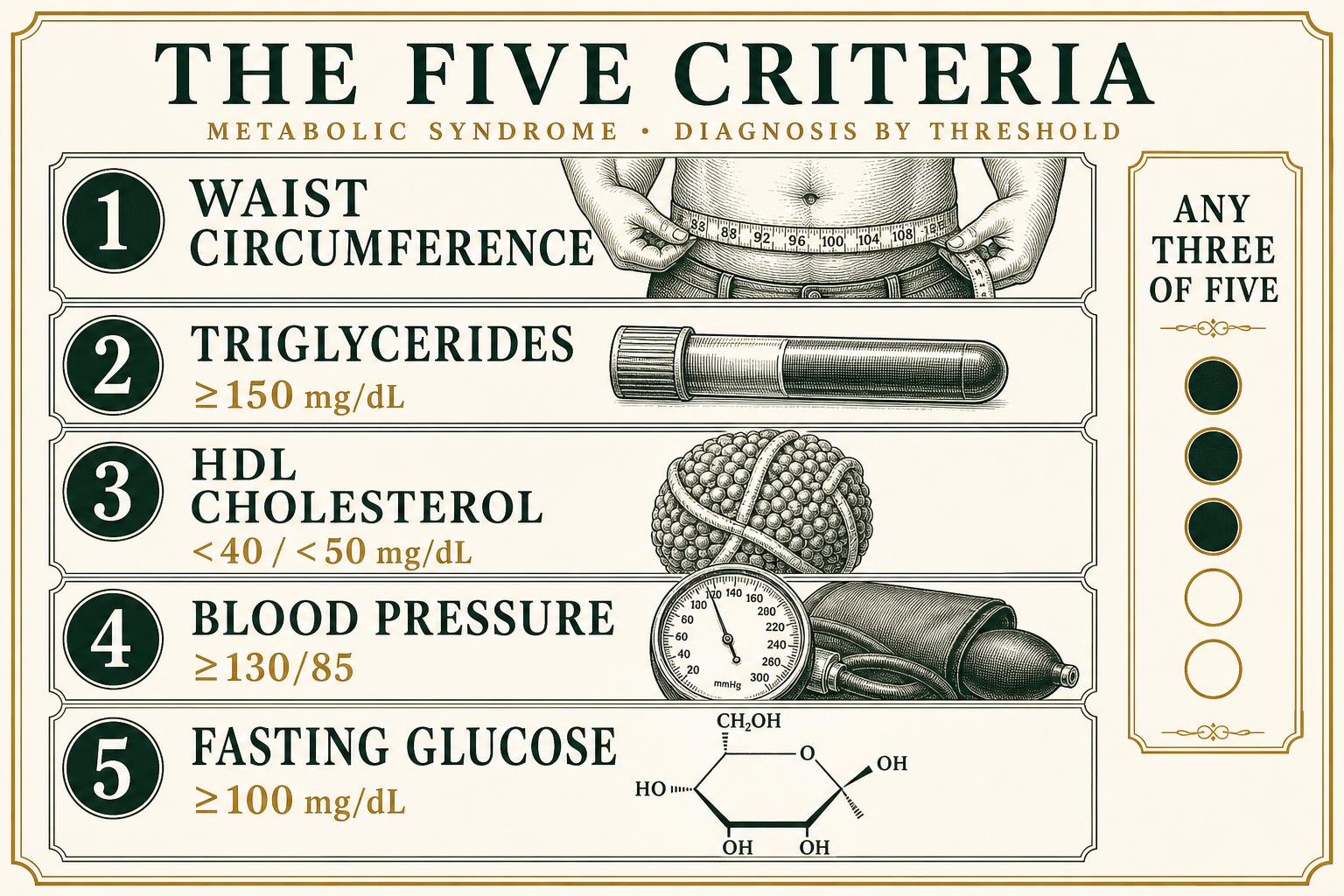
Metabolic syndrome is a cluster diagnosis: you meet it when any three of five routine measurements — waist circumference, blood pressure, fasting triglycerides, HDL cholesterol, and fasting glucose — cross defined thresholds at the same time. It affects roughly one in three American adults, and its prevalence rises with each decade of age (Hirode & Wong, JAMA, 2020).
The clustering is the clinically important part. Each marker carries modest risk alone; together they identify people whose cells have become inefficient at handling fuel, which is why the syndrome roughly doubles cardiovascular risk and multiplies type 2 diabetes risk about fivefold (Mottillo et al., Journal of the American College of Cardiology, 2010).
This guide covers what the five criteria mean, what sits upstream of them, which earlier markers detect the problem years sooner, and what the intervention evidence actually supports.
Metabolic syndrome is not five separate problems that happen to co-occur. It is one problem that shows up in five places.
Contents(16 sections)
Key takeaways
Metabolic syndrome is diagnosed when three or more of five criteria are met: waist circumference ≥40 in (men) or ≥35 in (women), blood pressure ≥130/85 mmHg, triglycerides ≥150 mg/dL, HDL <40 mg/dL (men) or <50 mg/dL (women), and fasting glucose ≥100 mg/dL.
The thresholds mark where risk becomes obvious, not where it begins — you can fail zero criteria and still be well into dysfunction.
Insulin resistance is the shared upstream mechanism; fasting insulin, HOMA-IR, and the triglyceride-to-HDL ratio detect it years before fasting glucose moves.
The syndrome roughly doubles cardiovascular risk and raises type 2 diabetes risk about fivefold compared with meeting no criteria.
The highest-yield interventions are unglamorous and well-evidenced: build and keep skeletal muscle, walk after meals, protect sleep duration and timing, and reduce ultra-processed carbohydrate density.
Lifestyle intervention outperformed metformin for diabetes prevention in the Diabetes Prevention Program — 58% versus 31% risk reduction over 2.8 years.
Reversal is common and well-documented, but it is a clinical process: markers, medications, and dose changes need professional oversight.
The Primer
What metabolic syndrome actually is
Metabolic syndrome is a label for a pattern, not a disease with its own cause. Clinicians noticed that five measurements tend to drift out of range together, and that people with several of them at once develop heart disease, type 2 diabetes, and fatty liver at far higher rates than people with one alone. The syndrome names that clustering so it can be caught earlier.
The practical meaning: your body is struggling to handle fuel. Glucose and fat are arriving faster than your cells can store or burn them cleanly, and the overflow shows up in your waistline, your blood pressure, and your lipid panel at the same time. The mechanism is covered in depth in Insulin Resistance: The Silent Engine.
The five criteria, in plain numbers
Under the harmonized definition (Alberti et al., Circulation, 2009), you meet the syndrome with three or more of the following:
| Criterion | Threshold | What it signals |
|---|---|---|
| Waist circumference | ≥40 in / 102 cm (men), ≥35 in / 88 cm (women) | Visceral and ectopic fat storage past personal capacity |
| Blood pressure | ≥130/85 mmHg, or on treatment | Insulin-driven sodium retention and vascular stiffening |
| Fasting triglycerides | ≥150 mg/dL, or on treatment | Liver overproducing fat-carrying particles |
| HDL cholesterol | <40 mg/dL (men), <50 mg/dL (women) | Impaired reverse cholesterol transport |
| Fasting glucose | ≥100 mg/dL, or on treatment | Insulin no longer holding glucose in range |
Population-specific waist thresholds are lower for South Asian, Chinese, Japanese, and several other groups — commonly ≥90 cm for men and ≥80 cm for women — because ectopic fat accumulates at lower total body weight.
Why the thresholds understate the problem
Every one of those cutoffs is a line drawn through a continuous risk gradient. A fasting glucose of 99 mg/dL is not metabolically equivalent to 82 mg/dL; a waist that has grown four inches while body weight stayed flat is a meaningful signal even if it hasn't crossed 40 inches.
This is why relying on the criteria alone delays recognition by years. The earlier signal is insulin, not glucose — the pancreas compensates long before the numbers on a standard panel move. See Metabolic Dysfunction: Why Researchers Now Treat It as a Root Cause for how far upstream this sits.
The signs before the labs
- Afternoon energy crashes, and needing to eat every few hours to stay functional — a practical sign that fat oxidation has become unreliable (Metabolic Flexibility).
- Waist expanding faster than total body weight.
- Blood pressure creeping upward year over year (Rethinking Blood Pressure).
- A triglyceride-to-HDL ratio above roughly 2.
- Skin tags or darkened velvety skin at the neck, armpits, or groin (acanthosis nigricans), both associated with high circulating insulin.
What actually moves the markers
The intervention set is consistent across the strongest trials, and it works on one lever: how much fuel arrives at once, and how much capacity exists to dispose of it.
- Build and keep skeletal muscle. Muscle is the largest glucose sink in the body, and disposal capacity scales with lean mass (Protein and Lean Mass).
- Walk 10–15 minutes after meals. Post-meal movement blunts the glucose excursion directly (Breaking Up Sitting).
- Raise aerobic capacity. VO₂ max is among the strongest predictors of all-cause mortality (VO₂ Max and Lifespan).
- Protect sleep duration and timing. Even short-term sleep restriction measurably reduces insulin sensitivity (Natural Sleep Support, Light Timing and the Circadian Clock).
- Reduce ultra-processed carbohydrate density and fructose load (Uric Acid and Fructose).
The Deep Dive
Insulin resistance as the unifying mechanism
The five criteria are downstream expressions of one defect. When peripheral tissue stops responding efficiently to insulin, the pancreas compensates with higher output, and chronically elevated insulin has effects well beyond glucose:
- In the liver, hyperinsulinemia with continued substrate delivery drives de novo lipogenesis and VLDL export — producing the high triglycerides of criterion three, and the low HDL of criterion four via CETP-mediated lipid exchange that also generates small dense LDL particles.
- In the kidney, insulin promotes distal sodium reabsorption; combined with sympathetic activation and reduced nitric oxide bioavailability, this contributes to criterion two.
- In adipose tissue, once subcutaneous storage nears its individual limit — Roy Taylor's "personal fat threshold" — lipid spills into liver, skeletal muscle, and pancreas. Intramyocellular and intrahepatic lipid interfere with insulin signaling directly, which is why lean people can be metabolically unhealthy.
Tier II · Members only · Free
Continue into the deep dive
Tier I is free and always open. Tier II — the full mechanisms, dosing detail, nuance, and citations — unlocks with a free Vital Codex membership.
- Every Tier II deep dive across all hubs
- Saved reading progress across articles
- Member knowledge modules and their quizzes
- The Dispatch, if you opt in
Frequently asked
Is metabolic syndrome reversible?
Yes, frequently — and reversal is best documented earlier in the course. The DiRECT trial produced type 2 diabetes remission in 46% of participants at one year with a structured weight-management program, and the Diabetes Prevention Program reduced progression to diabetes by 58% with intensive lifestyle change. Reversal should be pursued with clinical supervision, particularly if you take medication for glucose or blood pressure.
How many of the five criteria do I need to be diagnosed?
Three or more of the five, measured concurrently: elevated waist circumference, blood pressure ≥130/85 mmHg, fasting triglycerides ≥150 mg/dL, HDL below 40 mg/dL in men or 50 mg/dL in women, and fasting glucose ≥100 mg/dL. Being on treatment for blood pressure, triglycerides, or glucose counts toward the relevant criterion.
Can you have metabolic syndrome at a normal weight?
Yes. Roughly 20% of people with normal BMI show metabolic dysfunction, because risk tracks where fat is stored rather than total body fat. Once subcutaneous storage capacity is exceeded, lipid accumulates in liver, muscle, and pancreas at any body size — which is why waist-to-height ratio and fasting insulin are more informative than BMI alone.
What is the single most useful early test?
Fasting insulin, ideally paired with fasting glucose to calculate HOMA-IR. Insulin rises years to decades before fasting glucose or HbA1c leave the reference range, so a standard panel can look reassuring while dysfunction is well established. Interpret it with a clinician, since assay ranges differ between labs.
How long does it take to improve the markers?
Triglycerides and fasting glucose often respond within 2–6 weeks of reduced refined-carbohydrate intake and added post-meal walking. HDL and waist circumference move more slowly, typically over 3–6 months. HbA1c lags by design because it integrates roughly three months of glycemia, so re-testing sooner than 10–12 weeks tends to be uninformative.
Do I need medication if I have metabolic syndrome?
That is a clinical decision that depends on your absolute cardiovascular risk, your glucose trajectory, your blood pressure, and your preferences. Lifestyle intervention outperformed metformin for diabetes prevention in the Diabetes Prevention Program, but medication is appropriate for many people — often alongside, not instead of, the lifestyle levers. Discuss it with your clinician rather than deciding from general reading.
Research Notes & Sources(expand)
Alberti KGMM, Eckel RH, Grundy SM, et al. "Harmonizing the Metabolic Syndrome." Circulation, 2009;120(16):1640–1645. Source of the harmonized five-criteria definition and population-specific waist thresholds.
Hirode G, Wong RJ. "Trends in the Prevalence of Metabolic Syndrome in the United States, 2011–2016." JAMA, 2020;323(24):2526–2528. Prevalence approaching one in three US adults, rising with age.
Mottillo S, Filion KB, Genest J, et al. "The Metabolic Syndrome and Cardiovascular Risk: A Systematic Review and Meta-Analysis." Journal of the American College of Cardiology, 2010;56(14):1113–1132. Basis for the roughly doubled cardiovascular risk estimate.
Knowler WC, Barrett-Connor E, Fowler SE, et al. "Reduction in the Incidence of Type 2 Diabetes with Lifestyle Intervention or Metformin." New England Journal of Medicine, 2002;346(6):393–403. Diabetes Prevention Program: 58% versus 31% risk reduction over 2.8 years.
Lean MEJ, Leslie WS, Barnes AC, et al. "Primary care-led weight management for remission of type 2 diabetes (DiRECT)." The Lancet, 2018;391(10120):541–551. Remission in 46% at one year, scaling with magnitude of weight loss.
The Look AHEAD Research Group. "Cardiovascular Effects of Intensive Lifestyle Intervention in Type 2 Diabetes." New England Journal of Medicine, 2013;369(2):145–154. Marker improvement without event reduction in established diabetes.
Taylor R. "Type 2 diabetes and remission: practical management guided by the twin cycle hypothesis." Diabetologia, 2024. Personal fat threshold and ectopic fat framing.
Araújo J, Cai J, Stevens J. "Prevalence of Optimal Metabolic Health in American Adults." Metabolic Syndrome and Related Disorders, 2019;17(1):46–52. Context for how few adults meet all five metabolic health criteria.
Editorial note: this guide is educational synthesis of published research. It is not medical advice, and it does not establish a clinician–patient relationship. Diagnosis, medication decisions, and dose changes require a qualified clinician working from your own measurements.
Continue exploring: Continue through the Metabolism hub for the mechanisms behind each marker.
Explore Metabolism