A recent meta-analysis of randomized controlled trials found that interrupting prolonged sitting with brief bouts of movement was associated with modest improvements in executive function and working memory compared with sitting uninterrupted [Source: https://pubmed.ncbi.nlm.nih.gov/?term=breaking+up+prolonged+sitting+cognition+meta-analysis]. Walking produced the most consistent positive signal. Attention, information-processing speed, and global cognition did not improve reliably. The effect sizes were small, the certainty of evidence was low, and the measurements were acute — taken within the same sitting session rather than months later.
The most defensible reading is not that a two-minute walk makes you smarter. It is that several uninterrupted hours in a chair appear to cost something measurable in the mental faculties most sensitive to circulation and metabolic state, and that short, comfortable movement recovers part of that cost. Framed this way, movement breaks are a way of preventing avoidable decline across a long desk day rather than a cognitive enhancer. That framing matters, because it sets a realistic expectation: you are protecting the quality of hour six, not unlocking a new ceiling in hour one.
Contents(15 sections)
Key takeaways
Brief movement breaks during prolonged sitting are associated with modest, acute improvements in executive function and working memory, while attention and processing speed show no reliable change.
Walking is the most consistently useful interruption across trials; low-intensity movement appears sufficient.
The plausible mechanisms are vascular and metabolic — restored cerebral blood flow, shear-stress-driven nitric oxide signaling, and improved post-meal glucose handling — not a large neurotrophic response.
Static standing is not a reliable substitute for movement, and in high-demand tasks it can even compete for attentional resources.
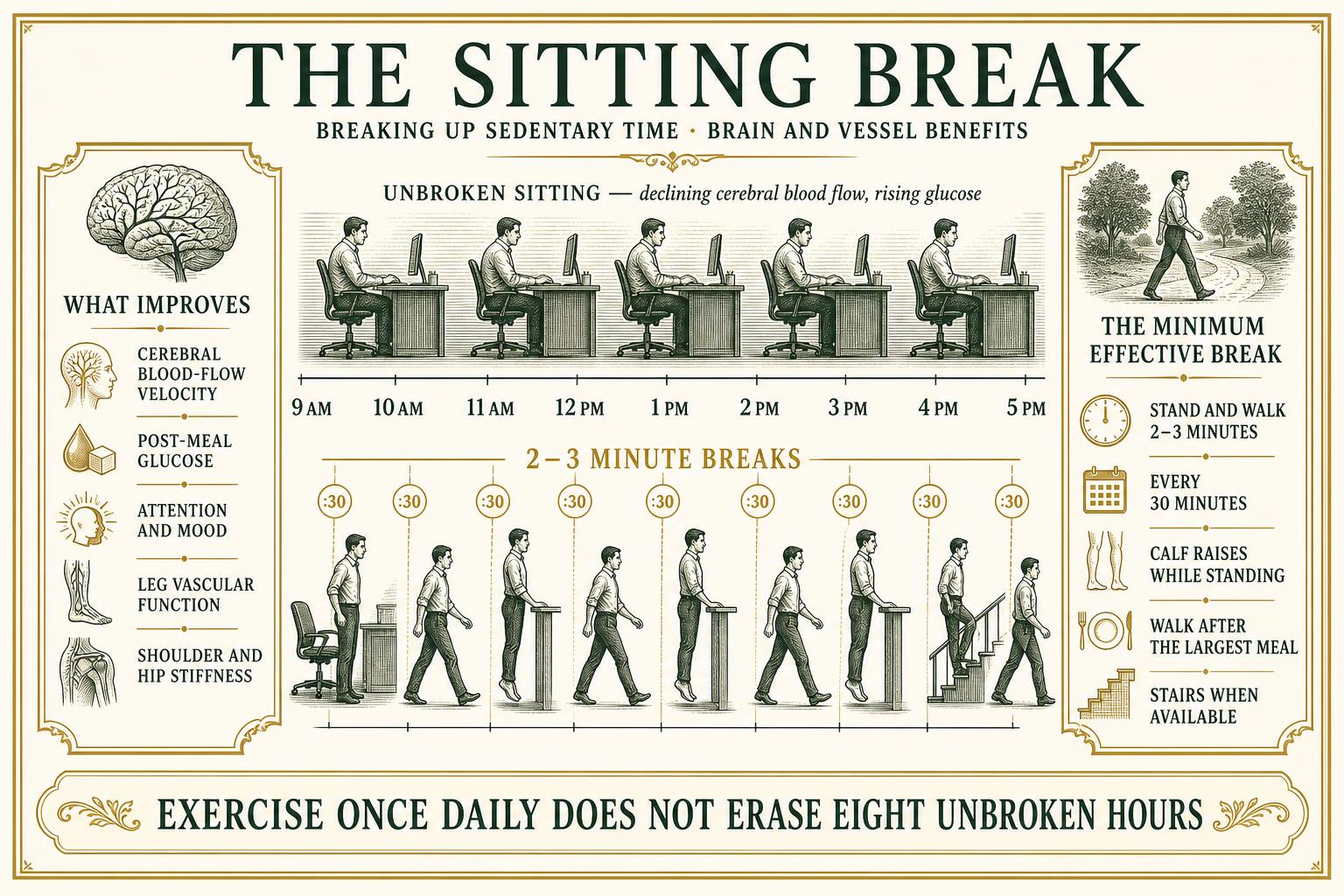
Practical application is simple: 2–5 minutes of easy walking between focused work blocks, and a walk after lunch when the day allows it.
The Primer
What the research found
The meta-analysis pooled 21 randomized controlled trials covering 433 participants across a wide age range, from young adults to older adults [Source: https://pubmed.ncbi.nlm.nih.gov/?term=breaking+up+prolonged+sitting+cognition+meta-analysis]. The interruptions varied considerably: walking, standing, resistance exercise, stationary cycling, stair climbing, and in some protocols simple seated or standing leg movement.
Two cognitive domains improved modestly — executive function and working memory. Three did not show consistent benefit: attention, information-processing speed, and global cognition. That pattern is informative. The domains that responded are the ones most dependent on the prefrontal cortex and most sensitive to short-term shifts in blood flow and fuel availability. The domains that did not respond are, broadly, faster and more automatic, and less easily nudged by a few minutes of walking.
Why sitting too long may affect the brain
When you sit still for hours, blood pools in the legs, venous return slows, and the pulsatile quality of flow through the large arteries feeding the brain is reduced. Measured over three to four hours of uninterrupted sitting, cerebral blood-flow velocity has been reported to fall by roughly 5 to 6 percent [Source: https://pubmed.ncbi.nlm.nih.gov/31359240/]. That is not a dangerous drop, but the brain is metabolically expensive and intolerant of shortfalls, and small reductions in supply plausibly show up first in the most demanding tasks.
Two of those demanding tasks have plain-language definitions worth holding onto. Executive function is the set of control abilities you use to hold a goal in mind, ignore distraction, switch between tasks, and inhibit the easy-but-wrong response. Working memory is the small, temporary workspace where you keep a few items live while you manipulate them — a phone number while you dial, a clause while you finish the sentence, three variables while you debug. These are precisely the capacities that feel eroded at the end of a long, still afternoon.
What kind of break seems most useful
Walking was the most reliably beneficial interruption in the pooled trials. Notably, the useful dose appears low. Light walking — the pace you would use crossing an office or a parking lot — was enough to register in these studies. The goal is not to convert each break into a training session.
There is a practical reason to prefer gentle over vigorous when you are returning to concentrated work. Hard effort raises arousal, body temperature, and breathing rate, and can leave a short period of settling before fine-grained focus returns. A calm two- to five-minute walk restores circulation without that overshoot, so you can sit back down and resume the thread immediately.
A realistic desk-day strategy
- Work in blocks of roughly 30 to 60 minutes rather than open-ended stretches.
- Take 2 to 5 minutes of comfortable walking between blocks.
- Use natural stopping points — the end of a section, a sent email, a passing test — instead of letting a rigid timer cut into deep thought.
- Walk after lunch whenever the schedule allows; this is the highest-value break of the day.
- Change positions across the day rather than defending one perfect posture: sit, stand, walk, and sit again.
The Deep Dive
What the meta-analysis does and does not show
The pooled result is best stated conservatively: interrupting prolonged sitting produced small, statistically detectable, acute improvements in executive function and working memory, with low overall certainty of evidence [Source: https://pubmed.ncbi.nlm.nih.gov/?term=breaking+up+prolonged+sitting+cognition+meta-analysis]. Trials in this literature are small, protocols are heterogeneous, cognitive batteries differ between studies, blinding is effectively impossible, and publication bias is difficult to exclude at this sample size. Any of these could inflate a modest signal.
It follows that the finding does not establish movement breaks as major cognitive enhancers. It also does not establish neuroprotection. These are distinct claims. Acute performance support means your executive control tests slightly better in hour four than it otherwise would have. Long-term neuroprotection — preserved brain volume, slower cognitive aging, reduced dementia risk — is a separate question addressed by longitudinal physical-activity research rather than by same-session crossover trials [Source: https://pubmed.ncbi.nlm.nih.gov/29848057/]. Breaking up sitting is defensible on the first claim today; it is only suggestive on the second.
Tier II · Members only · Free
Continue into the deep dive
Tier I is free and always open. Tier II — the full mechanisms, dosing detail, nuance, and citations — unlocks with a free Vital Codex membership.
- Every Tier II deep dive across all hubs
- Saved reading progress across articles
- Member knowledge modules and their quizzes
- The Dispatch, if you opt in
Frequently asked
How often should I take a movement break?
Roughly every 30 to 60 minutes is a reasonable default, taken at a natural stopping point rather than on a strict timer. The pooled trial data suggest more frequent interruptions favor executive-function outcomes while longer intervals may favor working-memory outcomes, so there is no single optimal schedule and the difference between plausible schedules is small. The practical priority is avoiding multi-hour uninterrupted blocks entirely; whether you break at 30 or 55 minutes matters far less than whether you break at all.
Is standing enough, or do I need to walk?
Walking is the better choice for cognitive purposes. Static standing does not produce the rhythmic leg-muscle contraction that drives venous return and restores pulsatile cerebral blood flow, and standing-desk studies on cognitive outcomes have been mixed [Source: https://pubmed.ncbi.nlm.nih.gov/29128517/]. Some high-demand task protocols even found standing slightly impaired attentional and executive performance, likely because postural control competes for the same resources [Source: https://pubmed.ncbi.nlm.nih.gov/29558931/]. Standing remains useful for reducing total sitting time and varying posture — treat it as a complement to walking breaks, not a replacement.
Does walking after lunch actually help?
Yes, and it is probably the highest-value break in a typical desk day. Light walking after a meal meaningfully reduces postprandial glucose and insulin excursions because contracting muscle takes up glucose through insulin-independent pathways [Source: https://pubmed.ncbi.nlm.nih.gov/23761134/], and large glycemic swings are associated with reduced alertness and slower performance in the hours that follow [Source: https://pubmed.ncbi.nlm.nih.gov/25998386/]. Ten minutes at an easy pace is sufficient. It will not eliminate the natural circadian afternoon dip, but it removes one avoidable contributor to it.
Is this the same as doing exercise snacks?
No — they serve different goals. Movement breaks are short, light, and frequent, and their purpose is to maintain circulation, glucose handling, and cognitive performance across a working day. Exercise snacks are brief vigorous efforts, such as stair climbing or repeated hard squats, aimed at cardiorespiratory fitness and metabolic adaptation [Source: https://pubmed.ncbi.nlm.nih.gov/30943148/]. Both belong in a well-designed week, but a vigorous bout raises arousal and body temperature in ways that can delay the return to precise focus, so place hard efforts away from your most demanding cognitive blocks.
Could circulatory-support strategies complement movement breaks?
Plausibly, though movement remains the intervention with the clearest evidence. The proposed mechanism behind movement breaks runs through shear stress, endothelial nitric oxide synthase, and nitric oxide-mediated vasodilation [Source: https://pubmed.ncbi.nlm.nih.gov/28900017/], and dietary and lifestyle factors that support endothelial function operate on the same pathway. That overlap makes broader circulatory support a reasonable adjunct within a general health strategy. It is not a substitute: no supplement reproduces the skeletal-muscle pump, and the trials showing cognitive preservation studied movement, not nutrients. Discuss any supplement changes with a qualified clinician, particularly if you take antihypertensive, anticoagulant, or antiplatelet medication.
Continue exploring: Cognition — Neurogenesis, synaptic plasticity, and focus architecture.
Explore Cognition