A fever, cough, headache, rash, nausea, profound fatigue, or sudden neurologic symptom does not announce its cause. Infection can produce each of them. So can contaminated food, combustion gases, solvents, pesticides, metals, medications, and other exposures. In some cases, both processes are active: an exposure changes immune defenses or tissue resilience, then an infection supplies the immediate trigger.
The useful question is therefore not “Do germs cause disease, or does terrain?” Germs can cause disease, toxic exposures can cause disease, and terrain changes what either one does to a particular person. The disciplined task is differential diagnosis: reconstruct the timeline, map who became ill and where, test plausible agents, examine shared exposures, and update the explanation as evidence accumulates.
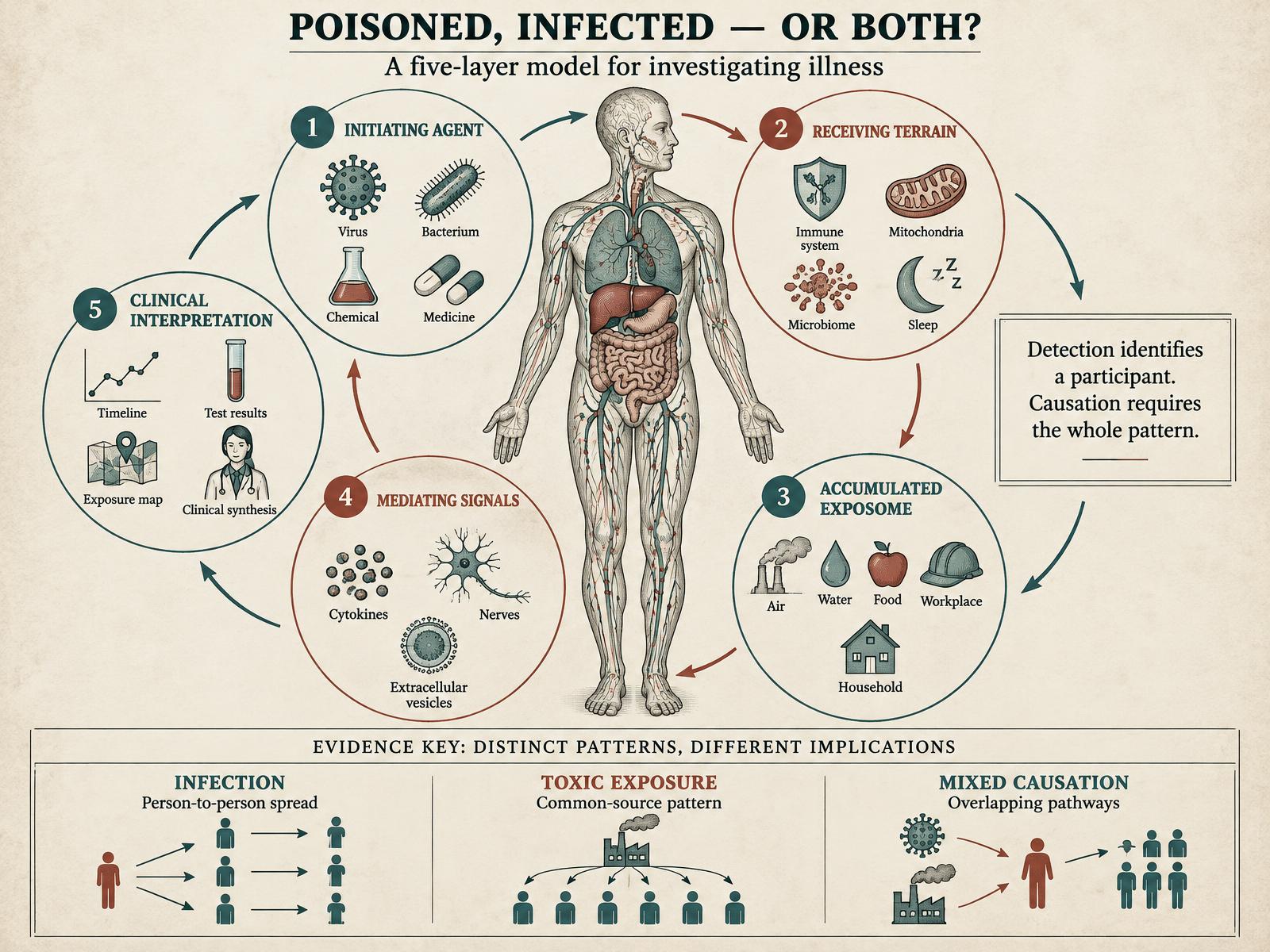
Detection identifies a participant. Causation requires the whole pattern.
Contents(17 sections)
Key takeaways
Infection, toxic exposure, medication injury, and mixed causation can create similar symptom clusters; symptoms alone rarely identify the cause.
A propagated pattern across generations of contact supports transmission, while abrupt illness among people sharing one place, meal, product, or airspace supports a common-source exposure.
The exposome — cumulative chemical, physical, occupational, dietary, pharmaceutical, biological, and social exposures — is a legitimate complement to genetics and microbiology, not a replacement for them.
Host terrain matters because age, nutrition, sleep, metabolic health, prior immunity, microbiome, organ reserve, and previous exposures change susceptibility and recovery.
Extracellular vesicles are real signaling particles involved in both toxic injury and infection; they do not make viruses imaginary, and current evidence does not establish person-to-person “exosome shedding” as a substitute for viral transmission.
The safest approach is parallel testing: investigate pathogens and exposures together when the history supports both, while treating urgent instability before the cause is fully resolved.
The Primer
Why poisoning can look like infection
Many symptoms attributed to an invading organism are generated by the host. Cytokines signal the brain to raise temperature, reduce appetite, conserve energy, alter sleep, and withdraw from activity. This coordinated sickness response can help contain infection, but similar inflammatory signaling can follow tissue injury or toxic exposure. Carbon monoxide causes headache, weakness, nausea, confusion, and flu-like malaise. Organophosphate pesticides can cause sweating, vomiting, diarrhea, constricted pupils, and breathing difficulty. Contaminated food can produce vomiting and fever whether the culprit is a live organism, a preformed microbial toxin, or a chemical contaminant.
Overlap does not mean the causes are interchangeable. It means symptom recognition is the beginning of an investigation, not the end.
The population pattern is often more revealing than the symptom list
Investigators ask who became ill, when, where, and after what contact or exposure.
| Pattern | More consistent with infection | More consistent with common-source exposure |
|---|---|---|
| Timing | Cases appear over successive incubation periods | Many cases begin within a narrow window |
| Connections | Illness follows contact networks | Illness follows a place, meal, product, shift, or airspace |
| Secondary cases | New cases occur among later contacts | Few or no cases among unexposed contacts |
| Geography | Spread moves through communities | Cases cluster around a source or plume |
| Testing | Concordant pathogen evidence | Concordant exposure biomarker or environmental sample |
| Response to control | Isolation or targeted treatment interrupts spread | Removing the source stops new cases |
These are clues, not laws. Foodborne infections can create abrupt point-source curves. Some toxins have delayed effects. A workplace exposure can coexist with a transmissible respiratory virus. Good investigation uses the whole pattern.
The five-layer model
1. Initiating agent. The trigger may be a virus, bacterium, fungus, parasite, toxicant, medication, contaminated product, heat stress, or more than one of these.
2. Receiving terrain. Prior immunity, age, metabolic health, nutrition, sleep, genetics, microbiome composition, lung and kidney function, and existing disease influence dose response and recovery. Terrain modifies causation; it does not erase the agent.
3. Accumulated exposome. The exposome includes lifetime contact with air pollution, water contaminants, workplace agents, food, medicines, tobacco, alcohol, psychosocial stress, infections, and the built environment. It is the environmental counterpart to the genome — a framework for measuring what the body has encountered across time.
4. Mediating signals. Cytokines, damage-associated molecules, hormones, autonomic nerves, metabolites, and extracellular vesicles translate a local event into a body-wide response. These pathways help explain why different triggers can converge on fatigue, fever, pain, cognitive fog, or loss of appetite.
5. Clinical interpretation. Test results acquire meaning only inside a timeline and a pretest probability. A positive PCR result can identify a relevant infection, an incidental or resolving infection, or residual nucleic acid depending on the test, specimen, symptoms, and timing. A detectable chemical can represent background exposure, recent exposure, or clinically important poisoning depending on dose, toxicokinetics, specimen, and reference range.
A real example: Spain's toxic oil syndrome
In 1981, Spain confronted what initially looked like an epidemic of atypical pneumonia. The illness ultimately affected roughly 20,000 people and caused hundreds of deaths. Epidemiologic investigation linked the syndrome not to person-to-person contagion but to illegally marketed rapeseed oil that had been denatured for industrial use and then fraudulently sold as food.
The lesson is not that epidemics are generally poisoning. It is that shared exposure can imitate infection convincingly, and that careful interviews, case mapping, food tracing, laboratory work, and removal of the source can overturn an early diagnosis. Similar principles apply to carbon-monoxide events, contaminated water, occupational releases, and adulterated products.
Questions worth asking when illness clusters
- Did several people become ill after the same meal, building, workplace shift, renovation, pesticide application, new medication, supplement batch, or water source?
- Did symptoms begin nearly simultaneously, or did cases appear in waves consistent with an incubation period?
- Are household members sick because they share contact, or because they share air, food, water, heating equipment, or a consumer product?
- Are there unusual neurologic signs, pupil changes, odors, skin findings, liver injury, kidney injury, or symptom relief away from a location?
- What changed immediately before illness: travel, visitors, work tasks, flooding, smoke, hobbies, solvents, pest control, heating, food, drugs, or supplements?
A written timeline is more useful than a vague list. Record time, place, products, doses, meals, contacts, symptoms, test dates, and what improved or worsened the pattern.
When not to investigate on your own
Confusion, fainting, seizures, severe breathing difficulty, blue or gray lips, chest pain, new weakness on one side, persistent high fever, severe dehydration, rapidly worsening symptoms, or suspected carbon monoxide, pesticide, solvent, or medication poisoning require urgent medical help. Move away from a suspected airborne source only if it is safe to do so. Do not induce vomiting or begin chelation, binders, or a “detox” protocol without poison-control or clinical guidance; the wrong intervention can worsen injury or obscure testing.
The Deep Dive
Causation is a chain, not a test result
A laboratory result answers a narrow question: was a target detected in a particular specimen at a particular time? Causal inference requires more. Modern infectious-disease reasoning combines temporal sequence, biological plausibility, dose or exposure opportunity, pathogen localization, immune response, epidemiologic association, intervention effects, and — where feasible — culture, sequencing, or experimental evidence.
Toxicology asks parallel questions: was there a credible source and route; was the dose sufficient; did symptoms follow the expected latency and toxidrome; are biomarkers valid for the relevant exposure window; did environmental samples confirm the source; and did cases stop after removal? Neither discipline reduces causation to one number.
Tier II · Members only · Free
Join Vital Codex free
Unlock every Tier II deep dive, save your reading, and open the member knowledge modules. Free, no card, no paywall.
The Dispatch is a separate weekly email. Your membership works with or without it.
Frequently asked
Can a toxic exposure cause fever and flu-like symptoms?
Yes. Toxic and inflammatory exposures can activate cytokine pathways that produce fatigue, aches, headache, appetite loss, and sometimes fever. However, fever still raises concern for infection, and the presence or absence of fever cannot distinguish the two by itself.
Does a positive PCR test prove that a pathogen caused every symptom?
No. It establishes detection of the assay's target in that specimen. Clinical relevance depends on symptoms, timing, specimen quality, prevalence, test performance, and other findings. A positive result can be powerful causal evidence when it fits the full pattern; it should not prevent investigation of a simultaneous exposure or complication.
Are exosomes actually viruses produced during detoxification?
No. Extracellular vesicles and enveloped viruses share some physical features and cellular machinery, but they are not interchangeable entities. Vesicles participate in responses to toxins and infections; viruses carry genomes organized to reproduce new virions in susceptible cells. The overlap is mechanistically important, not evidence that viruses do not exist.
What tests can show toxic exposure?
The correct test depends on the suspected agent and timing. Examples include carboxyhemoglobin soon after carbon-monoxide exposure, blood lead, appropriately speciated urine arsenic, cholinesterase activity for some pesticide exposures, or targeted environmental sampling. Hair panels and post-chelator “provoked” urine tests are not general screening tools and can mislead.
Should I suppress a fever immediately because inflammation is harmful?
Not automatically. Fever is a regulated host response, but its significance depends on age, temperature, duration, symptoms, pregnancy, medical conditions, and hydration. Seek clinical guidance for high, persistent, or concerning fever rather than assuming either that all fever is beneficial or that eliminating it resolves the cause.
What is the single most useful step if several people become ill together?
Protect anyone who is severely ill, then preserve the timeline. Note exact onset times, shared locations, meals, products, heating or ventilation conditions, work tasks, contacts, and medications. Alert clinicians or public-health authorities that both infectious and common-source explanations may need investigation.
Research Notes & Sources(expand)
This article was inspired by Sayer Ji's Poisoned, Not Infected investigative series and independently checked against public-health guidance, consensus extracellular-vesicle standards, and peer-reviewed literature. The synthesis and wording are original to Vital Codex.
- Wild CP. “Complementing the genome with an exposome.” Cancer Epidemiology, Biomarkers & Prevention. 2005. PubMed
- Vermeulen R, Schymanski EL, Barabási AL, Miller GW. “The exposome and health: Where chemistry meets biology.” Science. 2020. DOI
- CDC. “Steps of a Toxicological Outbreak Investigation.” Training module
- CDC. “Generating a Differential Diagnosis in an Unexplained Respiratory Disease Outbreak.” Guidance
- CDC. “Toxic-Oil Syndrome — Spain.” Morbidity and Mortality Weekly Report. 1981. Report
- Dantzer R. “Cytokine-induced sickness behavior: mechanisms and implications.” Annals of the New York Academy of Sciences. 2001. DOI
- Théry C, et al. “MISEV2018: Minimal information for studies of extracellular vesicles.” Journal of Extracellular Vesicles. 2018. Full text
- Hoen ENMN, et al. “MISEV2023: From basic to advanced approaches.” Journal of Extracellular Vesicles. 2024. DOI
- Raab-Traub N, Dittmer DP. “Viral effects on the content and function of extracellular vesicles.” Nature Reviews Microbiology. 2017. DOI
- Nolte-'t Hoen E, Cremer T, Gallo RC, Margolis LB. “Extracellular vesicles and viruses: Are they close relatives?” PNAS. 2016. DOI
- Relman DA. “The search for unrecognized pathogens.” Science. 1999. PubMed Central
- Sayer Ji. “Poisoned, Not Infected — An Investigative Series.” 2026. Source series
Educational content only. This article does not diagnose infection or poisoning and should not delay emergency care, poison-control advice, or evaluation by a qualified clinician.
Continue exploring: Inflammation — Cytokine signaling and chronic low-grade systemic stress.
Explore InflammationThe Codex Dispatch
More on Inflammation, one email a week
One considered email each Sunday: research translation, no hype, no supplement pitches. Separate from membership — unsubscribe anytime.