Statin drugs are usually discussed through two equally unhelpful lenses: as universally life-saving medicines everyone with an elevated cholesterol marker should accept, or as uniformly dangerous drugs with no legitimate role. Neither framing serves patients.
The more useful question is not whether statins are good or bad. It is: for this person, with this cardiovascular risk, metabolic profile, medication history, and set of priorities, what is the likely absolute benefit, what are the plausible trade-offs, and what else should be addressed? Statins can be valuable — especially after a cardiovascular event or in clearly high-risk disease — but a prescription should not substitute for investigating insulin resistance, blood pressure, smoking, inflammation, sleep, diet quality, activity, thyroid status, kidney function, or drug interactions.
This article is educational and not personal medical advice. Do not start, stop, or alter a prescription medication without a qualified prescriber — particularly after a heart attack, stroke, stent, bypass, or with familial hypercholesterolemia.
Relative risk sells headlines. Absolute risk is what shows up in your own decade.
Contents(14 sections)
Key takeaways
Statins reduce cardiovascular events in appropriately selected groups; the strongest evidence is outcome evidence, not LDL-lowering alone.
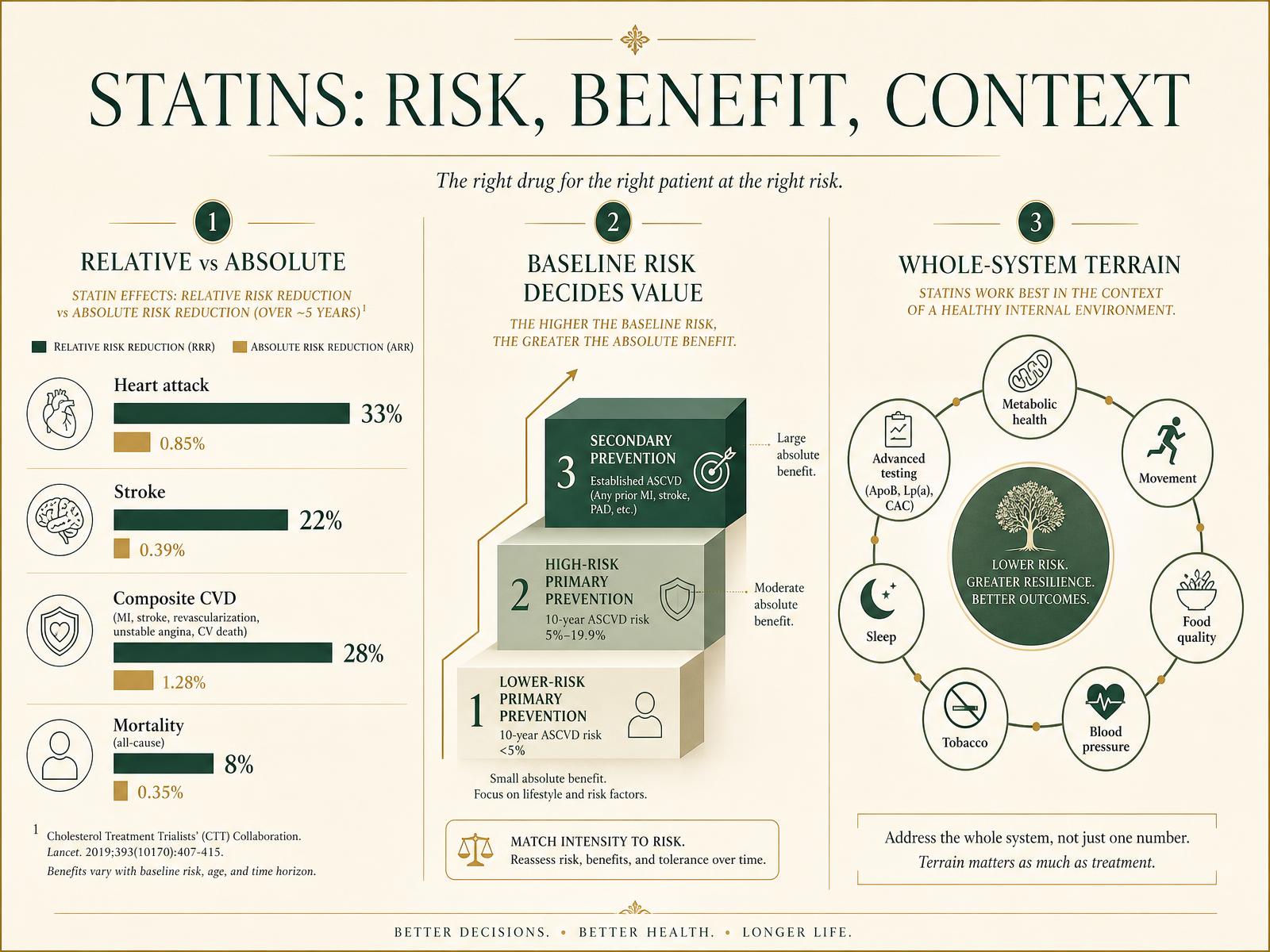
Relative risk reduction can sound dramatic while absolute differences in primary-prevention trials were roughly 0.35–1.28% over 1–6 years.
Absolute benefit rises as baseline risk rises, which is why secondary prevention and low-risk primary prevention are different decisions.
Pooled placebo-controlled primary-prevention data found no significant overall increase in serious adverse events, myalgia, liver-enzyme elevation, or cancer — which does not erase individual intolerance.
CoQ10 depletion during statin therapy is biochemically plausible; trial evidence for symptom relief remains mixed.
Cholesterol-only thinking is incomplete: ApoB, Lp(a), blood pressure, glucose regulation, and CAC change both risk and the value of a drug.
The Primer
The problem with cholesterol-only thinking
Cholesterol is essential biology, not metabolic debris. It is required for cell membranes, bile acids, steroid hormones, vitamin D synthesis, and tissue repair. The clinically relevant issue is how lipoprotein particles, vascular injury, inflammation, glycemic dysregulation, blood pressure, smoking, kidney disease, and inherited risk interact over time.
LDL-C is a useful marker but not a complete map. Two people with identical LDL-C can differ sharply in triglycerides, HDL-C, ApoB particle burden, lipoprotein(a), blood pressure, glucose regulation, coronary artery calcium, family history, and smoking status — and those differences change both baseline risk and the potential value of a drug. A practical assessment often includes a lipid panel read as a pattern, ApoB or non-HDL-C, Lp(a) at least once in adulthood, blood pressure, HbA1c or glucose, waist circumference, kidney and thyroid function, and — when the decision remains genuinely uncertain — a clinician-guided CAC scan.
This is not an argument for ignoring LDL-related risk. It is an argument for graduated, individual risk assessment instead of treating one laboratory result as a diagnosis.
What statins do
Statins inhibit HMG-CoA reductase, the rate-limiting enzyme in hepatic cholesterol synthesis. The liver responds by increasing LDL-receptor activity and clearing more LDL-containing particles from circulation. Statins also influence plaque biology and inflammatory signaling, though LDL/ApoB reduction remains central to their proven effect.
The important evidence is not that statins lower LDL-C. It is that, in appropriately selected groups, they reduce heart attacks, strokes, revascularization, composite cardiovascular outcomes, and all-cause mortality.
Relative versus absolute benefit
Relative-risk language exaggerates how a result feels in daily life. In the USPSTF primary-prevention review, a 33% relative reduction in myocardial infarction corresponded to about 0.85% fewer events in absolute terms over roughly one to six years; stroke fell 22% relatively and 0.39% absolutely; composite cardiovascular outcomes 28% and 1.28%; all-cause mortality 8% and 0.35%.
Those are pooled averages, not promises for an individual. Absolute benefit rises as baseline risk rises. Someone with established coronary disease, prior stroke, diabetes plus multiple risk factors, significant kidney disease, or very high inherited LDL-related risk has substantially more to gain than a low-risk person whose only finding is a modestly elevated LDL-C.
Side effects, honestly framed
People deserve a clear account of potential adverse effects without being told symptoms are imaginary — or that every symptom appearing after a prescription was caused by the drug. Randomized placebo-controlled trials are the tool that separates drug effects from symptoms that occur in adulthood anyway, and pooled primary-prevention data did not show a significant overall increase in serious adverse events, reported myalgia, liver-enzyme elevation, or cancer.
Population-level results do not erase individual experience. Some patients do develop clinically important muscle symptoms, altered glucose handling, or laboratory abnormalities. The right response is careful evaluation, not automatic dismissal and not automatic permanent abandonment of risk reduction. Severe muscle pain or weakness with dark urine, marked fatigue, or jaundice warrants urgent medical evaluation.
The Deep Dive
Secondary prevention and primary prevention are different decisions
In secondary prevention — previous heart attack, ischemic stroke, symptomatic peripheral arterial disease, stent, bypass, or documented obstructive coronary disease — baseline risk is high, so event reduction is more clinically meaningful. Medication decisions should be made cautiously and collaboratively, and abruptly stopping therapy can be hazardous.
In high-risk primary prevention — no previous event, but diabetes, severe hypercholesterolemia, substantial plaque burden, chronic kidney disease, strong family history, or high calculated risk — a statin may offer meaningful benefit, while lifestyle and upstream-risk work remain essential rather than optional.
Tier II · Members only · Free
Continue into the deep dive
Tier I is free and always open. Tier II — the full mechanisms, dosing detail, nuance, and citations — unlocks with a free Vital Codex membership.
- Every Tier II deep dive across all hubs
- Saved reading progress across articles
- Member knowledge modules and their quizzes
- The Dispatch, if you opt in
Frequently asked
Do statins lower the risk of dying?
In pooled primary-prevention trials, all-cause mortality was about 8% lower in relative terms, corresponding to roughly 0.35% fewer deaths in absolute terms over one to six years. The absolute figure is larger in higher-risk and secondary-prevention populations.
Why does absolute risk reduction matter more than relative risk reduction?
Relative risk describes the proportional change; absolute risk describes what actually happens to a group of people. A 33% relative reduction in heart attacks translated to under one percentage point in absolute terms in low- to moderate-risk primary prevention, and to much more when baseline risk is high.
Does taking CoQ10 prevent statin muscle symptoms?
Statin therapy can lower circulating CoQ10, but randomized evidence that supplementation relieves statin-associated muscle symptoms is mixed. It can be a reasonable individual trial under clinical guidance, not a guaranteed fix, and it should not delay evaluating other causes.
Is red yeast rice a safer natural alternative?
Not automatically. Red yeast rice can contain monacolin K, which is chemically identical to lovastatin, and content varies widely between products — meaning uncertain dosing with statin-like effects and interactions.
Should everyone with high LDL-C take a statin?
No single lab value settles the decision. Baseline risk, ApoB or non-HDL-C, Lp(a), blood pressure, glucose regulation, family history, age, and — when uncertain — coronary artery calcium all shape how much benefit is realistically available.
Can I stop a statin if I already had a heart attack?
Discuss it with a prescriber before changing anything. In secondary prevention baseline risk is high and stopping abruptly can be hazardous; alternatives such as dose reduction, a different statin, or non-statin therapy exist.
Research Notes & Sources(expand)
Chou R, Cantor A, Dana T, et al. Statin Use for the Primary Prevention of Cardiovascular Disease in Adults: Updated Evidence Report and Systematic Review for the US Preventive Services Task Force. JAMA. 2022;328(8):754–771. doi:10.1001/jama.2022.12138.
Cholesterol Treatment Trialists' Collaboration. Efficacy and safety of more intensive lowering of LDL cholesterol: a meta-analysis of data from 170,000 participants in 26 randomised trials. The Lancet. 2010;376:1670–1681. doi:10.1016/S0140-6736(10)61350-5.
Collins R, Reith C, Emberson J, et al. Interpretation of the evidence for the efficacy and safety of statin therapy. The Lancet. 2016;388:2532–2561. doi:10.1016/S0140-6736(16)31357-5.
NICE. Cardiovascular disease: risk assessment and reduction, including lipid modification. 2023 update.
Continue exploring: Labs & Biomarkers — Reading bloodwork beyond the reference range.
Explore Labs & Biomarkers