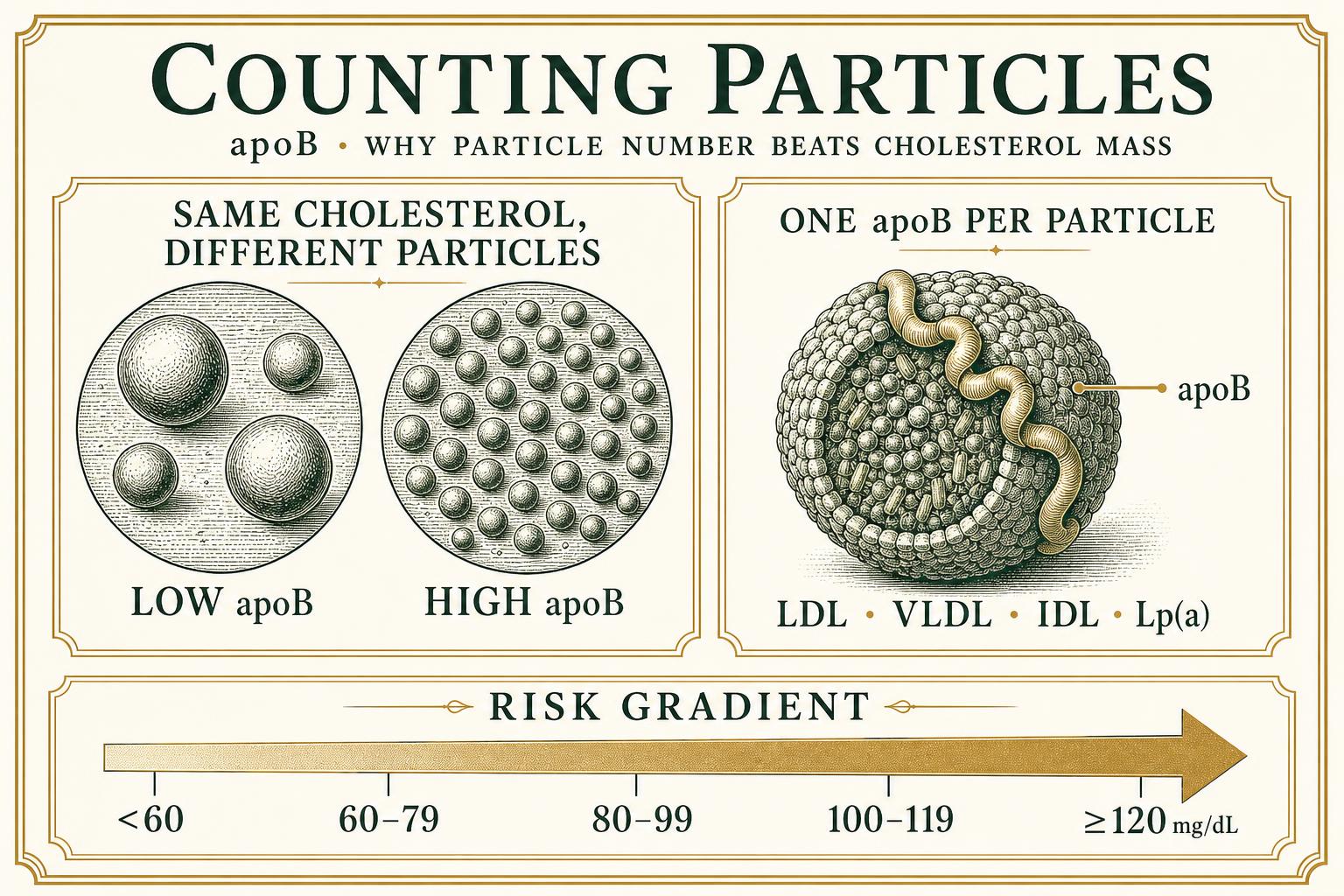
Standard lipid panels report how much cholesterol is being carried, not how many particles are doing the carrying. Atherosclerosis is driven by particles that enter and lodge in the artery wall, and every one of those particles carries exactly one apolipoprotein B molecule. That makes ApoB a direct count of atherogenic particles rather than an estimate of their cargo.
Contents(11 sections)
Key takeaways
Every atherogenic lipoprotein (LDL, VLDL, IDL, Lp(a)) carries exactly one ApoB molecule, so ApoB is a particle count.
ApoB outperforms LDL-C and non-HDL-C for predicting cardiovascular events in head-to-head analyses.
Discordance matters: normal LDL-C with high ApoB is a common and under-recognized high-risk pattern.
Practical targets: below 80 mg/dL for general prevention, below 60 mg/dL for established disease or high risk.
The Primer
What ApoB actually measures
Cholesterol does not travel loose in blood. It is packaged inside lipoprotein particles, and the particles that can burrow into an artery wall each carry one copy of a protein called apolipoprotein B. Measuring ApoB therefore tells you how many of those particles are circulating — not how much cholesterol they happen to be holding.
The distinction matters because particle number and cholesterol content vary independently. Two people with identical LDL cholesterol can have very different particle counts, and it is the particle count that tracks with disease.
Why LDL-C can mislead
LDL-C on most panels is calculated, not measured, and it describes cargo. In insulin resistance, high triglycerides, and metabolic syndrome, particles become small and cholesterol-depleted: you end up with many particles carrying less cholesterol each. LDL-C looks reassuring while the number of artery-penetrating particles is high.
This mismatch is called discordance, and it is exactly the population that standard screening misses.
What to ask for and what to aim at
Ask for an ApoB test alongside your standard panel; it is inexpensive, widely available, and does not require fasting. Broadly: under 80 mg/dL is a reasonable primary-prevention target, under 60 mg/dL is where secondary prevention and high-risk guidance sits, and above 100 mg/dL warrants a serious conversation.
Add Lp(a) once in a lifetime. It is largely genetic, it is included in the ApoB count, and knowing it changes how aggressively the rest of the picture should be treated.
The Deep Dive
The single-particle stoichiometry
Each LDL, IDL, VLDL, and Lp(a) particle carries one non-exchangeable ApoB-100 molecule; chylomicrons and their remnants carry ApoB-48. Because the protein is not transferred between particles in circulation, a plasma ApoB concentration is a direct molar count of atherogenic particles. Roughly 90% of circulating ApoB in a fasting sample is on LDL particles.
This is why ApoB behaves as a causal exposure variable rather than a correlate: the response-to-retention model of atherosclerosis holds that lesion initiation depends on the flux of ApoB-containing particles across the endothelium and their retention by arterial proteoglycans. Flux scales with particle number, not with the cholesterol mass inside each particle.
Tier II · Members only · Free
Continue into the deep dive
Tier I is free and always open. Tier II — the full mechanisms, dosing detail, nuance, and citations — unlocks with a free Vital Codex membership.
- Every Tier II deep dive across all hubs
- Saved reading progress across articles
- Member knowledge modules and their quizzes
- The Dispatch, if you opt in
Frequently asked
Can I have normal cholesterol and still have high ApoB?
Yes, and it is common. Insulin resistance produces small, cholesterol-depleted LDL particles, so LDL-C can read normal while particle count is elevated. This discordant pattern is precisely the one standard panels miss.
Do I need to fast for an ApoB test?
No. ApoB is stable in the non-fasting state, which is one of its practical advantages over calculated LDL-C.
Is ApoB better than an NMR particle count?
For most purposes yes — ApoB is assay-standardized, cheaper, and more widely reproducible. LDL-P correlates closely, but ApoB is the more portable number.
What target should I use?
Under 80 mg/dL for general prevention and under 60 mg/dL if you have established cardiovascular disease, diabetes, elevated Lp(a), or a strong family history. Discuss targets with a clinician who reads the full picture, not one marker.
Continue exploring: Labs & Biomarkers — Reading bloodwork beyond the reference range.
Explore Labs & Biomarkers