Creatine is usually filed under gym supplements, which understates it. Its job is to regenerate ATP within seconds in any tissue with sudden energy demand — skeletal muscle, yes, but also brain, heart, and retina. That makes it one of the few compounds with a plausible case in both strength and cognitive aging, and it has one of the cleanest safety records in the literature.
The muscle effects are settled science. The interesting questions are now cellular: how mitochondrial creatine kinase physically stabilizes the organelle it fuels, why brain dosing differs from muscle dosing, and what a still-thin frontier literature on post-viral fatigue, cardiometabolic disease, and cancer metabolism does and does not support.
Creatine is not a muscle supplement that happens to reach the brain. It is an energy buffer that happens to build muscle.
Contents(24 sections)
Key takeaways
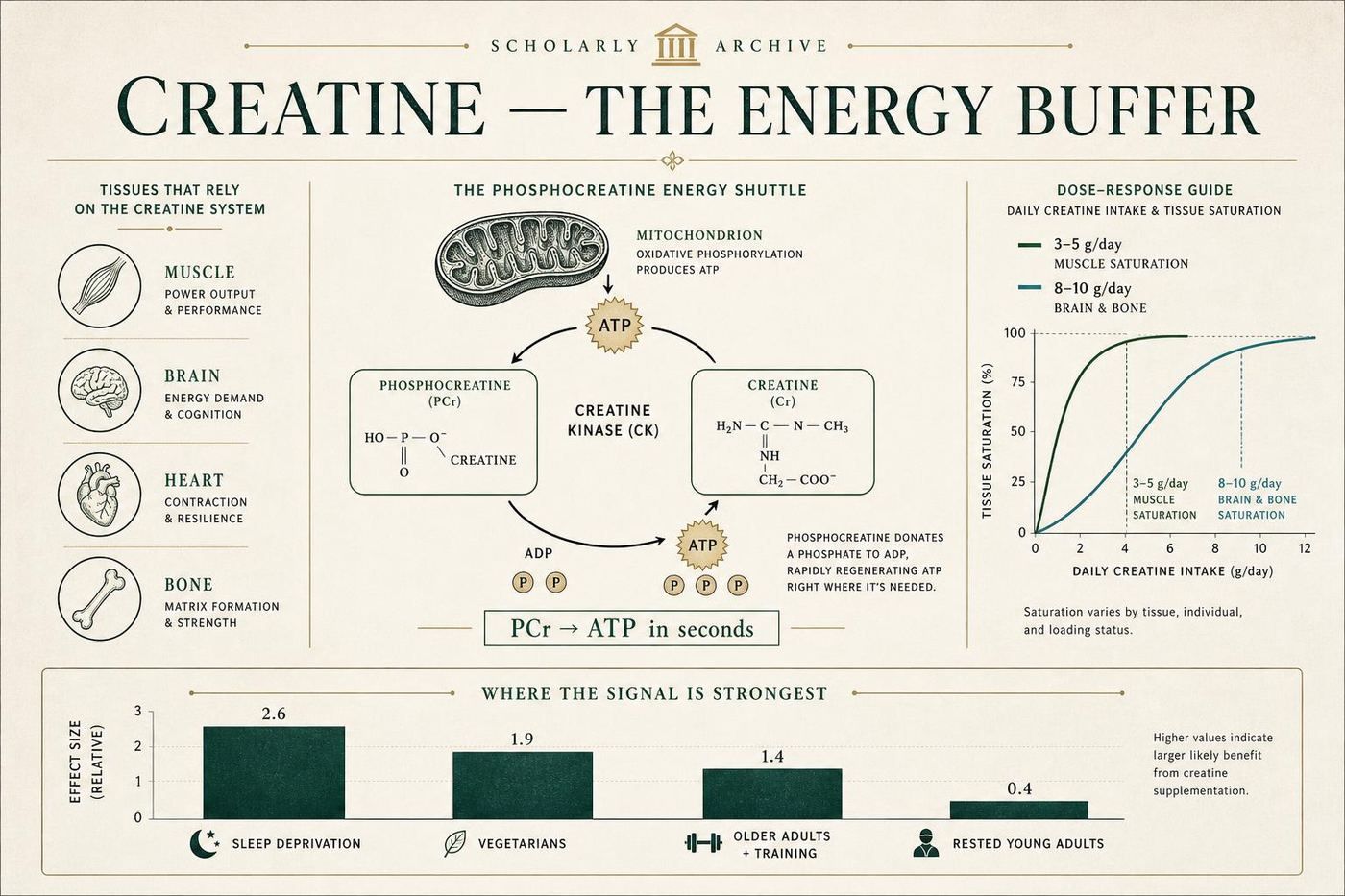
Creatine's single mechanism — fast ATP regeneration via phosphocreatine — explains its effects in muscle, brain, metabolism, and aging.
Muscle saturates at 3–5 g daily of creatine monohydrate within about four weeks; loading is optional, not required.
The brain is a harder compartment: uptake across the blood–brain barrier is slower, and researchers now argue for 8–10 g daily for cognitive and bone endpoints.
Cognitive benefit is state-dependent — largest under sleep deprivation, metabolic stress, and in vegetarians; small and contested in rested, well-fed young adults.
In older adults, creatine plus resistance training preserves lean mass, strength, and independence, with emerging bone density signals.
Mitochondrial creatine kinase binds cardiolipin and the ANT/VDAC complex, stabilizing cristae and delaying permeability transition — creatine protects the structure that makes the ATP it recycles.
Frontier signals worth watching, none of them settled: low tissue creatine in long COVID with a small positive pilot trial, AMPK/PGC-1α-driven mitochondrial biogenesis, and cardiometabolic bioenergetics.
Cancer is genuinely two-sided: protective against cachexia in models, yet some tumors exploit creatine metabolism to progress. Not a treatment decision to make alone.
Safety is strong: no credible renal harm signal in healthy people, and early weight gain is intracellular water, not fat.
The Primer
What creatine is, in plain language
Creatine is a small natural compound. Your body makes some of it, and you get the rest from foods like red meat and fish. Most of it is stored in your muscles, with a small but important amount in your brain.
Its job is simple: it helps refill your cells' energy. Every cell runs on a tiny energy molecule called ATP, and hard work — lifting, sprinting, even sustained thinking — burns through it in seconds. Creatine acts like a backup battery that recharges ATP fast. That one job explains almost every benefit below.
The benefits, plainly stated
- Stronger muscles. Faster energy supply means a few more reps, faster sprints, and more strength accumulated over months of training.
- Faster recovery. Even a few days of supplementation can reduce physiological stress and speed recovery after hard work.
- A sharper brain when you are tired. Under sleep deprivation, stress, or long mental workloads, creatine supports memory, focus, and processing speed.
- Support for the aging brain. Trials are now testing creatine against memory decline and Alzheimer's disease, on the premise that an aging brain runs short on energy the same way an aging muscle does.
- Strength and independence with age. Older adults who combine creatine with basic strength training keep more muscle, and keeping muscle tracks with keeping cognition.
- Blood sugar help. Working muscle pulls glucose out of the blood, and creatine appears to support that process during exercise.
- Bone, early signs. Newer work at higher doses points toward a bone density benefit.
- A bigger win for some people. Vegetarians and vegans get little creatine from food and often see the largest gains; recent reviews also highlight specific benefits for women's hormonal, cognitive, and bone health.
How people take it
The tested form is plain creatine monohydrate. A common dose is 3 to 5 grams once daily, every day. It takes a few weeks to fill the body's stores, so consistency matters far more than timing. Decades of research rank it among the safest supplements ever studied in healthy people. Expect one to two kilograms of early weight gain from intracellular water — that is the supplement working, not fat.
Skip HCl, buffered, and liquid forms. They cost more without outperforming monohydrate.
The takeaway
Creatine is an inexpensive, unpatentable, unglamorous compound that refills cellular energy — and that single mechanism pays out in muscle, brain, metabolism, and aging. Its reputation was built by evidence, not marketing.
The Deep Dive
The phosphocreatine system
Creatine is stored as phosphocreatine (PCr), and the creatine kinase reaction uses it to regenerate ATP from ADP within seconds of demand. Mitochondrial creatine kinase phosphorylates creatine using mitochondrially generated ATP; phosphocreatine then diffuses to cytosolic sites of demand, where cytosolic isoforms regenerate ATP locally. This spatial shuttle solves a diffusion problem — ATP itself moves too slowly relative to demand in large cells with spiky energy flux.
The same shuttle operates in neurons, which is why creatine matters in any tissue with high, fluctuating energy needs. In magnetic-resonance spectroscopy work, a single dose of creatine raised PCr and ATP ratios, prevented a fall in brain pH, and improved cognitive performance and processing speed.
Tier II · Members only · Free
Continue into the deep dive
Tier I is free and always open. Tier II — the full mechanisms, dosing detail, nuance, and citations — unlocks with a free Vital Codex membership.
- Every Tier II deep dive across all hubs
- Saved reading progress across articles
- Member knowledge modules and their quizzes
- The Dispatch, if you opt in
Frequently asked
Do I need to load creatine?
No. Loading reaches saturation in about a week; 3–5 g daily gets there in three to four weeks with the same end point.
How much creatine is needed for brain effects?
More than for muscle. Because blood–brain barrier transport is rate-limiting, current cognitive and bone work uses roughly 8–10 g daily rather than the 3–5 g that saturates muscle.
Is creatine bad for the kidneys?
Not in people with normal renal function, across trials up to five years. It raises serum creatinine as a measurement artifact without changing actual filtration.
Does creatine cause hair loss?
The claim rests on one small unreplicated study measuring a hormone ratio, not hair loss. There is no trial evidence of hair loss from creatine.
Should women take creatine?
Yes — women typically have lower baseline stores, and the strength, lean mass, bone, cognitive, and mood data in women are at least as favorable as in men.
Does creatine help if I do not train?
Much less. Creatine widens the energy margin on high-cost efforts; a training stimulus is what converts that margin into muscle, strength, and bone.
Can creatine help long-COVID fatigue?
Possibly. Long-COVID patients show measurably low tissue creatine, and a six-month pilot trial at 4 g daily raised muscle and brain creatine while improving fatigue, aches, and concentration. With twelve participants, it is a signal to watch, not established therapy.
Is creatine safe for someone with cancer?
Unclear, and it should be a clinical conversation. Some models show creatine protecting against muscle wasting, while other tumor types appear to exploit creatine metabolism to progress. Effects look context-dependent on tumor biology.
Continue exploring: Muscle & Aging — Hypertrophy, sarcopenia prevention, and structural health.
Explore Muscle & Aging