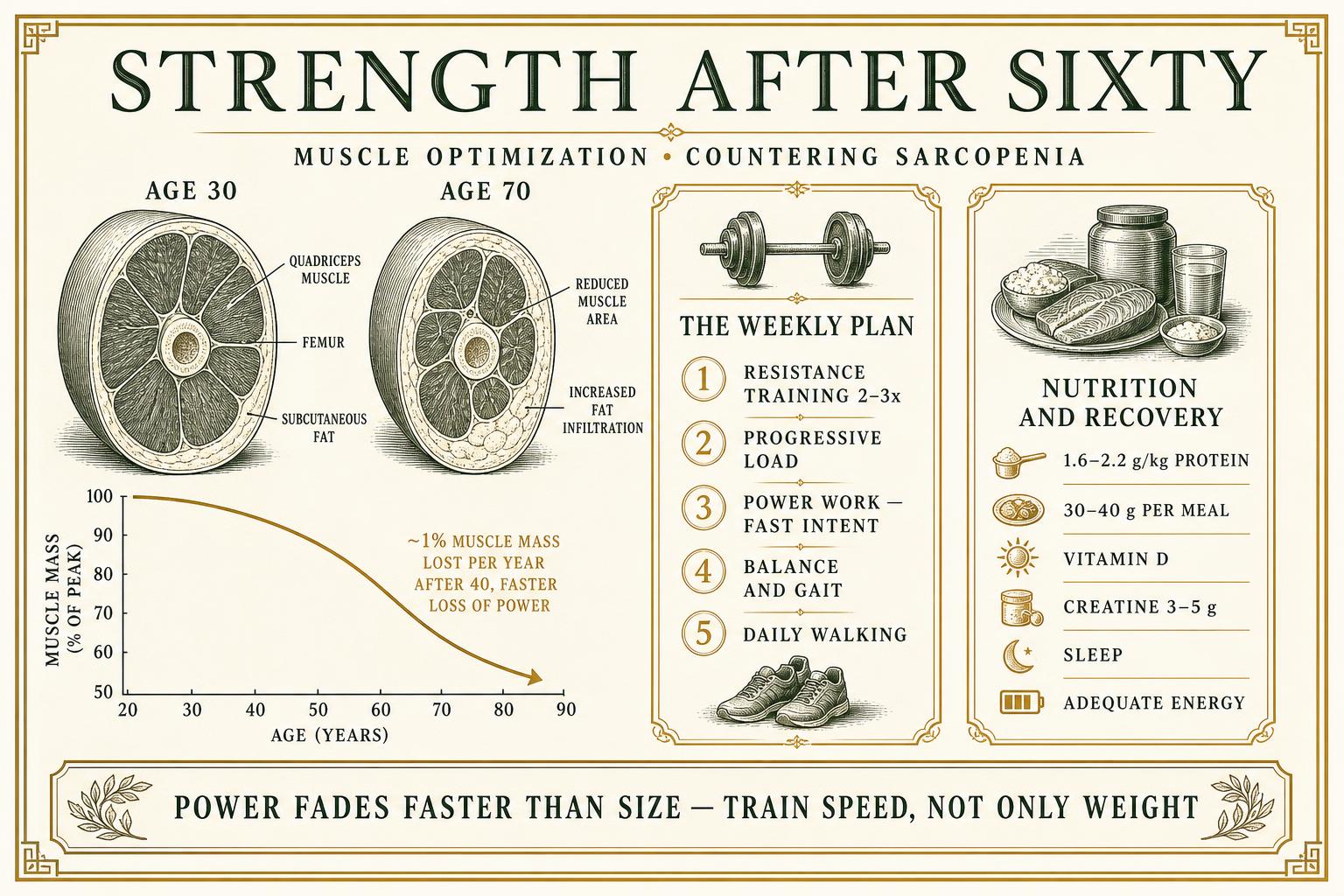
Muscle is the most protective tissue an aging body carries. It regulates glucose, absorbs falls, sustains independence, and — in the largest cohort studies — predicts all-cause mortality more strongly than most blood markers.
Sarcopenia is rarely caused by a single deficit. It reflects a compounded loss of training stimulus, protein sufficiency, mitochondrial capacity, and recovery. That is also why the fix has to be layered.
Contents(16 sections)
Key takeaways
Resistance training 2–3× per week is the single most durable intervention for preserving muscle after 60.
Target 1.2–1.6 g protein per kg bodyweight, with 30–40 g of leucine-rich protein per meal.
Creatine (3–5 g/day) is the most evidence-backed muscle supplement across older-adult trials.
Breakfast is the weakest protein meal in most older adults' diets — moving it from ~10 g to ~30 g is the single easiest correction available.
Support systems — inflammation, sleep, circulation, mitochondrial function — decide how much of the training and nutrition stimulus actually converts into new tissue.
The Primer
Why muscle earns priority
Grip strength, chair-rise speed, and gait velocity outperform most blood biomarkers as predictors of independence and mortality in the last two decades of life. The single most modifiable input to all three is trained lean mass.
For most people, appearance is beside the point. Function is the goal: getting up from the floor, carrying groceries, staying steady on uneven ground.
What older muscle actually needs
Aging muscle becomes less sensitive to the anabolic signals it once responded to easily. The dose of protein required to trigger muscle protein synthesis rises, and the training stimulus has to be more deliberate — meaningful load, not just movement.
A workable weekly frame: two to three resistance sessions, five to ten thousand steps most days, and one to two easy aerobic sessions long enough to matter. That combination outperforms almost any supplement.
The morning gap
There is no magic breakfast food that reverses muscle loss. What there is — and it is genuinely underappreciated — is a structural gap in how most older adults distribute protein across the day.
A typical pattern looks like 10 g at breakfast (toast, cereal, fruit, coffee), 20 g at lunch, and 50 g at dinner. That adds up to a respectable daily total, but it only clears the threshold that switches on muscle protein synthesis once. The other two meals are, from the muscle's point of view, nearly silent.
Evening out the distribution — roughly 30 g at each of three meals — delivers the same total while triggering the building response three times instead of once. For most people over 60, breakfast is where that correction has to happen, because breakfast is where the deficit lives. Three free-range eggs, two cups of Greek yogurt, a scoop of whey in coffee or oats, or leftover fish or chicken each get you to about 30 g.
Where eggs appear in this article, choose free-range or pasture-raised. The protein and leucine content is essentially the same, but hens with outdoor access and a varied diet produce yolks with measurably more omega-3 fat, vitamin D, vitamin E, and carotenoids (lutein and zeaxanthin) and a lower omega-6 to omega-3 ratio than conventional cage eggs. Those are the same nutrients that reduce anabolic resistance and support joint and eye health in later decades, so the upgrade costs little and adds real value alongside the protein.
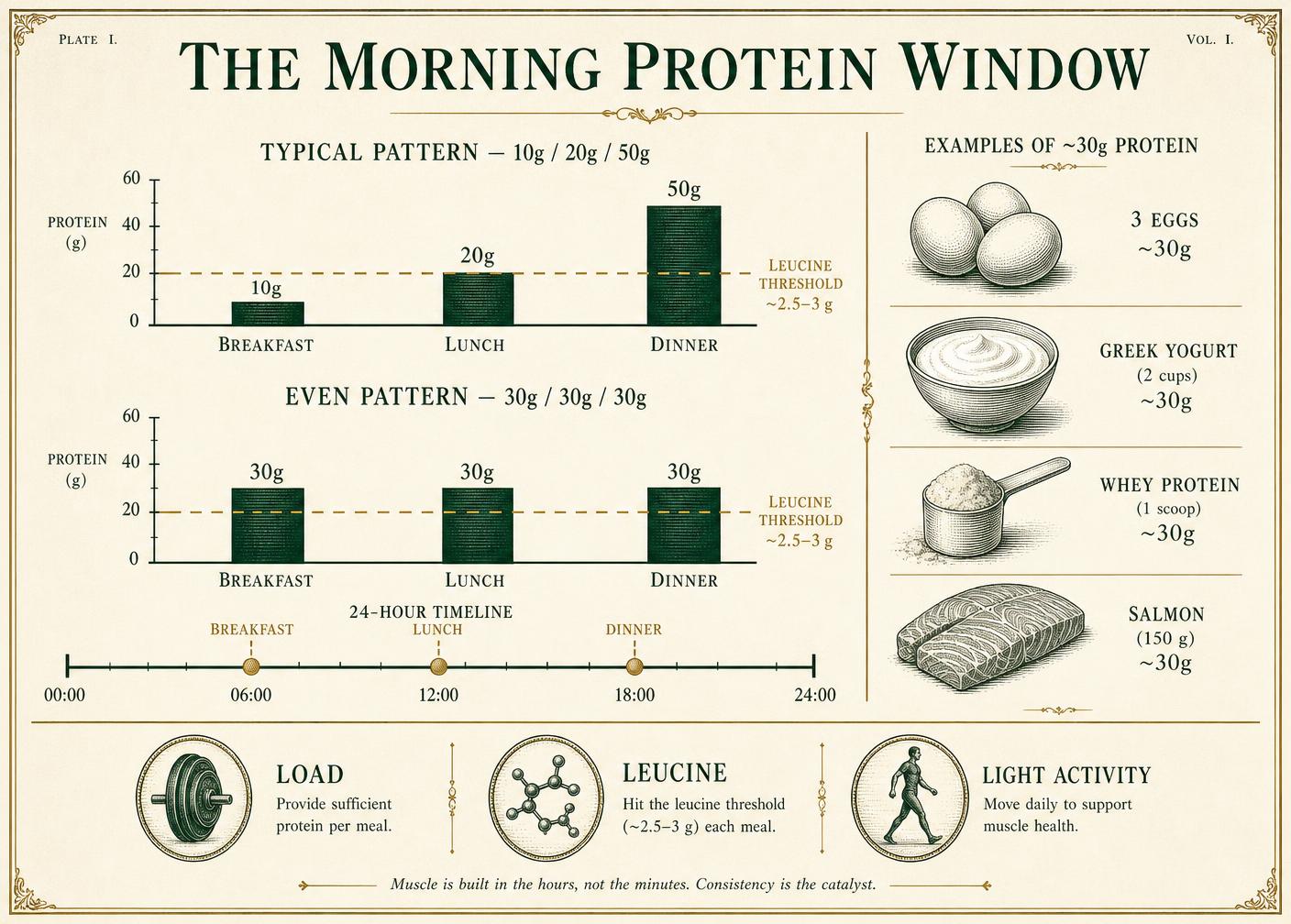
The legs matter here more than the arms. Quadriceps and glutes are the largest muscle groups in the body, they are the ones that lose fast-twitch fibers first, and they are the ones standing between a stumble and a fall. But food alone does not build them. Protein supplies the material; load supplies the instruction. Adding a good breakfast without adding resistance work mostly produces well-fed muscle that is still not being asked to do anything.
The overnight window
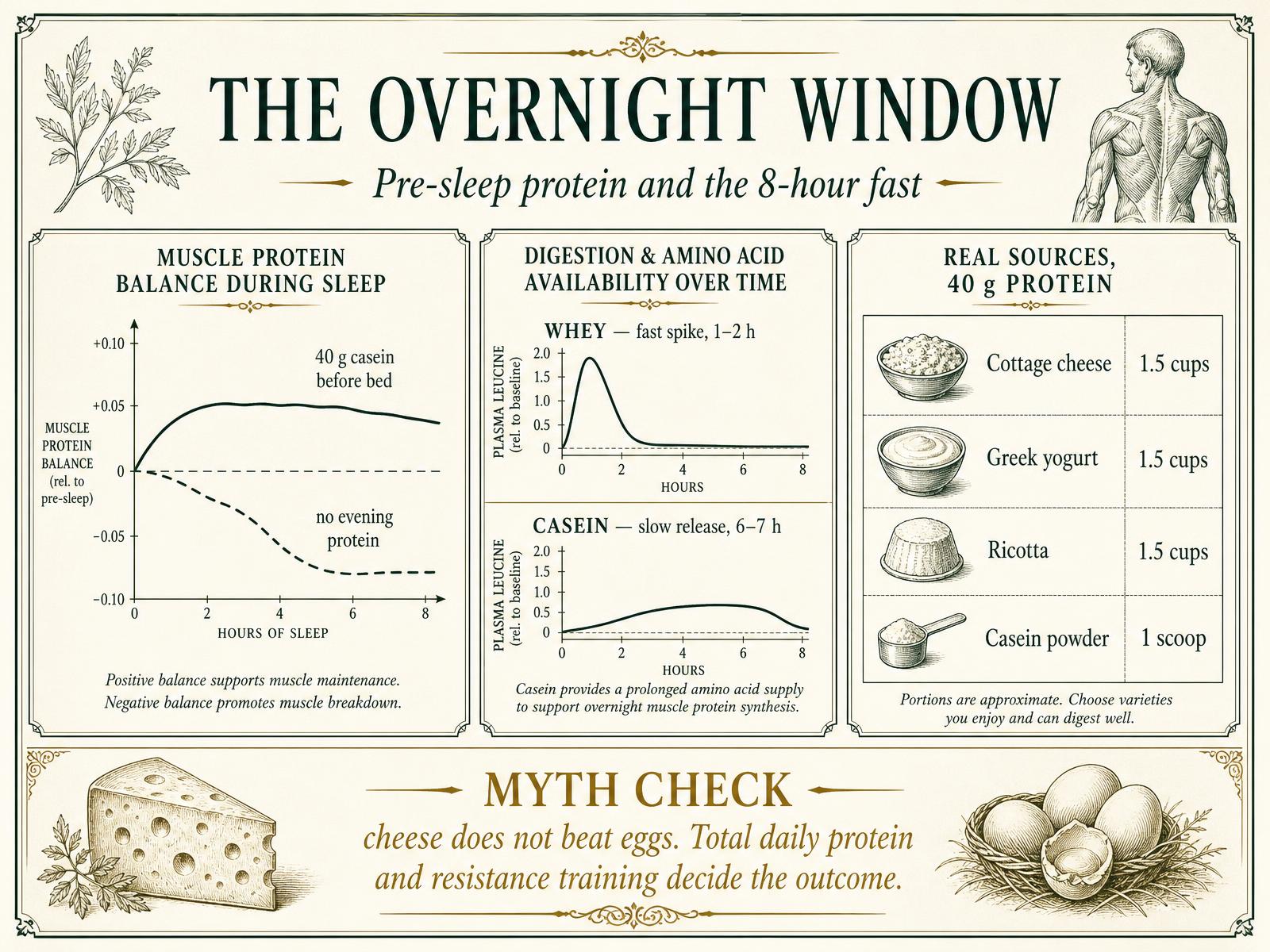
Breakfast is the deficit most older adults have. Sleep is the gap almost nobody thinks about. Between dinner and breakfast, most people go seven to ten hours without amino acids arriving, and muscle protein balance drifts negative during that stretch. It is a small nightly loss, but it repeats roughly 365 times a year.
A protein feeding before bed narrows that gap. In controlled trials, 27.5–40 g of protein taken shortly before sleep raised overnight muscle protein synthesis rates in both young and older men, and when added to a resistance-training program over twelve weeks it produced larger gains in muscle size and strength than training with a non-caloric placebo. The effect is real and modest — an optimization on top of adequate total intake, not a replacement for it.
Slow-digesting protein suits this slot better than fast protein. Casein — the dominant protein in dairy — clots in the stomach and releases amino acids over roughly six to seven hours, while whey peaks within an hour and clears. For an eight-hour fast, the slower curve keeps amino acids available longer. That is why cottage cheese, Greek yogurt, ricotta, and micellar casein powder show up in this research, and why the practical target is about 40 g of protein in the last hour before bed.
Myth check: the cheese-versus-eggs claim
A popular online genre claims specific cheeses build muscle "1,000 times better than eggs" after 70. The mechanism it borrows is real; the conclusion is not. Three corrections are worth making explicitly:
- Cheese does not outperform eggs per gram of protein. An ounce of parmesan carries about 10 g of protein and an egg about 6 g, but that is a serving-size comparison, not a quality one. Egg protein has among the highest measured protein quality scores of any food. What differs is release speed, not superiority.
- "Faster digestion" is not a defect. Fast protein is what you want at breakfast and after training, when the goal is to clear the leucine threshold quickly. Slow protein is what you want before an eight-hour fast. Neither food is the better one; they suit different slots.
- Total daily protein and resistance training still decide the outcome. In the pre-sleep trials, the participants were training. Adding cottage cheese at night to a sedentary day with 60 g of total protein will not reverse sarcopenia.
Two practical cautions come with the dairy route. Hard and processed cheeses carry substantial sodium — one to two ounces of parmesan is reasonable, half a block is not — and processed cheese products contain notably less protein than the real thing. If dairy does not suit you, a casein powder, a large serving of Greek yogurt, or simply a protein-anchored dinner eaten later covers the same ground.
Choosing the cheese: source quality matters
If cheese is going to be a regular protein anchor, the version worth buying is traditional, small-batch cheese made from organic raw milk produced without synthetic growth hormone — the kind of cheese Amish and Mennonite dairies, and comparable European farmstead producers, have made for generations. The protein and casein content is similar across sources, so the reason to prefer these is everything else in the matrix.
- No synthetic growth hormone. Recombinant bovine growth hormone (rBST/rBGH) raises IGF-1 in the milk supply and is banned in the EU, Canada, and Japan. Since aging-biology research is generally interested in lower chronic IGF-1 signalling, there is no upside to adding a hormone-stimulated dairy stream to a diet you are otherwise optimizing.
- Pasture and forage change the fat. Milk from cows on grass and mixed forage carries more omega-3 fat, more conjugated linoleic acid, more vitamin K2 (MK-4), and a lower omega-6 to omega-3 ratio than milk from confinement, grain-heavy systems. This is the same upgrade logic as choosing free-range eggs: identical protein, better accompanying nutrients.
- Raw-milk aged cheese keeps more of the living matrix. Traditionally made raw-milk cheeses aged sixty days or more retain a richer native enzyme and microbial profile, and several studies associate traditional farm dairy consumption with lower allergic and inflammatory outcomes. Long aging is also what makes raw-milk cheese legal to sell in the United States and substantially reduces pathogen risk.
- Fewer additives, less sodium engineering. Farmstead cheese is typically milk, culture, rennet, and salt. Industrial processed cheese products add emulsifying salts, phosphate additives, and colourings, and dilute the protein per ounce.
Two honest caveats. Raw-milk dairy is not appropriate for pregnancy, infancy, or significantly immunocompromised people — pasteurized organic grass-fed cheese is the right substitute there, and it retains most of the fatty-acid and K2 advantage. And source quality does not change the sodium arithmetic: a good raw-milk cheddar is still salty, so portion it as a 1–2 ounce contribution rather than the whole 40 g pre-sleep dose.
Serving size and timing for raw-milk cheese
Use cheese as a component of a protein slot, not the entire slot. Because aged cheese is concentrated and salty, 1–2 ounces is the practical serving. Pair it with a faster or larger protein source to hit the per-meal target.
| Goal | Timing | Serving | Combine with | Approximate protein |
|---|---|---|---|---|
| Breakfast anchor | Within 1–2 hours of waking | 1 oz raw-milk cheddar | 2–3 free-range eggs or ¾ cup Greek yogurt | 24–32 g |
| Post-training recovery | Within 2 hours of resistance work | 1 oz cheese + whey or dairy | 1 scoop whey in water or 1 cup Greek yogurt | 30–40 g |
| Pre-sleep slow release | Last hour before bed | 1.5–2 oz aged raw-milk cheese | 1 cup cottage cheese or 1 cup Greek yogurt | 35–45 g |
| Midday protein bridge | Between meals if appetite is low | 1 oz cheese | Small handful of nuts or a boiled egg | 12–18 g |
A few practical notes:
- Aged raw-milk cheese is slow-digesting. It fits the pre-sleep and between-meal slots better than the breakfast or post-workout windows, where a faster protein (eggs, whey, yogurt) is usually preferable.
- One ounce of hard aged cheese is roughly 7–10 g of protein. That means cheese alone rarely covers a full 30–40 g target; it should anchor flavor and fat while another source supplies volume.
- Sodium adds up quickly. Two ounces of aged cheddar can deliver 300–400 mg of sodium. If blood pressure is a concern, keep the cheese portion to 1 ounce and make up the protein with unsalted cottage cheese or Greek yogurt.
- Raw milk is safest when aged 60 days or more. Buy from a source you trust, keep it cold, and treat it as a perishable whole food rather than a shelf-stable snack.
The Deep Dive
The anabolic resistance of aging muscle
Older muscle shows a blunted response to both dietary protein and resistance exercise, a phenomenon known as anabolic resistance. The response can be largely restored — but it requires a higher per-meal leucine dose (roughly 2.5–3 g leucine, or 30–40 g of high-quality protein) and consistent loading of the muscle.
This is why intermittent fasting protocols that compress protein into one or two meals often underperform for older adults trying to preserve mass.
Tier II · Members only · Free
Continue into the deep dive
Tier I is free and always open. Tier II — the full mechanisms, dosing detail, nuance, and citations — unlocks with a free Vital Codex membership.
- Every Tier II deep dive across all hubs
- Saved reading progress across articles
- Member knowledge modules and their quizzes
- The Dispatch, if you opt in
Frequently asked
Can you still build muscle after 70?
Yes. Strength and function respond at every studied age, and even people in their 80s and 90s can measurably improve. Mass gains slow, but function almost always improves.
Is training more important than protein?
Neither works well alone in older adults. The two amplify each other; the mistake is skipping either.
How much protein is realistic if my appetite is low?
Anchoring three meals with 25–40 g of protein each (free-range eggs, dairy, fish, whey, legumes) usually gets there without stuffing. Whey is the most efficient tool when appetite is limited.
Is there one breakfast food that stops muscle loss in the legs?
No. No single food reverses sarcopenia. What helps is getting roughly 30 g of high-quality protein at breakfast instead of the 10 g most older adults eat, and pairing it with resistance work that actually loads the legs. Free-range eggs, Greek yogurt, whey, cottage cheese, and fish all reach that number — none of them is uniquely magic. Free-range is the default worth specifying: same protein, better fatty-acid profile and higher vitamin D, E, and carotenoid content than cage eggs.
Does it matter what time I eat the protein?
Less than the amount per meal. The evidence supports clearing the leucine threshold at each of three meals rather than hitting a specific clock time. Breakfast gets the attention only because it is usually the meal falling furthest short.
Does cottage cheese before bed really build muscle?
It helps, modestly, and only within a plan. Trials using 27.5–40 g of casein-rich protein before sleep show higher overnight muscle protein synthesis and, over twelve weeks alongside resistance training, greater gains in muscle size and strength than a placebo. Cottage cheese, Greek yogurt, ricotta, and micellar casein powder all supply that protein. It is an addition to adequate daily intake and training, not a substitute for either.
Is cheese better than eggs for muscle after 70?
No. That claim circulates widely online and misreads the science. Egg protein has among the highest measured quality scores of any food; cheese simply digests more slowly because of its casein content. Slow release is an advantage before an eight-hour overnight fast and a disadvantage at breakfast, where clearing the leucine threshold quickly is the goal. Use fast protein in the morning and slow protein at night rather than ranking the foods.
How much protein should I eat before bed, and what kind?
Roughly 40 g in the last hour before sleep, from a slow-digesting source. Older muscle needs the larger dose: 20 g measurably underperforms 40 g for overnight synthesis in older men. About 1.5 cups of cottage cheese, 1.5 cups of Greek yogurt, or a scoop of micellar casein each get you there. Watch sodium if hard or processed cheeses are your main source.
What kind of cheese is best for the pre-sleep dose?
Traditional aged cheese made from organic raw milk without synthetic growth hormone — the style Amish and Mennonite dairies and European farmstead producers make. The protein is comparable to any cheese, but pasture-fed raw milk brings more omega-3 fat, conjugated linoleic acid, and vitamin K2, and avoids rBST/rBGH-stimulated milk. Pasteurized organic grass-fed cheese is the correct choice in pregnancy, infancy, or immune compromise. Either way, watch sodium and treat cheese as part of the 40 g, not all of it.
Continue exploring: Muscle & Aging — Hypertrophy, sarcopenia prevention, and structural health.
Explore Muscle & Aging