Histotripsy is an image-guided therapy that uses focused sound waves to mechanically break apart tumors — without incisions, inserted probes, ionizing radiation, or heat-based ablation. It is already authorized in the United States for selected liver tumors, and is developing into a broader platform for kidney tumors, prostate disease, and cancer-immunotherapy combinations.
The deeper significance is not only that histotripsy can destroy a tumor from outside the body. It may also help the immune system recognize cancer more effectively. That combination — precise local destruction plus possible systemic immune engagement — is why histotripsy has become one of the most closely watched frontiers in modern oncology.
Rather than cutting a tumor, burning it, freezing it, or irradiating it, clinicians may increasingly dismantle it with sound.
Contents(16 sections)
Key takeaways
Histotripsy destroys tissue mechanically, through acoustic cavitation, rather than by heating, freezing, cutting, or irradiating it.
The treatment head stays outside the body; ultrasound imaging locates the target and shows the bubble cloud in real time.
In October 2023 the FDA authorized the Edison Histotripsy System for noninvasive destruction of liver tumors, including unresectable ones — the first authorization of its kind.
The pivotal #HOPE4LIVER program reported technical success in 95% of treated lesions, with encouraging one-year local control in selected tumors.
Mechanical disruption releases tumor antigens and danger signals, which may improve immune recognition and boost checkpoint-inhibitor activity.
Animal work has shown delayed growth of distant untreated tumors — an abscopal-type signal — when histotripsy is paired with immunotherapy or chemotherapy.
Kidney tumors are the likely next indication: HistoSonics submitted a De Novo request for a renal indication in May 2026, supported by the #HOPE4KIDNEY study.
The WOLVERINE trial began treating benign prostatic hyperplasia patients in 2026; pancreatic cancer and brain tumors remain longer-term frontiers.
Histotripsy is a genuine new platform, not a proven cancer cure; most applications beyond the liver are still investigational.
The Primer
What histotripsy is
The word histotripsy joins the Greek-derived terms for tissue (histo) and crushing (tripsy). It is a form of therapeutic focused ultrasound, but it works very differently from approaches that rely on heating tissue.
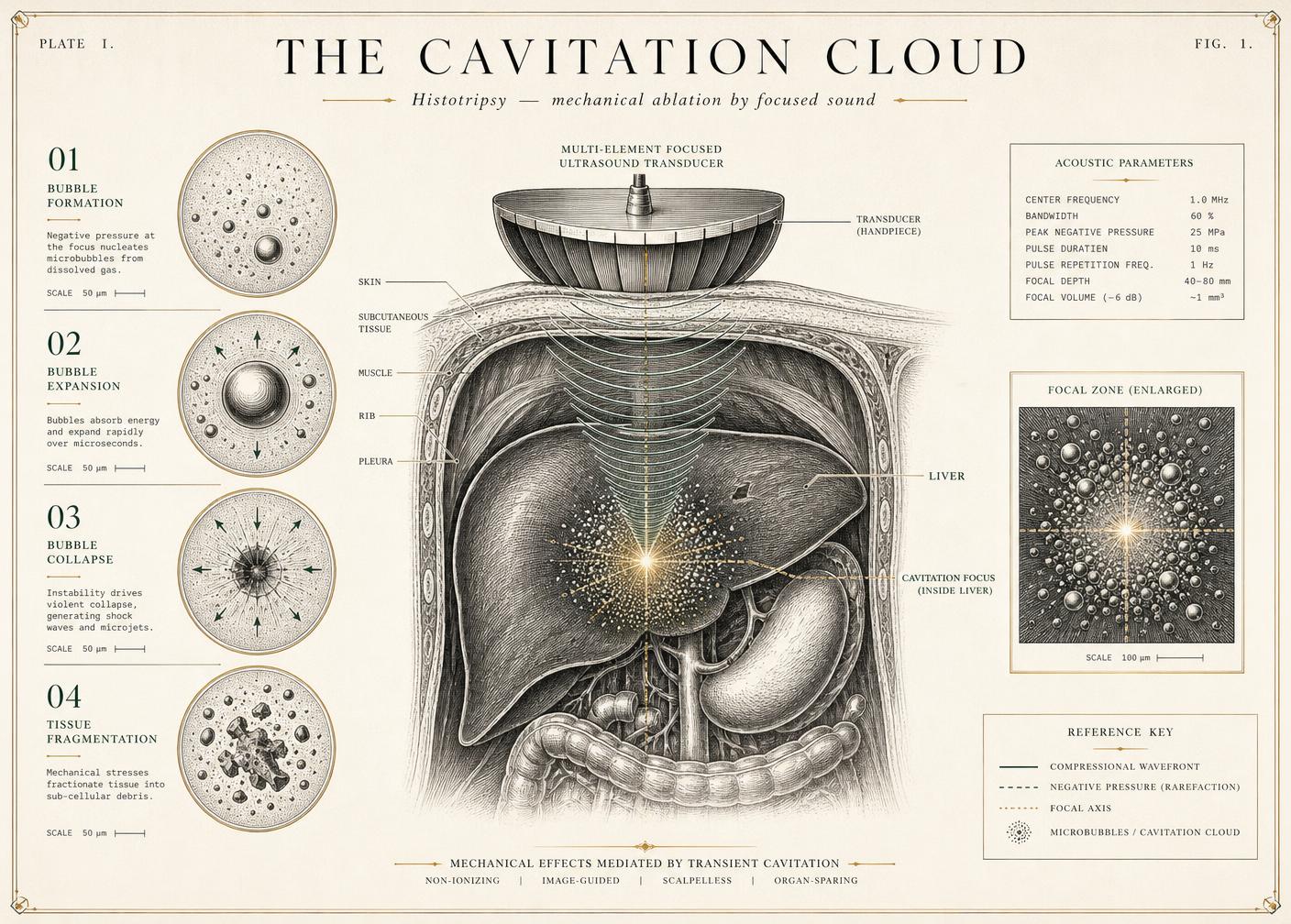
A treatment system sends brief, high-intensity ultrasound pulses through the skin and focuses them at a precisely selected point inside the body. At that focal point, the pulses create a dense cloud of microscopic bubbles in the fluid within tissue. The bubbles form, expand, and collapse extremely rapidly — a physical process called acoustic cavitation.
That bubble activity generates intense but highly localized mechanical forces. Cell membranes are disrupted, tumor tissue is fragmented into microscopic debris, and the body gradually clears the treated material through its normal biological processes.
Mechanical ablation, not burning
Most established local cancer treatments use one of a few strategies: surgery removes a tumor, radiation damages cancer cells with ionizing energy, radiofrequency and microwave ablation heat tissue until it dies, cryoablation freezes it, and chemical ablation injects a destructive substance into the lesion.
Histotripsy introduces another category: mechanical ablation by controlled cavitation. A simple analogy helps — thermal ablation is closer to cooking tissue; histotripsy is closer to using focused sound to produce a tiny, controlled, bubble-driven demolition zone inside it.
The treatment sequence
The clinical team first identifies the tumor and maps the planned treatment volume using ultrasound and other imaging. A multi-element transducer outside the body then directs energy so the strongest effect occurs at the focal target rather than along the entire beam path.
Short, high-amplitude pulses generate a confined cloud of microbubbles inside the target zone. The rapid bubble dynamics create shear forces and other mechanical effects that break apart tumor cells and soft-tissue architecture. Because the active bubble cloud is visible on ultrasound, treatment can be delivered with direct feedback.
Afterward, the treated area becomes a zone of fragmented, largely acellular material that the body gradually processes and clears.
Why the approach is different
Histotripsy's potential comes from a distinctive combination of properties. It is noninvasive — no incision, and no ablation needle passed through skin into the tumor. It is nonionizing and nonthermal, working primarily by mechanical disruption. It is image-guided, so clinicians can watch both the target and the cavitation activity during treatment. The effect is highly localized to the acoustic focus, and because no incision is required, the method may suit situations where repeated local treatment is useful. It is also compatible with combination therapy alongside immunotherapy, chemotherapy, or targeted drugs.
For tumors in anatomically challenging locations, these properties could eventually make treatment less invasive and more precise than many existing options.
The first clinical success: liver tumors
Histotripsy has crossed the most important line in medical development — from laboratory research into regulated clinical use. In October 2023, the U.S. Food and Drug Administration authorized marketing of the Edison Histotripsy System for noninvasive destruction of liver tumors, including unresectable liver tumors, making histotripsy the first FDA-authorized technology of its kind for that purpose.
The pivotal #HOPE4LIVER clinical program provided the foundation. In the early multicenter study, investigators reported technical success in 95% of treated lesions, and follow-up data reported encouraging local tumor-control outcomes at one year in selected treated liver tumors.
This matters because the liver is a frequent site of both primary cancer and metastases — from hepatocellular carcinoma, colorectal cancer, neuroendocrine tumors, breast cancer, melanoma, and others. Many patients cannot undergo major surgery, and some need local therapy repeatedly as new lesions emerge. For appropriately selected lesions, histotripsy offers a new possibility: destroy the target without placing a probe into the liver and without relying on heat.
The Deep Dive
The immune opportunity
The most interesting possibility is that histotripsy may do more than erase a local lesion.
When a tumor is mechanically disrupted, it releases a broad collection of tumor-associated antigens, nucleic acids, cellular debris, and molecular danger signals. In theory — and increasingly in experimental evidence — this can help alert the immune system that abnormal tumor material is present.
Tier II · Members only · Free
Continue into the deep dive
Tier I is free and always open. Tier II — the full mechanisms, dosing detail, nuance, and citations — unlocks with a free Vital Codex membership.
- Every Tier II deep dive across all hubs
- Saved reading progress across articles
- Member knowledge modules and their quizzes
- The Dispatch, if you opt in
Frequently asked
What is histotripsy?
Histotripsy is a noninvasive, image-guided therapy that focuses high-intensity ultrasound pulses at a point inside the body, creating a cloud of microbubbles whose rapid formation and collapse mechanically fragments the targeted tissue. The treatment head remains outside the skin.
Is histotripsy the same as HIFU or thermal ablation?
No. High-intensity focused ultrasound therapies traditionally destroy tissue with sustained heat. Histotripsy's primary mechanism is mechanical: cavitation-driven shear forces break apart cells rather than cooking them.
Is histotripsy FDA approved?
The FDA authorized the Edison Histotripsy System in October 2023 for noninvasive destruction of liver tumors, including unresectable liver tumors. Other applications — kidney tumors, benign prostatic hyperplasia, pancreatic cancer, brain tumors — remain investigational.
Which cancers can histotripsy treat today?
Currently, selected liver tumors in appropriate clinical settings, covering both primary liver cancer and liver metastases from cancers such as colorectal, neuroendocrine, breast, and melanoma. Candidacy depends on lesion size, location, imaging visibility, and the overall treatment plan.
Can histotripsy help immunotherapy work better?
That is the leading hypothesis. Mechanical disruption releases tumor antigens and danger signals that may improve immune recognition, and animal studies combining histotripsy with immunotherapy have shown stronger immune infiltration and slowed growth of distant untreated tumors. Human confirmation is still pending.
What is the abscopal effect?
It is the phenomenon in which treating one tumor is followed by regression or slowed growth of untreated tumors elsewhere in the body, presumed to be immune-mediated. Histotripsy is being studied as a potential trigger for it.
Does histotripsy use radiation?
No. It uses nonionizing acoustic energy, so there is no radiation dose and no cumulative radiation exposure concern from the treatment itself.
Research Notes & Sources(expand)
U.S. Food and Drug Administration. FDA Roundup: October 13, 2023 — authorization of the Edison System for noninvasive destruction of liver tumors.
Mendiratta-Lala M, et al. The #HOPE4LIVER Single-Arm Pivotal Trial for Histotripsy of Liver Tumors. Radiology, 2024.
ClinicalTrials.gov. #HOPE4KIDNEY Histotripsy Study and WOLVERINE Histotripsy Study for Benign Prostatic Hyperplasia.
HistoSonics corporate announcement, May 2026 — De Novo request submitted to the FDA seeking a kidney-tumor indication for the Edison system.
Reviews of histotripsy, focused ultrasound, tumor immune regulation, and clinical translation published in 2025–2026.
This article is educational and is not medical advice. Treatment decisions should be made with a qualified oncology, urology, interventional-radiology, or surgical team familiar with the patient's diagnosis and imaging.
Continue exploring: Mitochondria — Cellular energy production and the mechanisms of senescence.
Explore Mitochondria