Deep inside nearly every cell in the human body sits a single protein that stands between a damaged cell and a growing tumor. Scientists call it p53, and its nickname — "guardian of the genome" — was earned through more than four decades of research showing it to be the most frequently disrupted defense system in human cancer.
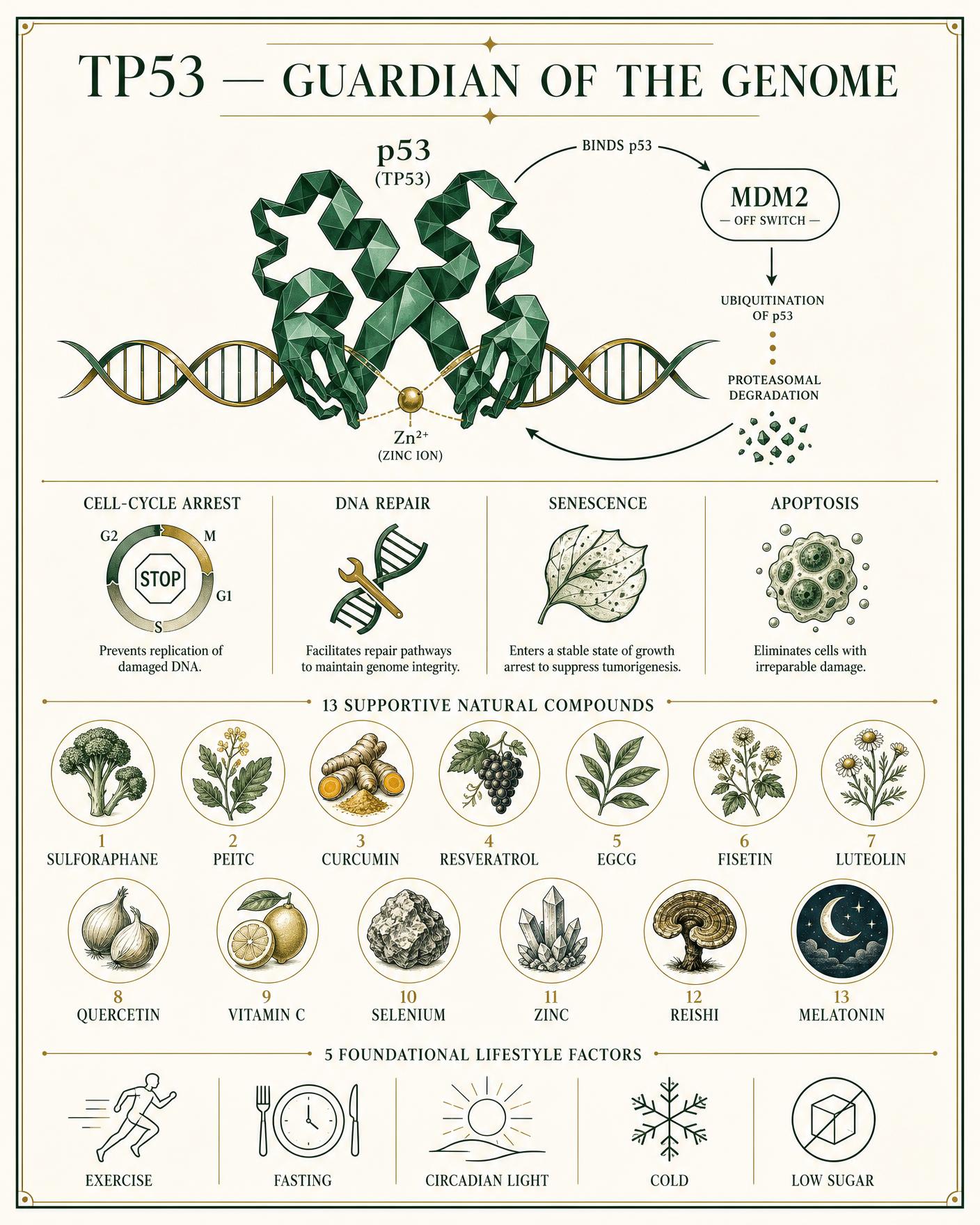
When DNA is damaged by toxins, radiation, oxidative stress, or the simple wear of repeated division, p53 acts as the cell's quality-control inspector. It reads the damage and makes one of four decisions: pause the cell cycle so repair machinery can work, activate DNA repair directly, push the cell into permanent retirement (senescence), or — if the damage is beyond repair — trigger apoptosis. p53 directly regulates more than 300 genes, making it one of the most consequential single proteins in human biology.
TP53 mutations appear in roughly half of all human cancers, more than any other gene, with rates varying enormously by tumor type — near-universal in high-grade serous ovarian cancer and small-cell lung cancer, relatively rare in early-stage prostate and thyroid cancers.
This is educational content, not personal medical advice. Nearly all of the research below is preclinical.
Without adequate zinc, even normal p53 can misfold — behaving functionally like a mutant.
Contents(17 sections)
Key takeaways
p53 is a zinc-dependent tumor suppressor mutated in about half of all human cancers, and it governs four outcomes: cell-cycle arrest, DNA repair, senescence, and apoptosis.
"p53 dysfunction" is two distinct problems: healthy (wild-type) p53 suppressed by an overactive MDM2 off switch, and structurally mutant p53 that cannot grip DNA.
Polyphenols such as curcumin, resveratrol, EGCG, luteolin, quercetin, and fisetin mainly act by lowering MDM2 or by stabilizing activating modifications on p53.
Sulforaphane and PEITC from cruciferous vegetables are the most direct dietary actors — PEITC has reactivated mutant p53 and blunted its gain-of-function activity in laboratory models.
Zinc is structural rather than optional: a single zinc ion holds the DNA-binding domain in shape, and zinc restoration can refold certain zinc-binding mutants such as R175H.
Exercise, fasting, circadian alignment, cold exposure, and reduced refined sugar activate p53 through mild, beneficial cellular stress.
Curcumin, resveratrol, and high-dose antioxidants have documented interactions with chemotherapy and radiation and require clinician oversight during active treatment.
The Primer
Two different problems, two different strategies
Before looking at specific compounds, it helps to know that "p53 dysfunction" is not one condition. The literature sorts it into two categories that respond to different interventions.
Suppressed wild-type p53. The gene is normal, but the protein is held down because MDM2 — its main off switch — is overproduced and constantly degrades it. The goal here is releasing the brake.
Mutant p53. The gene itself is altered, producing a misshapen protein. Many common mutations, including the zinc-binding class and R175H (the single most frequent p53 mutation), cause the protein to lose a critical zinc ion and misfold, leaving it physically unable to grip DNA. Some mutant p53 does not merely stop working — it actively drives cancer progression, a phenomenon called gain of function.
This distinction matters because a compound that releases MDM2's brake on healthy p53 works through a different mechanism than one that helps a misfolded, zinc-starved mutant refold.
Cruciferous vegetables: sulforaphane and PEITC
Broccoli, broccoli sprouts, watercress, Brussels sprouts, kale, and cabbage contain two compounds with unusually direct action on the p53 pathway.
Phenethyl isothiocyanate (PEITC), concentrated in watercress and broccoli, has been shown in laboratory research to reactivate mutant p53, restoring its ability to trigger cancer cell death even after the protein has been structurally altered. A 2025 pharmacology study went further, showing PEITC can neutralize the harmful gain-of-function activity that certain p53 mutations develop.
Sulforaphane works through a different route: it blocks MDM2, effectively extending how long normal p53 stays active inside the cell. Broccoli sprouts are among the most concentrated dietary sources, and eating crucifers raw or lightly cooked alongside a small amount of raw mustard seed or daikon radish measurably increases absorption, because the activating enzyme myrosinase is heat-sensitive.
Curcumin
The evidence connecting curcumin to p53 is among the most detailed in the natural-compound literature. Curcumin increases the half-life of p53 by interacting with the enzyme NQO1, protecting the protein from premature degradation.
More strikingly, studies in pancreatic cancer cell lines show curcumin can physically bind and stabilize certain mutant forms of p53, restoring DNA-binding ability and triggering apoptotic activity the untreated mutant could not initiate. Curcumin has also selectively destabilized the harmful gain-of-function version of mutant p53 while leaving wild-type p53 unaffected. Mechanistically it is grouped with the MDM2-lowering compounds, supporting p53/p21-mediated apoptosis.
Because curcumin has documented interactions with certain chemotherapy agents, anyone in active treatment should treat it as a compound to discuss with a clinician rather than a default addition.
Resveratrol
Resveratrol, found in red grapes, berries, and peanuts, is one of the most extensively mapped polyphenols with respect to p53. It promotes p53 acetylation — an activating modification — partly by down-regulating the corepressor MTA1. It interacts with SIRT1 concentration-dependently: at higher concentrations it inhibits SIRT1's deacetylation of p53, keeping the protein hyperacetylated and favoring apoptosis in cancer cells. It also induces phosphorylation of p53 at serine 15 through ERK and p38 signaling.
Work on the p53 core DNA-binding domain shows resveratrol interacts directly with both wild-type p53 and the tumor-derived mutant R248Q, reducing the protein's tendency to misfold and aggregate. A 2026 study found resveratrol sensitizes cancer cells to cisplatin regardless of p53 mutation status, making it a potential enhancer compound even where p53 restoration alone is insufficient.
EGCG, fisetin, luteolin, and quercetin
EGCG, the dominant catechin in green tea, is grouped with curcumin and resveratrol as an MDM2-lowering polyphenol, and is frequently studied in combination with them for synergistic effects on apoptosis pathways.
Fisetin — in strawberries, apples, cucumbers, and onions — stabilizes the active form of p53 and activates death signals through the DR5 receptor while largely sparing healthy cells. It is also a senolytic agent, meaning it may help clear damaged "zombie" cells that accumulate with age or after cancer treatment and drive chronic inflammation. That dual action makes it particularly relevant after chemotherapy or radiation.
Luteolin, present in celery, parsley, chamomile, and thyme, activates JNK, which phosphorylates and stabilizes p53 and protects it from proteasomal breakdown.
Quercetin, abundant in apples, capers, and red onions, supports p53 signaling while also interfering with the glycolytic (Warburg) metabolism many cancer cells rely on — relevant from both a p53 angle and a metabolic-terrain angle.
Lifestyle signals that activate p53
Some of the strongest p53 activators are not compounds but behaviors that create mild, beneficial cellular stress.
Exercise triggers molecular modifications that directly activate p53's tumor-suppressive function while reducing chronic inflammation and improving mitochondrial health — one of the most robustly supported interventions in all of cancer research, not a preliminary finding.
Fasting and time-restricted eating create mild metabolic stress that can activate p53 alongside AMPK signaling; this should be individualized with a care team, especially during active treatment.
Circadian alignment and sleep matter because DNA-repair and tumor-suppressor machinery runs on a daily clock. Morning sunlight helps set that rhythm, and protected sleep supports the nighttime melatonin rise linked to p53 activity.
Cold exposure stimulates mitochondrial biogenesis, training cellular metabolism toward the flexibility healthy cells have and cancer cells typically lack.
Reducing refined sugar removes the preferential fuel for cells that have shifted to fermentation-based energy production — a shift functional p53 actively suppresses.
The Deep Dive
Vitamin C and the MDM2 ubiquitination route
The relationship between ascorbate and p53 is among the most clinically discussed in this space. Research shows ascorbate activates p53 by promoting MDM2 ubiquitination, freeing p53 from its primary degradation pathway so it can engage its full tumor-suppressive transcriptional network. p53-expressing tumors showed stronger growth inhibition in response to ascorbate than p53-deficient tumors, suggesting synergy. Vitamin C also upregulates the downstream apoptosis proteins p21 and Bax while downregulating anti-apoptotic Bcl-2.
The concentrations associated with the most significant effects are pharmacological rather than dietary, which is why intravenous vitamin C — not oral supplementation — is the therapeutically relevant route discussed in integrative oncology contexts.
Tier II · Members only · Free
Continue into the deep dive
Tier I is free and always open. Tier II — the full mechanisms, dosing detail, nuance, and citations — unlocks with a free Vital Codex membership.
- Every Tier II deep dive across all hubs
- Saved reading progress across articles
- Member knowledge modules and their quizzes
- The Dispatch, if you opt in
Frequently asked
What does the TP53 gene do?
TP53 encodes the p53 protein, a tumor suppressor that detects DNA damage and then pauses the cell cycle, activates DNA repair, forces the cell into senescence, or triggers apoptosis. It directly regulates more than 300 genes, which is why it is called the guardian of the genome.
How common are TP53 mutations in cancer?
TP53 is mutated in roughly half of all human cancers — more often than any other gene. The rate varies sharply by tumor type: it is close to universal in high-grade serous ovarian cancer and small-cell lung cancer, and relatively rare in early-stage prostate and thyroid cancers.
Which foods most directly support p53 function?
Cruciferous vegetables are the most direct dietary lever: broccoli sprouts supply sulforaphane, which blocks the MDM2 off switch, and watercress supplies PEITC, which has reactivated mutant p53 in laboratory models. Turmeric, green tea, berries and grapes, onions, celery, Brazil nuts, oysters and pumpkin seeds, and reishi mushroom each act on separate parts of the pathway.
Why is zinc considered essential for p53?
A single zinc ion holds p53's DNA-binding domain in the conformation required to grip DNA. Inadequate zinc lets even normal p53 misfold and behave like a mutant, and restoring zinc availability can refold certain zinc-binding mutants such as R175H into a functional, wild-type-like shape.
Can natural compounds restore mutant p53?
In preclinical models, some can partially. PEITC and curcumin have reactivated specific mutant forms, and zinc metallochaperones have refolded zinc-binding mutants. None of this has been established in large human trials, so these are mechanisms of interest rather than treatments.
Are these compounds safe during chemotherapy?
Not automatically. Curcumin, resveratrol, and high-dose antioxidants have documented interactions with chemotherapy and radiation, because some conventional treatments work partly through oxidative stress that antioxidants may blunt. Timing and dosing should be decided with an oncology team.
Continue exploring: Mitochondria — Cellular energy production and the mechanisms of senescence.
Explore Mitochondria