Conventional oncology has treated cancer largely as a disease of random nuclear DNA mutation. A growing body of research reframes it as a disorder of cellular energy, with mitochondria acting as active regulators of cell fate rather than passive power plants — organelles carrying their own maternally inherited genome that help decide whether a cell sustains healthy function or is marked for programmed destruction.
That reframing changes what an intervention is trying to do. Instead of only targeting mutated proteins, the metabolic model targets the fuel supply, the signalling that sustains fermentation, and the terrain that keeps respiration intact. This entry lays out what the model claims, what is being tested, and where the claims outrun the data.
Treating cancer as a metabolic problem does not replace oncology — it asks what the tumour is running on.
Contents(11 sections)
Key takeaways
Mitochondria are regulators, not just powerhouses: nuclear-cytoplasmic transfer experiments show healthy mitochondria can suppress tumor formation in a damaged nuclear background, and dysfunctional mitochondria can trigger malignant behaviour in a normal one.
The Warburg effect is an active survival strategy, not a byproduct: fermentation blunts apoptosis, acidifies the microenvironment with lactate, degrades extracellular matrix, and suppresses local immune surveillance.
Mebendazole and metformin are the leading repurposed candidates, with mebendazole showing meaningful effect mainly in combination rather than as a single agent.
Ketogenic diets show their strongest clinical signal in glioblastoma, with consistent metabolic and quality-of-life gains across cancer types but limited tumor-progression data.
Exercise is the most robust natural driver of mitochondrial biogenesis through PGC-1alpha, supporting the respiratory capacity the model depends on.
No completed randomized trial supports standalone curative claims for ketogenic diets or repurposed drugs outside standard oncologic care.
The Primer
Rethinking cancer as a metabolic disease
Classic nuclear-cytoplasmic transfer experiments produced a result that is hard to fit into a mutation-first account. Placing a healthy, functional mitochondrion into a cell with a damaged nucleus can suppress tumor formation. Transferring dysfunctional mitochondria into an otherwise normal nuclear background can trigger malignant behaviour. That symmetry positions mitochondrial health, not only nuclear mutation, as central to carcinogenesis.
Complementary genomic work has found that fragments of mitochondrial DNA frequently insert into the nuclear genome in cancer cells, at rates comparable to chromosomal rearrangements. The two genomes are structurally entangled during tumor evolution, which makes clean separation of cause from consequence difficult.
The Warburg effect, updated
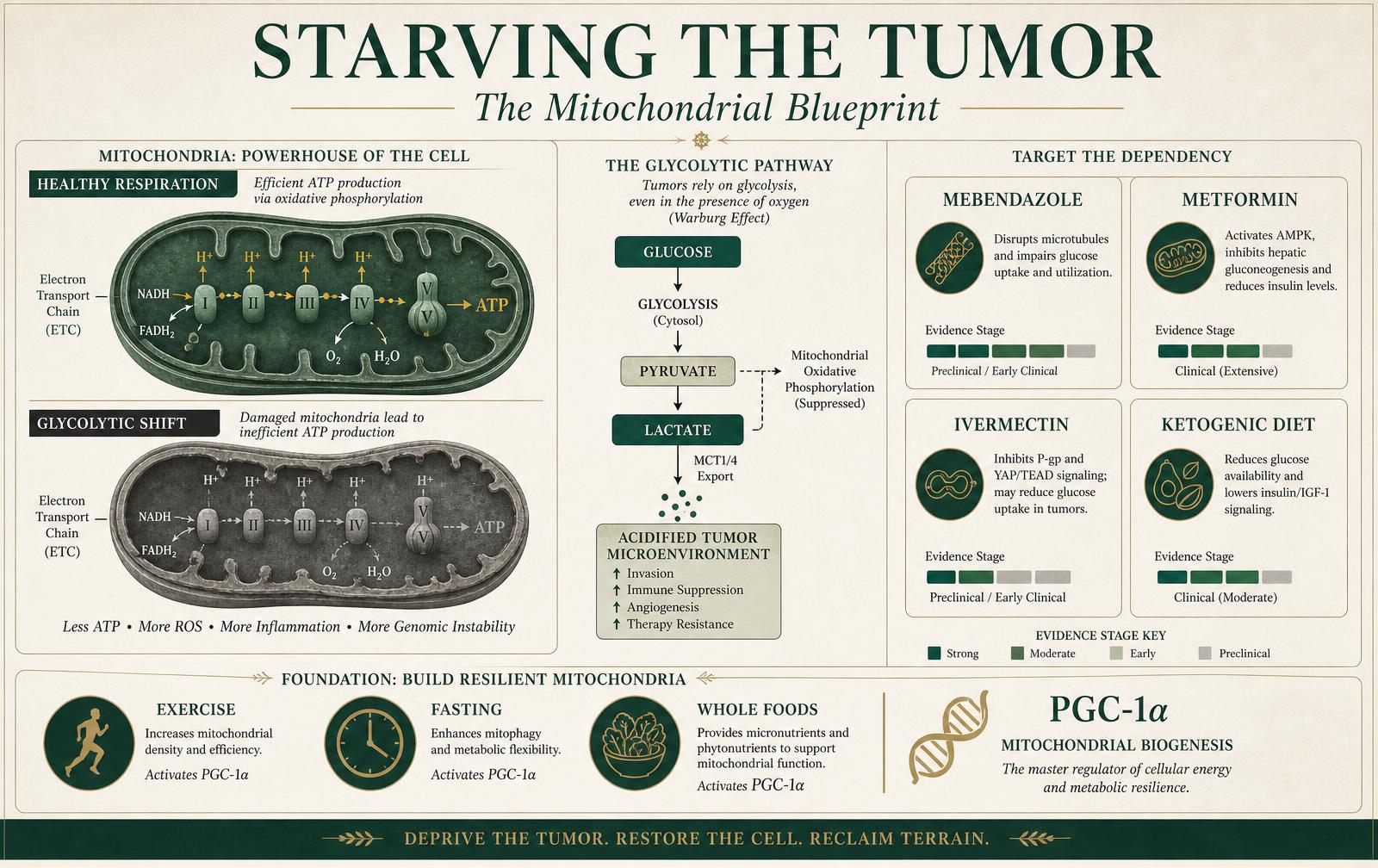
When mitochondrial respiration is impaired, cells default to aerobic glycolysis — fermenting glucose for energy even when oxygen is available. This is the Warburg effect, first described a century ago. Current reviews confirm the switch is not a side effect but an active survival strategy.
Four consequences follow. Fermentation blunts apoptosis, the programmed cell-death pathway. It floods the tumor microenvironment with lactate, acidifying surrounding tissue. That acidity degrades the extracellular matrix and enables invasion. And it suppresses local immune surveillance.
Hexokinase, pyruvate kinase M2 (PKM2), and the glucose transporters are now treated as central drivers of this reprogramming and are being pursued as drug targets. A "reverse Warburg effect" has also been described, in which tumors scavenge lactate from surrounding stromal cells as an alternative fuel. Colorectal-cancer-specific reviews echo the same list — hexokinase, phosphofructokinase, lactate dehydrogenase — and note that combined modulation of AMPK/mTOR signalling shows preclinical promise against chemoresistance.
Lifestyle drivers of mitochondrial biogenesis
Independent of any pharmacological intervention, exercise remains one of the most robust natural stimuli for mitochondrial renewal. Endurance exercise activates PGC-1alpha, the master transcriptional regulator of mitochondrial biogenesis, coordinately raising expression of both nuclear- and mitochondrial-DNA-encoded mitochondrial genes and strengthening crosstalk between the two genomes.
That pathway is the mechanistic basis for the terrain argument: regular physical activity, combined with intermittent fasting and nutrient-dense whole foods, supports the respiratory capacity a cell needs to resist the glycolytic shift associated with malignancy.
The Deep Dive
Mebendazole and the mitotic catastrophe angle
Mebendazole (MBZ), a decades-old deworming drug, continues to gain traction as a repurposed anticancer agent through microtubule disruption that triggers mitotic arrest and apoptosis.
A 2025 study using patient-derived tumor cells and a mouse colon cancer model found MBZ alone had modest cytotoxicity but synergized with irinotecan — and, importantly, promoted macrophage polarization from a tumor-supportive M2 state toward an inflammatory, tumor-fighting M1 state. That points to immune modulation beyond direct cell killing.
Tier II · Members only · Free
Continue into the deep dive
Tier I is free and always open. Tier II — the full mechanisms, dosing detail, nuance, and citations — unlocks with a free Vital Codex membership.
- Every Tier II deep dive across all hubs
- Saved reading progress across articles
- Member knowledge modules and their quizzes
- The Dispatch, if you opt in
Frequently asked
Does the metabolic model mean mutations don't matter?
No. It reorders them. The model holds that impaired respiration is upstream and that mutation accumulates as the energy system fails, supported by nuclear-cytoplasmic transfer experiments where the cytoplasm determined the outcome. Mutations still shape how a given tumor behaves and responds to targeted drugs.
Is a ketogenic diet a cancer treatment?
Not on current evidence. Trials show reliable improvements in glucose, triglycerides, body composition, and quality of life, and the glioblastoma data are genuinely encouraging, but survival evidence is mixed and mostly from small non-randomized studies. It is being tested as an adjunct to standard care, not a replacement for it.
Why mebendazole rather than fenbendazole?
Two reasons: mebendazole has a substantially larger human safety record, and it crosses the blood-brain barrier, which matters for central nervous system tumors. Neither drug is an approved cancer therapy.
What does the evidence actually support today?
Supportive metabolic care — glycaemic control, preserved lean mass, exercise, sleep, and treatment tolerance — has the most consistent data behind it. Repurposed drugs sit at Phase I–III depending on the agent, with metformin furthest along in colorectal cancer.
What single input matters most outside the clinic?
Mitochondrial capacity, and exercise is the strongest lever on it. Endurance training activates PGC-1alpha and raises expression of both nuclear- and mitochondrial-encoded mitochondrial genes, which is the biological basis of the terrain argument.
Continue exploring: Continue with the mitochondrial hub for the underlying bioenergetics.
Explore Mitochondria