Lithium has been filed under psychiatry for seventy years, at doses hundreds of times higher than the amount the body naturally carries. A different question is now open: whether lithium is a native trace element of the brain, quietly maintaining synapses, myelin, and protein clearance — and whether losing it is an early feature of cognitive aging.
A 2025 Nature study reported that endogenous lithium is dynamically regulated in the brain, is significantly lower in mild cognitive impairment and Alzheimer's disease, and that low-dose lithium orotate prevented pathology and memory loss in mice. That is a serious finding. It is also a mouse finding. This article separates the mechanism, the evidence, and the caution.
Microdose lithium is promising, biologically plausible, and not yet clinically settled.
Contents(15 sections)
Key takeaways
Lithium occurs naturally in soil, food, and drinking water, and is present in human tissue at trace levels; its normal biological role is only now being mapped.
A 2025 Nature study found lithium was the only metal significantly reduced at the mild-cognitive-impairment stage in human brain tissue, and that amyloid-beta can bind and sequester it.
The most discussed mechanism is inhibition of GSK-3β, the enzyme linked to tau hyperphosphorylation, inflammation, and neuronal survival signaling.
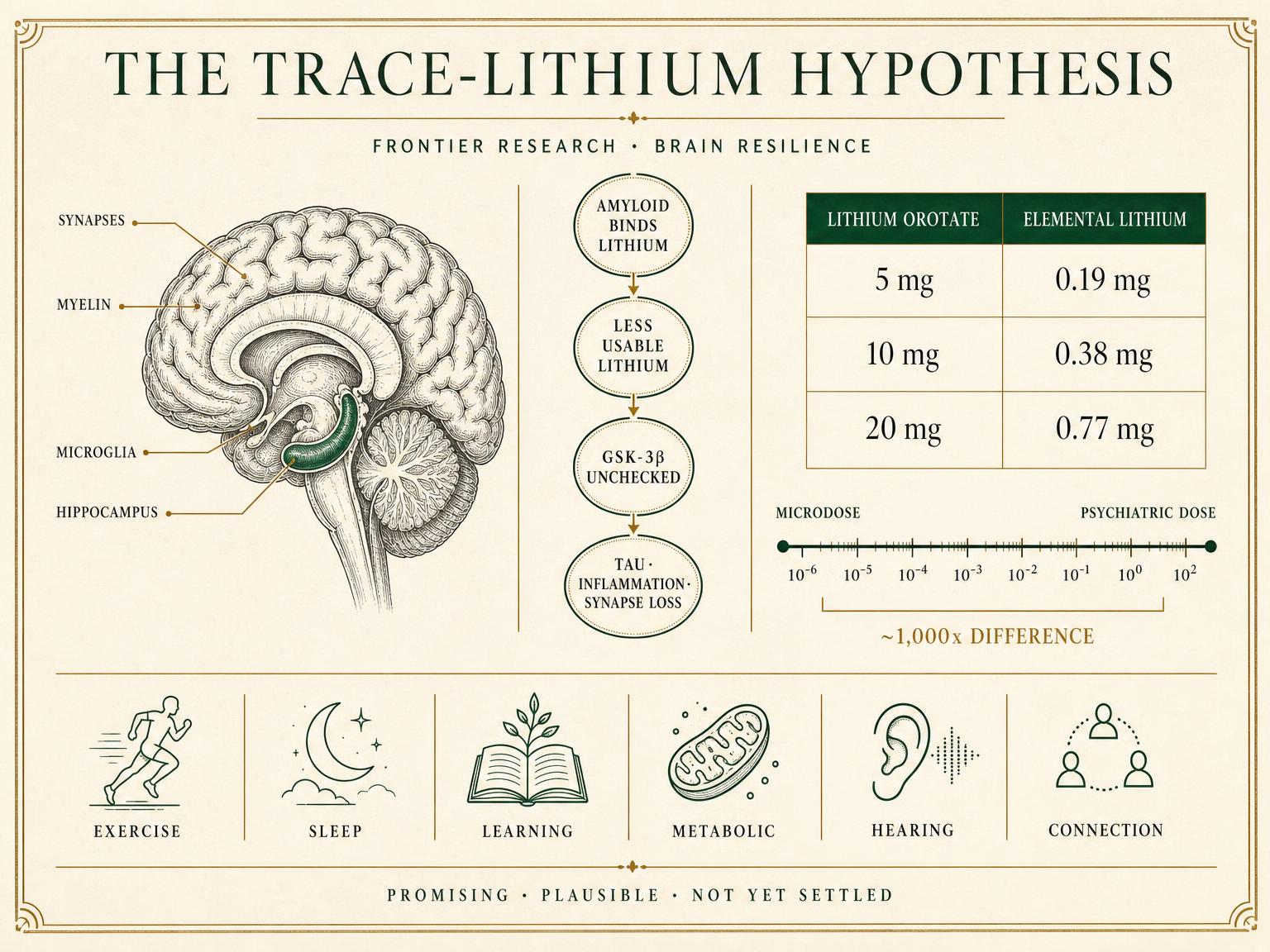
Lithium orotate is roughly 3.83% elemental lithium — a 10 mg label equals about 0.38 mg of elemental lithium, hundreds of times below psychiatric exposure.
Population studies link higher drinking-water lithium to lower suicide mortality, but ecological data cannot establish individual causation.
There is no established microdose, no RDA, no cycling schedule, and no human outcome trial showing preserved memory in healthy older adults.
Lithium is renally cleared and biologically active even at low amounts; kidney function, thyroid history, hydration, sodium intake, and drug interactions all matter.
The proven brain-health stack — exercise, sleep, learning, metabolic and vascular control, hearing correction, social connection — remains the foundation, not the microdose.
The Primer
The new view: lithium as a native brain element
Lithium is in the ground, in food, and in water. Everyone carries a small amount. Until recently nobody knew whether that trace amount was doing anything useful.
In 2025, researchers measured metals in human brain tissue and found that lithium was noticeably lower in people with early memory impairment and with Alzheimer's disease. Among all the metals studied, lithium was the only one already reduced at the earliest stage — the window in which intervention would matter most.
They also found a possible reason. As amyloid-beta clumps into plaques, it appears to bind lithium and lock it away. Less usable lithium may weaken protective cellular systems, which can feed a self-reinforcing cycle: more plaque, more tau change, more inflammation, lost synapses, thinning myelin, declining memory.
This does not mean Alzheimer's is a lithium deficiency. It suggests that disrupted lithium handling may be an early biological feature of brain aging worth studying seriously.
Why "microdosing" is a different question
Psychiatric lithium aims at a blood level. Microdose research aims at something else entirely: supporting normal cellular pathways at exposures near what the body already handles from diet and water.
The clearest molecular target is an enzyme called GSK-3β. It sits at the center of inflammation, cellular stress, neuronal survival, circadian signaling, and the phosphorylation of tau protein. When it runs too hot, it is implicated in neurodegenerative and mood pathways. Lithium inhibits it directly, competing with magnesium at the enzyme's active site.
In experimental models, low concentrations of lithium have been shown to:
- Reduce GSK-3β activity and tau hyperphosphorylation
- Support BDNF, CREB, and related neurotrophic signaling
- Improve synaptic resilience and neuronal survival
- Reduce inflammatory signaling and oxidative stress
- Improve mitochondrial function and cellular energy handling
- Promote autophagy, the recycling process that clears damaged proteins
- Support myelin and white-matter integrity
That list is why lithium keeps appearing in research on Alzheimer's disease, mild cognitive impairment, traumatic brain injury, stroke recovery, neuroinflammation, and ordinary brain aging.
Reading a lithium orotate label
Lithium orotate is the form most discussed in low-dose circles. The label needs translating, because it usually names the weight of the whole compound, not the lithium in it. Lithium orotate is about 3.83% elemental lithium.
| Lithium-orotate label amount | Approximate elemental lithium |
|---|---|
| 5 mg lithium orotate | ~0.19 mg elemental lithium |
| 10 mg lithium orotate | ~0.38 mg elemental lithium |
| 20 mg lithium orotate | ~0.77 mg elemental lithium |
Low-dose discussions typically involve 5–20 mg/day of the compound — roughly 0.2–0.8 mg/day of elemental lithium, far below psychiatric exposure. "Low," however, is not the same as "proven." There is no accepted clinical brain-health dose and no official recommended intake.
What still matters more
Even in the most optimistic reading, a microdose would be an addition to a strategy, not the strategy:
- Exercise. Aerobic and resistance training support vascular health, insulin sensitivity, mood, and BDNF-related plasticity.
- Deliberate learning. New skills, music, unfamiliar navigation, and making things challenge neural networks directly.
- Sleep protection. Memory consolidation and glymphatic clearance depend on it; apnea, insomnia, and sedating medications deserve attention.
- Metabolic and vascular control. Blood pressure, glucose, lipids, smoking, alcohol, and inactivity are the major drivers of avoidable decline.
- Hearing and vision correction. Sensory deprivation raises cognitive load and isolation — an underrated intervention.
- Social connection. Contact and purpose stimulate cognition and reduce depression.
- Anti-inflammatory fundamentals. Minimally processed, nutrient-dense food, adequate protein, healthy body composition, regular movement.
The Deep Dive
Neuroplasticity: the strongest conceptual link
Neuroplasticity is the brain's capacity to adapt — strengthening useful synapses, pruning inefficient ones, building new connections, reshaping network function, and in select regions generating new cells. For older adults this is not a luxury; it is the substrate of cognitive reserve, the ability to preserve function despite vascular stress, inflammation, injury, or early neurodegeneration.
Lithium's experimental effects map closely onto that machinery:
Tier II · Members only · Free
Continue into the deep dive
Tier I is free and always open. Tier II — the full mechanisms, dosing detail, nuance, and citations — unlocks with a free Vital Codex membership.
- Every Tier II deep dive across all hubs
- Saved reading progress across articles
- Member knowledge modules and their quizzes
- The Dispatch, if you opt in
Frequently asked
Is lithium orotate the same as prescription lithium?
No. Prescription lithium carbonate is dosed to reach a therapeutic blood level for psychiatric conditions, typically hundreds of milligrams of elemental lithium daily. Lithium orotate supplements deliver roughly 0.2–0.8 mg of elemental lithium per day — a fundamentally different exposure with a fundamentally different intent.
How much elemental lithium is in a 10 mg lithium orotate capsule?
About 0.38 mg. Lithium orotate is approximately 3.83% elemental lithium by weight, and supplement labels usually state the weight of the whole compound rather than the lithium content.
Does low-dose lithium prevent Alzheimer's disease?
Not on current evidence. The 2025 Nature work showed that reducing brain lithium in mice accelerated Alzheimer-like pathology and that low-dose lithium orotate prevented it in those models. No human trial has shown that supplementation prevents or slows Alzheimer's disease in people.
Who should avoid lithium supplements?
Anyone with reduced kidney function, thyroid or parathyroid disease, unstable hydration or sodium intake, or who takes diuretics, ACE inhibitors, ARBs, NSAIDs, or psychiatric medication should not use a lithium supplement without clinician supervision. Lithium is cleared by the kidneys, so anything affecting fluid balance affects lithium levels.
What does lithium actually do at the cellular level?
Its most studied action is inhibiting GSK-3β, an enzyme involved in tau phosphorylation, inflammation, circadian signaling, and neuronal survival. It also supports BDNF-related neurotrophic signaling, stimulates autophagy, and appears to influence mitochondrial function and myelin integrity.
Is drinking-water lithium a reliable brain-health signal?
It is suggestive, not conclusive. Meta-analyses associate higher water lithium with lower population suicide rates, but ecological studies cannot separate lithium from the many other ways regions differ, and at least one large individual-level study found no effect at low concentrations.
Continue exploring: Cognition — Neurogenesis, synaptic plasticity, and focus architecture.
Explore Cognition