Dopamine does not produce pleasure. It produces wanting — the drive to pursue, initiate, and persist. Pleasure is largely an opioid and endocannabinoid function, which is why it is possible to compulsively want something you no longer enjoy.
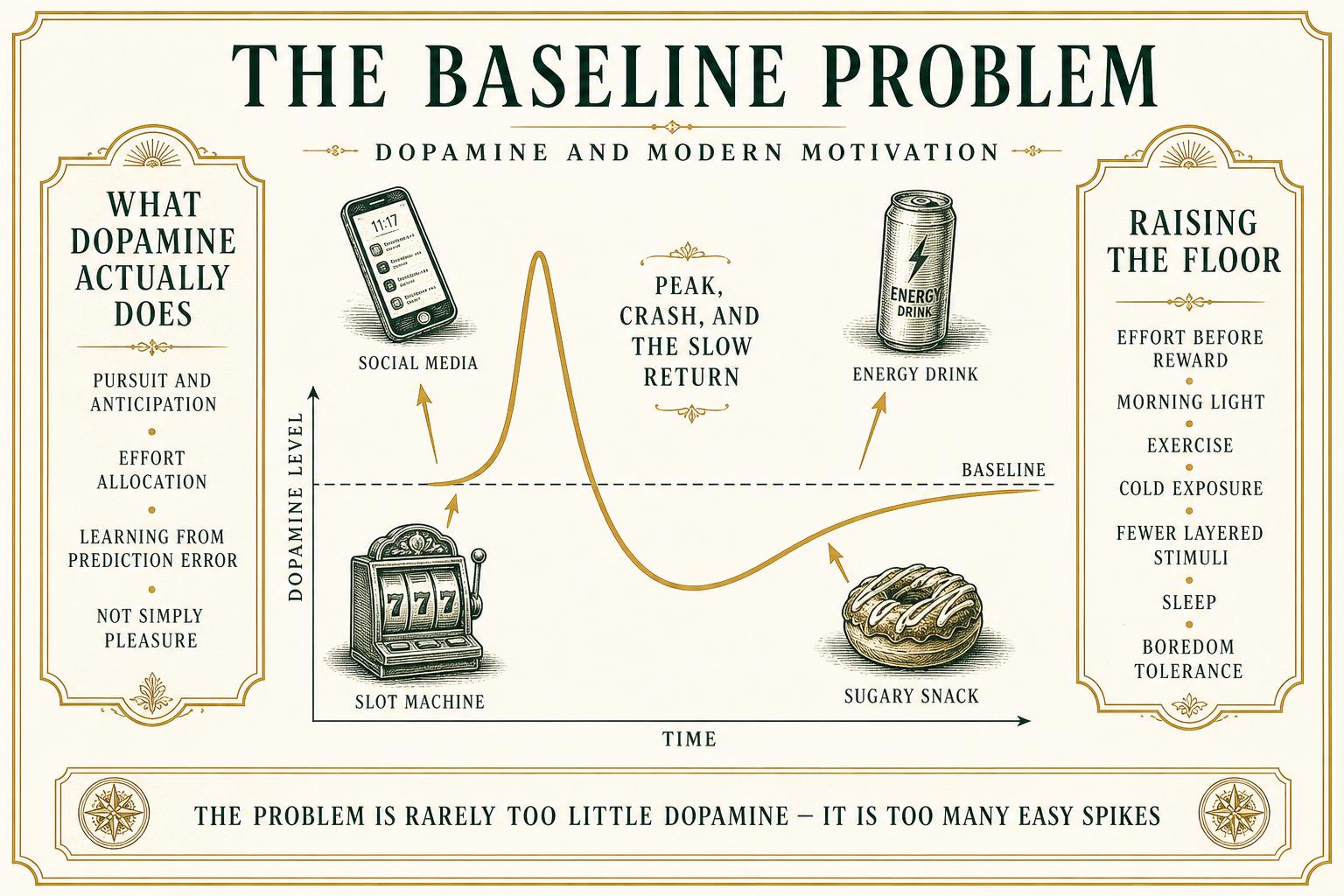
That distinction explains most of what feels wrong about motivation in a high-stimulus environment. Frequent, effortless, unpredictable rewards keep the pursuit system firing without requiring effort, and effortful goals begin to feel disproportionately expensive by comparison.
Contents(13 sections)
Key takeaways
Dopamine signals incentive salience — wanting and pursuit — not pleasure or satisfaction.
Reward prediction error is the core computation: dopamine fires to outcomes better than expected, not to expected ones.
Variable, unpredictable reward schedules produce the strongest and most persistent dopaminergic drive, which is why feeds and games are built on them.
Frequent high-magnitude stimulation shifts what counts as baseline, making ordinary effort feel less worthwhile.
Effort tolerance is trainable: sleep, exercise, morning light, protein, and deliberate friction on easy rewards are the levers with actual evidence.
The Primer
What dopamine really does
Dopamine's best-documented function is signaling reward prediction error. Neurons in the ventral tegmental area fire when an outcome is better than expected, stay quiet when it matches expectation, and dip below baseline when it is worse. That signal updates what you will pursue next time. It is a teaching signal for behavior, not a reward in itself.
The practical consequence: anticipation, not the reward, carries most of the dopaminergic weight. Refreshing the feed is more dopaminergic than what you find in it.
Why modern stimuli hit differently
Three properties make an activity dopaminergically potent: low effort to obtain, high magnitude, and unpredictable timing. Slot machines have all three. So do social feeds, short-form video, food engineered for maximum palatability, pornography, and shopping notifications. Traditional sources of satisfaction — a hard conversation, a training session, deep work — score badly on all three.
The baseline problem
Repeated high-magnitude stimulation prompts the system to compensate: reduced receptor availability and reduced tonic dopamine tone. The result is not dramatic damage but a shifted reference point. Ordinary activities that used to feel adequate now feel flat, and starting anything effortful feels harder than it should.
What restores it
Sleep first — reward sensitivity is measurably blunted after restriction. Then morning outdoor light and consistent wake time to anchor circadian dopamine signaling. Then movement, which raises tonic dopamine and improves effort tolerance. Then deliberate friction: phone out of the bedroom, notifications off, no stimulation during genuinely dull tasks. The goal is not abstinence but reintroducing the effort-to-reward gap the system evolved to work with.
The Deep Dive
The mechanistic picture
Two dopaminergic pathways matter here. The mesolimbic pathway (VTA to nucleus accumbens) governs incentive salience and effort allocation; the mesocortical pathway (VTA to prefrontal cortex) governs working memory and sustained attention. Phasic burst firing encodes prediction error, while tonic background firing sets the ambient willingness to expend effort. High-magnitude repeated stimulation primarily degrades the tonic signal and D2 receptor availability, which is why the phenomenology is low drive rather than anhedonia.
Salamone's effort-based decision-making work is more explanatory here than the older "pleasure center" model: accumbens dopamine depletion in rodents leaves the animal still able to enjoy reward but unwilling to work for it. That is a precise description of the complaint most people actually report.
Tier II · Members only · Free
Continue into the deep dive
Tier I is free and always open. Tier II — the full mechanisms, dosing detail, nuance, and citations — unlocks with a free Vital Codex membership.
- Every Tier II deep dive across all hubs
- Saved reading progress across articles
- Member knowledge modules and their quizzes
- The Dispatch, if you opt in
Frequently asked
Is dopamine the pleasure chemical?
No. Dopamine drives wanting, pursuit, and effort allocation. Pleasure is mediated largely by opioid and endocannabinoid signaling, which is why compulsive wanting can persist after enjoyment has faded.
Does a dopamine detox work?
Not as described neurochemically, but the underlying practice — periods away from high-magnitude, low-effort stimulation — does reliably restore interest in ordinary activities. The mechanism is contrast and effort valuation, not receptor depletion.
How long does it take for motivation to recover?
Most people notice a shift within one to two weeks of consistently reduced stimulation, better sleep, and daily movement. Deeply entrenched patterns take longer and benefit from environmental change rather than intention alone.
Do supplements help?
Marginally, and only where there is a deficit. Tyrosine can help under acute stress or sleep deprivation; correcting iron, B6, and vitamin D deficiency supports synthesis. None substitutes for sleep, light, and movement.
Continue exploring: Cognition — Neurogenesis, synaptic plasticity, and focus architecture.
Explore Cognition