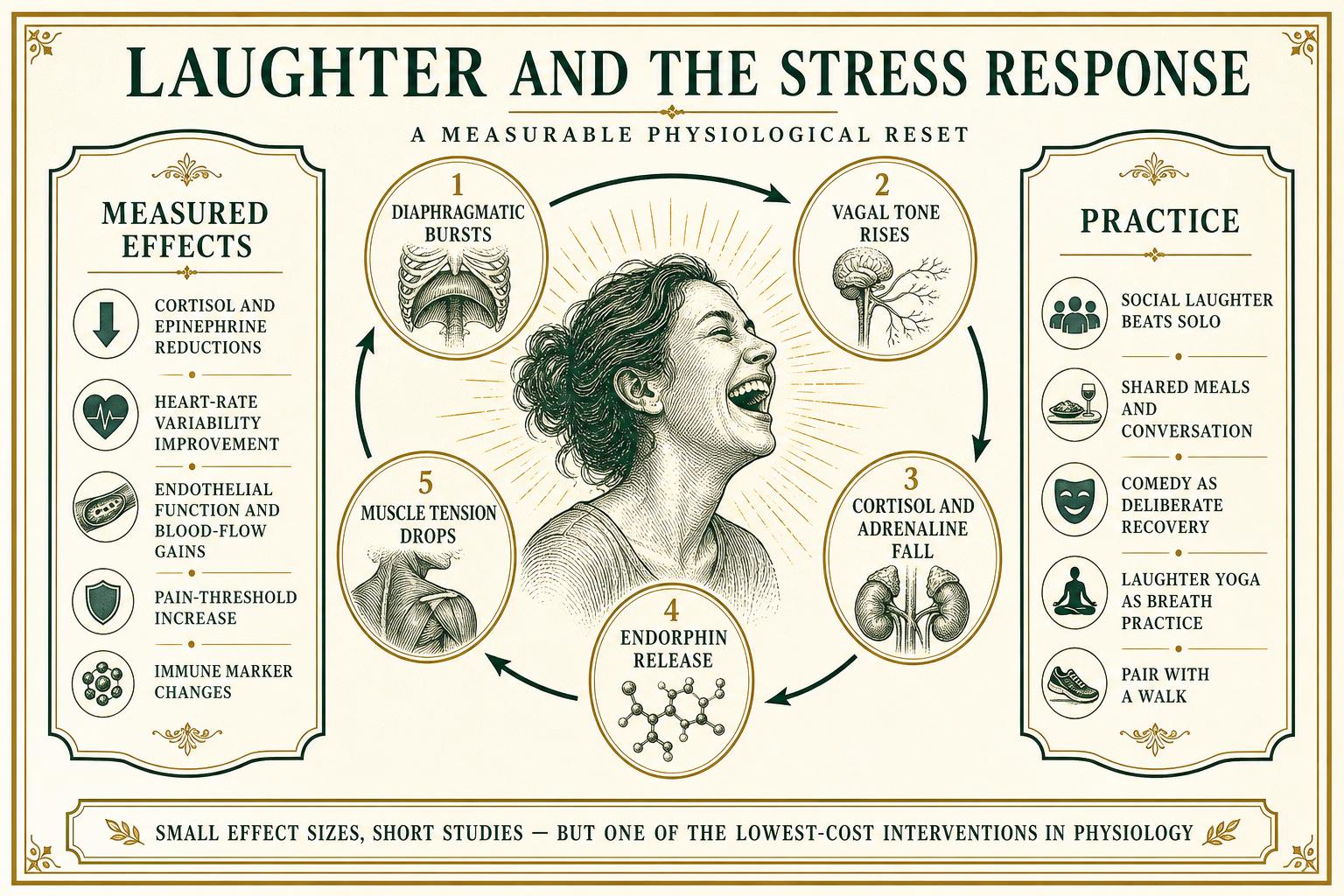
Laughter produces a coordinated physiological response: a brief cardiovascular and respiratory surge, followed by muscular relaxation, reduced circulating cortisol, endogenous opioid release, and improved endothelial function. These are measurable changes, not metaphors.
The research field has a name — gelotology, established at Stanford by William F. Fry in the 1960s — and its most useful finding is not that laughter feels good, but that humor operates as a form of cognitive reappraisal, changing what the brain does with a threat rather than changing the threat.
Contents(12 sections)
Key takeaways
Laughter reduces cortisol and epinephrine; in older adults, even anticipating a humorous event lowered cortisol before it occurred (Berk et al.).
Neuroimaging locates humor appreciation in mesolimbic reward circuitry, with endogenous opioid release measurable in social laughter (Manninen et al., J Neurosci, 2017).
Twenty minutes of laughter improved brachial artery flow-mediated dilation in a crossover trial, while a stressful film impaired it (Miller et al., 2005).
Simulated laughter appears to trigger part of the same cascade, which is the mechanistic basis of laughter yoga protocols.
Self-enhancing and affiliative humor styles track with resilience; self-defeating and aggressive styles do not.
The Primer
What happens in the body during a real laugh
A genuine belly laugh is a short burst of physical work. Heart rate and respiratory rate rise, the diaphragm and abdominal muscles contract rhythmically, and then the whole system drops into a relaxation phase — muscle tone falls, blood pressure declines below its pre-laughter baseline, and subjective tension eases. The shape of the curve resembles a brief exercise bout followed by a cool-down.
Chemically, the reward system releases endorphins, which act as both analgesics and mood elevators. Dopamine and serotonin signaling contribute the motivational and settled-mood components. Cortisol, the principal glucocorticoid of chronic stress, declines.
Why humor changes the stress appraisal
Stress physiology begins with an appraisal: how threatening is this, and do I have the resources to handle it? When the second answer feels like no, the hypothalamic-pituitary-adrenal axis activates.
Humor intervenes at the appraisal step. Reframing a chaotic presentation as a comedy of errors or an obstructive form as bureaucratic performance art does not alter the facts; it alters the assigned threat magnitude. This is cognitive reappraisal, one of the better-validated emotion regulation strategies in psychology, arriving in a package most people will actually use.
The practical version
Humor works best as an ordinary habit rather than a technique. Protect a daily source of it. Notice absurdity in situations you cannot control. Choose humor that includes people rather than targets them — the style matters more than the volume.
The Deep Dive
The endocrine and immune data
Berk and colleagues' work on mirthful laughter reported reductions in cortisol, epinephrine, dihydrophenylacetic acid, and growth hormone during laughter exposure, alongside increases in natural killer cell activity, immunoglobulins, and interferon-gamma signaling. A later study in the same program found that older adults anticipating a humorous event showed cortisol declines before viewing began, implicating expectation itself.
These are small studies with modest samples, and the immune endpoints are surrogate markers rather than clinical outcomes. The direction of effect has nonetheless been reproduced often enough across laboratories to be credible.
Tier II · Members only · Free
Continue into the deep dive
Tier I is free and always open. Tier II — the full mechanisms, dosing detail, nuance, and citations — unlocks with a free Vital Codex membership.
- Every Tier II deep dive across all hubs
- Saved reading progress across articles
- Member knowledge modules and their quizzes
- The Dispatch, if you opt in
Frequently asked
Does forced laughter have real effects?
Partially. Voluntary laughter appears to reproduce some autonomic and mood effects, though likely less strongly than spontaneous laughter, since reward-circuit engagement contributes to the full response.
How much laughter is required?
Studies showing vascular and endocrine effects used roughly 15–20 minutes of genuinely funny material. There is no established dose; frequency across the week is more plausible than a single long session.
Can humor be harmful during grief or acute crisis?
Humor used to avoid processing loss is different from humor that provides temporary relief within it. The distinction between self-enhancing and self-defeating styles is the practical guide.
Is any of this a substitute for treatment?
No. Laughter modifies stress physiology; it does not treat depression, anxiety disorders, or cardiovascular disease. It belongs alongside sleep, exercise, and social connection as part of the baseline.
Continue exploring: Cognition — Neurogenesis, synaptic plasticity, and focus architecture.
Explore Cognition