Most protein arguments are about arithmetic: grams per kilogram, servings per meal, whether the target is 0.8 or 1.6. The frontier research asks a different question entirely. It treats protein not as building material but as a signal — an instruction that tells cells whether to grow or to repair.
That reframing changes what counts as an interesting variable. If total protein is a dial on a growth pathway, then the pathway itself becomes the target, and the newest work is asking whether a single amino acid can move it as effectively as cutting protein across the board.
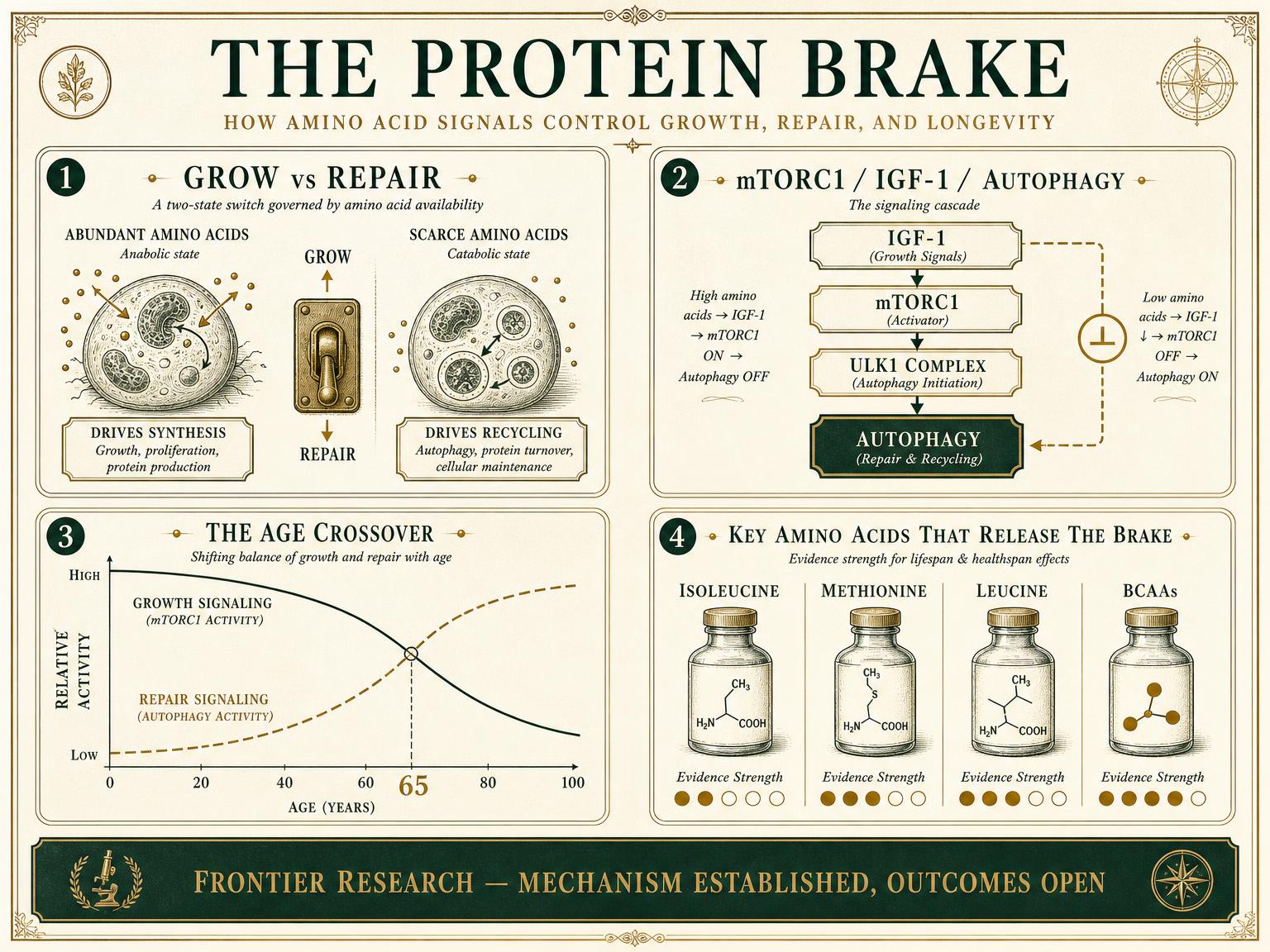
Protein is not just building material. It is an instruction telling the cell to grow rather than repair.
Contents(14 sections)
Key takeaways
Dietary protein activates two growth pathways — mTORC1 and the growth hormone/IGF-1 axis — that also suppress autophagy, the cell's recycling and cleanup machinery.
A widely cited analysis of US survey data found that adults aged 50 to 65 with high protein intake had substantially higher all-cause and cancer mortality over the following 18 years, and that the association weakened or disappeared when the protein came from plants.
The same analysis found the direction reversed after age 65, where higher protein tracked with lower mortality. This age crossover is the single most important nuance in the field.
The frontier has moved from total protein to specific amino acids: the branched-chain amino acid isoleucine, plus methionine, appear to carry a disproportionate share of the signaling effect in animal models.
A 2026 review in the Cell Press family maps this amino-acid-specific work and states plainly that laboratory promise is not yet ready to guide dietary advice.
FGF21, a metabolic hormone, is emerging as a mediator: a 2025 human trial showed protein restriction raised FGF21 and increased the calories needed to hold body weight steady.
Late-life animal work is mixed rather than uniformly positive — isoleucine restriction started in old mice improved several aging markers but reduced grip strength.
Nothing here supports older adults cutting protein. If anything, the observational and clinical literature points the opposite way after 65.
The Primer
Protein as an instruction, not just a brick
Every cell runs a rough triage. When nutrients are abundant, it builds: proteins, membranes, new tissue. When nutrients are scarce, it switches to maintenance: breaking down damaged components, recycling parts, repairing what already exists.
Amino acids are one of the loudest inputs to that decision. Their presence is read as a signal that construction is affordable. The consequence is not controversial — abundant amino acids push cells toward growth and away from cleanup. What is genuinely contested is whether that daily nudge, repeated across decades, meaningfully shapes how a person ages.
| Signal state | What the cell prioritizes | Pathway activity |
|---|---|---|
| Amino acids abundant | Protein synthesis, tissue building, cell growth | mTORC1 high, IGF-1 high, autophagy suppressed |
| Amino acids scarce | Recycling damaged components, stress resistance, repair | mTORC1 low, autophagy active, FGF21 rising |
Neither state is "good." Growth is how you repair a torn muscle and how a child develops. Repair is how you clear damaged proteins before they accumulate. The frontier hypothesis is about balance over time — that a diet keeping growth signaling permanently elevated may deny cells the repair windows they evolved to use.
The two pathways worth knowing by name
mTORC1 is a nutrient sensor. It responds to amino acids, insulin, and energy status, and when active it drives protein synthesis and blocks autophagy. Leucine is its most direct amino-acid activator. This is precisely why leucine is marketed for muscle building — and precisely why the same activation is scrutinized in longevity research.
The GH/IGF-1 axis is the systemic version. Dietary protein raises circulating IGF-1, a growth factor that promotes cell division and suppresses cell death. Humans and animals with genetically reduced IGF-1 signaling show unusually low rates of several age-related diseases, which is what made protein intake worth investigating in the first place.
Autophagy is the third piece, and it is the reason fasting and protein intake intersect. Because amino acids suppress autophagy through mTORC1, protein timing matters to anyone interested in cellular cleanup — a point covered in more depth in the autophagy and fasting windows entry.
The age crossover
This is the finding that most summaries get wrong in one direction or the other.
An analysis of US national survey data followed adults for 18 years and split them by age. Among respondents aged 50 to 65, high protein intake was associated with roughly a 75 percent increase in all-cause mortality and a several-fold increase in cancer mortality. Among respondents over 65, the association inverted: higher protein tracked with lower cancer and overall mortality. Elevated diabetes mortality was seen across all ages.
Two qualifications matter enormously:
- Source changed the signal. The middle-age associations were attenuated or abolished when the protein was plant-derived, which means "protein" may be standing in for the whole dietary pattern.
- It is observational. People who eat more animal protein differ in many other ways. Association is not causation, and a single cohort analysis does not establish a dose–response rule.
The crossover has a plausible mechanism. In middle age, the limiting risk is accumulated damage and cancer promotion, where growth signaling is a liability. In advanced age, the limiting risk is losing muscle and functional capacity, where anabolic signaling is protective and older adults absorb and use protein less efficiently. Different problem, opposite answer. Our muscle optimization after 60 entry covers the older-adult side of this in practical detail.
What this does not license
Frontier research is easy to misread as instruction. Three limits are worth stating outright:
- No evidence supports older adults reducing protein for longevity. The literature points the other way.
- No human trial has shown that lowering protein or a single amino acid extends human lifespan. The lifespan data are from mice and other model organisms.
- Restriction and undernutrition are different things. Every one of these experiments holds calories and micronutrients adequate; involuntary low intake in an older or ill person is a clinical problem, not a longevity strategy.
The Deep Dive
The pivot: from total protein to single amino acids
The most active frontier is the recognition that "protein restriction" is a blunt instrument. If the effects run through specific signals, then specific amino acids should reproduce them — without the muscle and satiety costs of cutting protein wholesale.
| Target | Signaling rationale | State of evidence |
|---|---|---|
| Isoleucine | Branched-chain amino acid; restriction improves insulin sensitivity and metabolic health in rodents largely independent of calorie reduction | Strongest rodent case; human trials early, some registered studies withdrawn or unreported |
| Methionine | Sulfur amino acid; restriction extends lifespan across multiple model organisms and alters one-carbon metabolism | Robust in animals; human work limited to short metabolic studies |
| Leucine | Most direct mTORC1 activator | Mechanistically central, but restriction risks the anabolic response needed for muscle |
| Total BCAAs | Combined signaling load; tracks with insulin resistance in human metabolomics | Short human crossover trials show reduced meal-induced insulin secretion and microbiome shifts |
Tier II · Members only · Free
Continue into the deep dive
Tier I is free and always open. Tier II — the full mechanisms, dosing detail, nuance, and citations — unlocks with a free Vital Codex membership.
- Every Tier II deep dive across all hubs
- Saved reading progress across articles
- Member knowledge modules and their quizzes
- The Dispatch, if you opt in
Frequently asked
Does eating protein shorten your life?
No human study has shown that. One widely cited analysis of US survey data found higher all-cause and cancer mortality among 50-to-65-year-olds with high protein intake, weakened when the protein was plant-derived, and the direction reversed after age 65. That is an observational association in one cohort, not a demonstrated causal effect.
What is mTOR, and why does protein activate it?
mTORC1 is a cellular nutrient sensor. When amino acids — leucine most directly — insulin, and energy are abundant, it drives protein synthesis and suppresses autophagy. That is useful for building muscle and less useful if the goal is cellular cleanup, which is why the same pathway appears in both fitness and longevity research.
Why is isoleucine specifically being studied?
In rodents, restricting isoleucine alone reproduces much of the metabolic benefit of restricting all protein — improved insulin sensitivity and reduced adiposity — without reducing food intake. The hope is a targeted intervention rather than an across-the-board protein cut. Human trials remain early.
Should older adults eat less protein?
The evidence points the other way. Above roughly 65, higher protein intake is associated with lower mortality, older adults use dietary protein less efficiently, and preserving muscle becomes the dominant risk consideration. Late-life animal work on isoleucine restriction also showed reduced grip strength alongside its benefits.
Is protein restriction just calorie restriction under another name?
Apparently not. In a 2025 trial in lean men, five weeks of minimum-requirement protein intake increased the calories needed to maintain body weight, alongside a rise in FGF21. Protein restriction therefore has metabolic effects that are not explained by eating less energy.
Does plant protein signal differently than animal protein?
Its amino-acid proportions differ — generally lower methionine and a different branched-chain profile — and human cohort associations with mortality are consistently weaker for plant protein. Whether that reflects amino-acid signaling, the accompanying fiber and phytochemicals, or the broader dietary pattern is unresolved.
Is any of this ready to act on?
The mechanisms are ready to understand; the protocols are not ready to follow. A 2026 review of this literature stated directly that the laboratory promise does not yet support dietary advice. The defensible moves are meeting protein requirements without maximizing, shifting some protein toward plants, and maintaining adequate protein plus resistance training after 65.
Research Notes & Sources(expand)
Sources are grouped by claim category. Frontier findings are labeled as animal, short-term human, or observational so readers can weight them appropriately.
- Age-dependent mortality association — Levine et al., "Low protein intake is associated with a major reduction in IGF-1, cancer, and overall mortality in the 65 and younger but not older population," Cell Metabolism, 2014. Observational cohort analysis with supporting mouse tumor experiments; establishes the age crossover and the plant-protein attenuation.
- Amino-acid-specific restriction review — "The hallmarks of protein and amino acid restriction in aging and longevity," Cell Press, 2026. Maps mechanism across amino acids and explicitly states the evidence does not yet support dietary recommendations.
- Late-life restriction, mixed outcomes — Green et al., late-life protein or isoleucine restriction in 20-month-old mice, 2024. Improved metabolic health and slowed molecular aging indicators; isoleucine restriction reduced grip strength with sexually dimorphic cardiac effects.
- FGF21 and energy requirements in humans — "Dietary protein restriction elevates FGF21 levels and energy requirements to maintain body weight in lean men," Nature Metabolism, 2025. Five-week eucaloric design; the strongest human mechanistic data in this set.
- BCAA reduction, short human trial — randomized crossover trial of short-term branched-chain amino acid reduction in type 2 diabetes, reporting reduced meal-induced insulin secretion and microbiome changes. Short duration, small sample.
- BCAA metabolism background — "The role of BCAA metabolism in metabolic health and disease," Experimental & Molecular Medicine, 2024. Review context for why branched-chain amino acids track with insulin resistance.
- Clinical translation status — registered isoleucine-repletion controlled-diet studies in prediabetes and obesity, including protocols posted in 2026 with withdrawn or pending status. Illustrates how early human translation still is.
Continue exploring: The Vital Codex library on nutrition, cellular signaling, and frontier longevity research.
Explore Nutrition