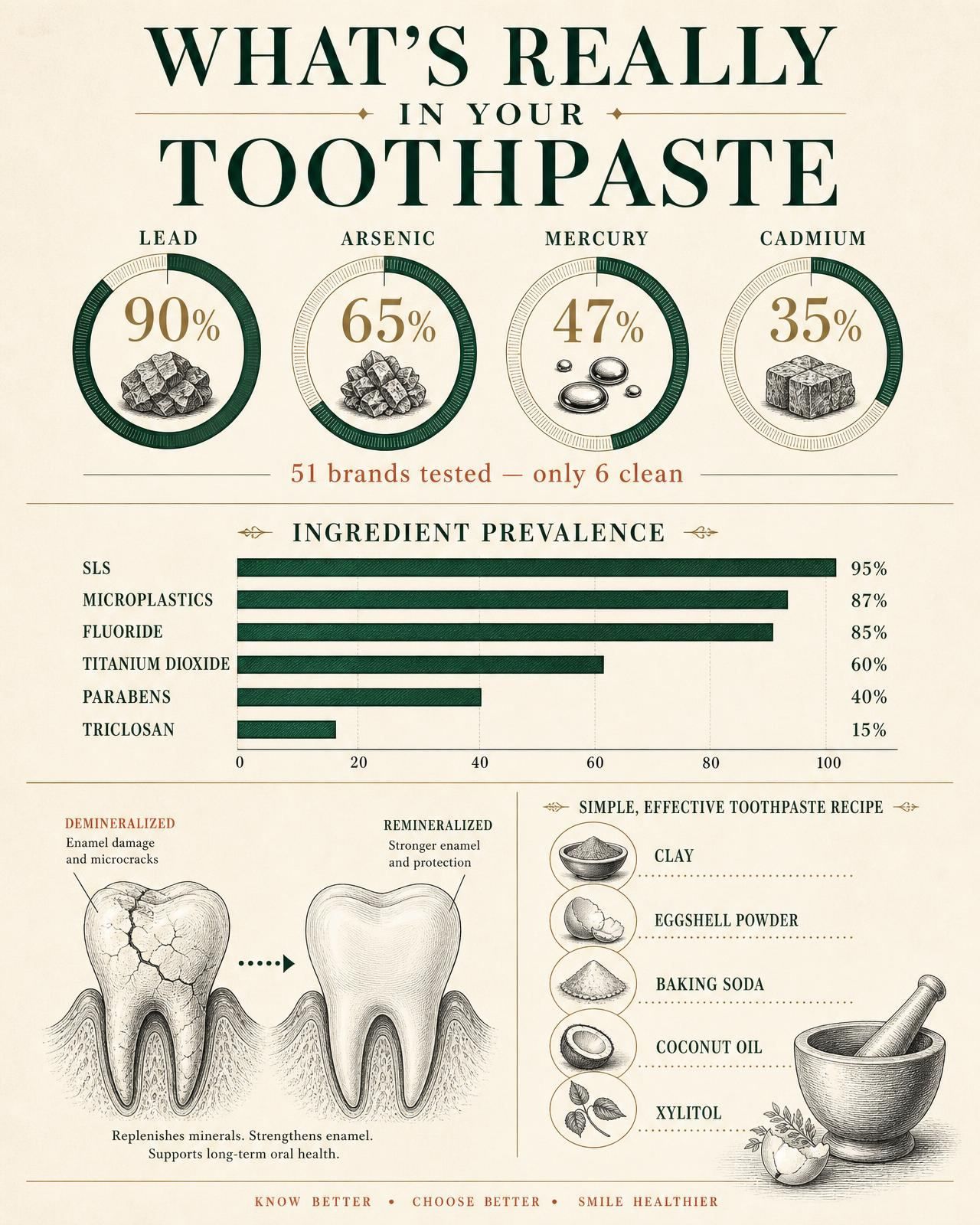
Independent testing of 51 popular toothpaste brands found lead in 90% of them, arsenic in 65%, mercury in 47%, and cadmium in 35% — only six products tested clean across all four metals. The contamination is not deliberate; it arrives with the raw materials, chiefly bentonite clay, calcium carbonate, and bone-derived hydroxyapatite.
The rest of the tube deserves the same scrutiny. Sodium lauryl sulfate is the most cytotoxic common ingredient against human gum cells, triclosan works but sits under active regulatory doubt, and fluoride's benefit is real yet modest while its cumulative dose is genuinely hard to control. A well-made eggshell-based paste is the most evidence-backed home alternative.
Fluoride is the loudest debate on the tube, but it is rarely the ingredient doing the most quiet damage.
Contents(14 sections)
Key takeaways
Independent testing of 51 toothpaste brands found lead in 90%, arsenic in 65%, mercury in 47%, and cadmium in 35%; only 6 tested clean on all four.
Some products reached 6,313 ppb lead — over 300 times the FDA's 20 ppm limit applied to other consumer products.
SLS at typical concentrations (0.75–2.75%) increases mucosal shedding, ulcer frequency, and gingival cell death above 0.5%, and reduces fluoride deposition on enamel.
A Cochrane review of 30 trials (~15,000 participants) found triclosan-plus-fluoride cut plaque 22%, gingivitis 22%, and bleeding gums 48% — yet the FDA declined to call triclosan generally safe and effective in 2016.
Eggshell powder is 94–98% calcium carbonate with trace phosphate, magnesium, strontium, zinc, and copper; multiple trials show it matches or exceeds fluoride toothpaste for enamel remineralization.
The Primer
The hidden chemistry of commercial toothpaste
Modern toothpaste combines detergents, abrasives, humectants, preservatives, and cavity-fighting agents. A 2026 systematic review evaluated fluoride, triclosan, parabens, surfactants, titanium dioxide, artificial sweeteners, carrageenan, and heavy metals, concluding that while most ingredients fall within regulated safety margins, several show genotoxic, endocrine-disrupting, or tumor-promoting potential under chronic or high-dose exposure.
That is the honest framing: not a panic, but a set of daily, lifelong exposures that were approved individually and never assessed as a stack.
Heavy metal contamination
The most alarming recent finding comes from independent testing of 51 popular brands: 90% contained lead, 65% arsenic, 47% mercury, and 35% cadmium. Only 6 of 51 tested clean across all four.
Contamination traces back to raw materials rather than intentional additives. Hydroxyapatite derived from cow bone, calcium carbonate, and bentonite clay are the primary carriers, with bentonite-clay-based products showing the highest concentrations. Some products showed lead reaching 6,313 parts per billion — over 300 times the FDA's 20 ppm limit for other consumer products. Heavy metals disrupt cellular function and are linked to kidney damage, osteoporosis, anemia, and elevated carcinogenic risk.
SLS: the foaming agent nobody questions
Sodium lauryl sulfate is the detergent that makes toothpaste foam, present in most conventional pastes at 0.75–2.75%. It consistently shows the highest cytotoxicity of any common ingredient tested against human gingival cells.
Research shows SLS significantly increases mucosal desquamation, mouth ulcer frequency and pain, and epithelial cell death at concentrations above 0.5% — with 38% of applied SLS retained in the oral cavity immediately after brushing. Emerging work links SLS to reduced oral microbiome diversity and increased pathogenic bacteria. It also reduces fluoride's effectiveness by limiting deposition on enamel, undermining one of toothpaste's core claimed benefits.
A practical read
If you change one thing, change the foaming agent: SLS-free pastes are widely available and the trade-off is only sensory. If you change two things, look at what supplies the abrasive and mineral fraction, since that is where the heavy metals ride in.
The Deep Dive
Triclosan: real benefit, unresolved safety
Triclosan/copolymer combined with fluoride has genuine clinical support. A Cochrane review of 30 studies spanning nearly 15,000 participants found it reduced plaque by 22%, gingivitis by 22%, and bleeding gums by 48% versus fluoride toothpaste alone, with no evidence of harm in studies up to three years.
But regulatory bodies have grown uneasy. The U.S. Geological Survey classifies triclosan as a "contaminant of emerging concern." In 2016 the FDA ruled that triclosan and 18 other antiseptic ingredients are not generally recognized as safe and effective, forcing reformulation of consumer antiseptic washes. Laboratory studies show triclosan acts as a weak endocrine disruptor, binding both androgen and estrogen receptors, and it has been detected in human breast milk, blood, and urine. The FDA ruling did not extend to toothpaste specifically, but the same concerns apply to daily oral exposure.
Tier II · Members only · Free
Continue into the deep dive
Tier I is free and always open. Tier II — the full mechanisms, dosing detail, nuance, and citations — unlocks with a free Vital Codex membership.
- Every Tier II deep dive across all hubs
- Saved reading progress across articles
- Member knowledge modules and their quizzes
- The Dispatch, if you opt in
Frequently asked
Is fluoride toothpaste actually dangerous?
At standard toothpaste concentrations (1,000–1,500 ppm), fluoride's cancer and neurotoxicity risks are debated but not conclusively proven for typical use. The larger concern is cumulative exposure from water, food, and toothpaste combined — especially in children, who tend to swallow toothpaste.
Why does "triclosan-free" not automatically mean risk-free?
Triclosan is flagged by the FDA and USGS as a contaminant of emerging concern with documented endocrine-disrupting activity, but it also has real, Cochrane-level plaque and gingivitis benefits. It is a genuine trade-off rather than a clear-cut ingredient to simply avoid or embrace.
How do heavy metals end up in toothpaste if they aren't added intentionally?
They are contaminants present in raw materials such as bentonite clay, calcium carbonate, and bone-derived hydroxyapatite — not added deliberately, but present because of sourcing practices and a lack of purification standards across the industry.
Does eggshell toothpaste work as well as fluoride?
In multiple clinical studies, yes. Eggshell-derived calcium and hydroxyapatite have matched or outperformed fluoride toothpaste for enamel remineralization, including a 2026 study reporting a 115.97% remineralization rate that restored enamel to near-normal hardness.
Is homemade toothpaste safe for daily use?
Yes, when made with food-grade ingredients and clean handling — store it in a glass jar and use clean utensils to avoid contamination. Skip xylitol entirely if you have dogs, since it is toxic to them in small amounts.
How long does homemade toothpaste last?
Typically 2–3 months in an airtight glass jar kept cool and dry. In hot or humid climates, refrigeration helps prevent the coconut oil base from separating or turning rancid.
Continue exploring: Inflammation — Cytokine signaling and chronic low-grade systemic stress.
Explore Inflammation