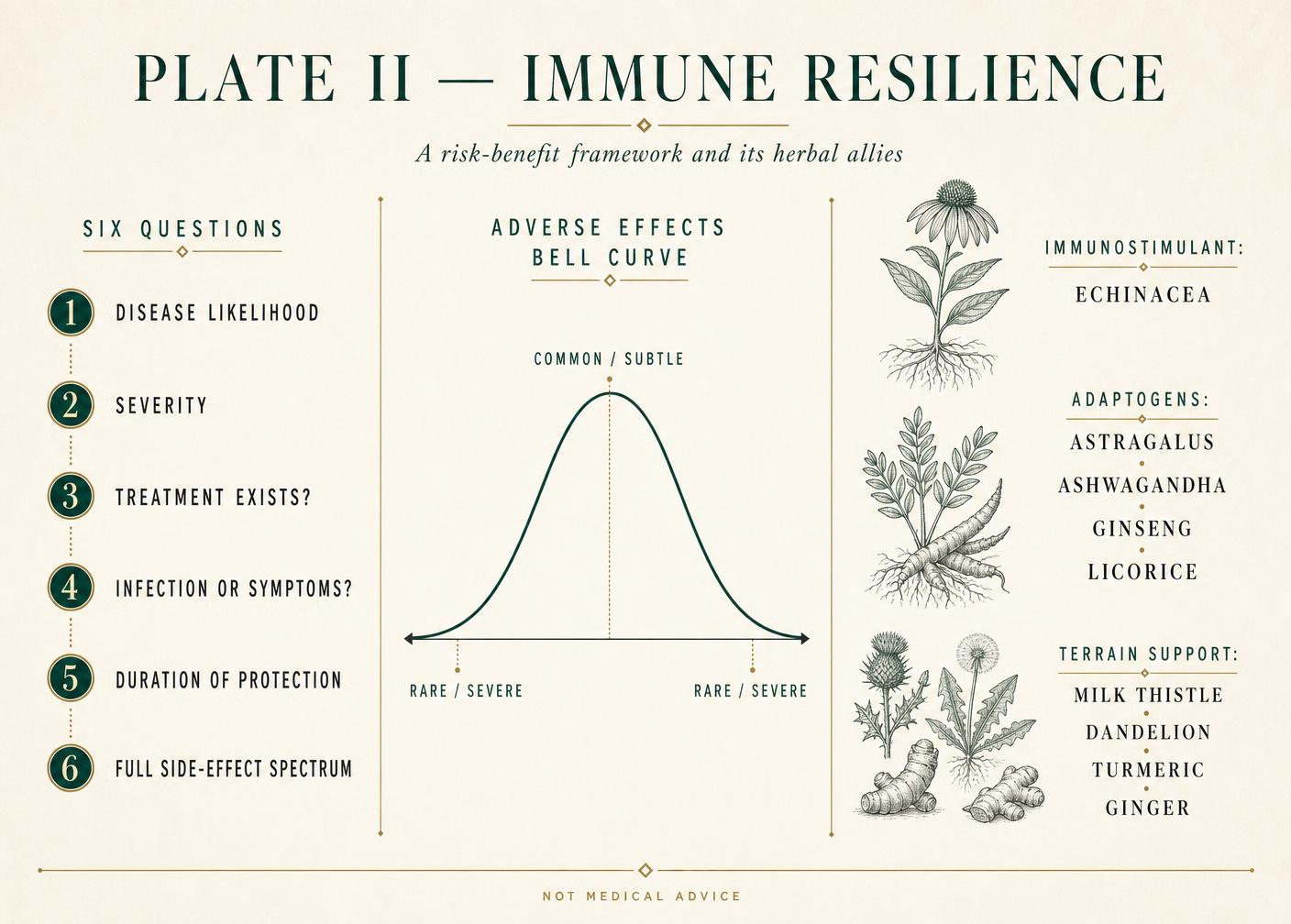
A real risk-benefit decision about any vaccine requires weighing at least six variables against each other: the probability of catching the disease, its severity if caught, whether treatment exists, whether the vaccine prevents infection or only symptoms, how long that protection lasts, and the full spectrum of adverse effects. Most families are handed a schedule and a slogan instead of that calculation. The framework popularized by A Midwestern Doctor argues that this complexity is precisely why the phrase "safe and effective" cannot substitute for an individualized answer.
This is not an argument to reject modern medicine. It is an argument for informed, individualized decision-making — and for a piece that mainstream vaccine debates almost always skip: what a person can proactively do with herbs and terrain-based support regardless of which immunization choices they make. Tier I is the quick-reference layer. Tier II covers mechanism, evidence quality, and where the claims outrun the literature.
Contents(13 sections)
Key takeaways
A defensible vaccine decision weighs six variables — disease probability, disease severity, treatment availability, whether the vaccine blocks infection or only symptoms, duration of protection, and the full adverse-effect spectrum — not one slogan.
Absolute risk matters more than historical fear: chickenpox mortality in children is roughly 1 in 100,000, concentrated in the already immunocompromised.
Vaccine adverse effects plausibly follow a bell curve, where rare severe reactions get attention and milder chronic patterns are harder to attribute and rarely counted.
Herbal immune support splits into two categories: immunostimulants (echinacea) that broadly activate immune cell populations, and adaptogens (astragalus, ashwagandha, Panax ginseng) that help normalize immune function under stress rather than spike it.
A Cochrane meta-analysis of 14 trials found echinacea reduced cold incidence by roughly 58% and shortened duration by about 1.4 days — unusually strong evidence for a botanical.
Herb-specific contraindications are real: echinacea in autoimmune conditions, licorice glycyrrhizin and blood pressure, high-dose garlic with anticoagulants.
The Primer
The six questions to ask before deciding
Ask these for every vaccine individually, not for "vaccines" as a category. The answers differ enormously between, for example, tetanus in a rural farming family and chickenpox in a healthy suburban child.
How likely am I or my child to actually contract this disease, given where and how we live? How severe would it typically be in someone of this age and health status? Is there an existing, accessible treatment if it does occur? Does the vaccine prevent infection, or only reduce symptom severity — and for how long before protection wanes? Does population-wide vaccination create selective pressure toward pathogen variants, or remove the natural periodic re-exposure that had been boosting adult immunity? And what is the real rate of adverse effects, including the subtle chronic ones that rarely get formally attributed to vaccination?
Herbal allies worth knowing either way
These apply regardless of vaccination choices. None of them is a substitute for acute medical care.
Astragalus root works as an immune modulator and adaptogen, supporting T-cell, B-cell, and antibody activity while helping the body regulate its stress response. Echinacea is an immunostimulant that increases T-cell, B-cell, and NK-cell activity, with clinical evidence for shortening cold duration and reducing infection risk. Ashwagandha is an adaptogen that boosts NK-cell activity and innate immunity while buffering the cortisol-driven immune suppression chronic stress produces. Licorice root (Glycyrrhiza) shows demonstrated antiviral activity against several virus families alongside immune modulation. Milk thistle and dandelion root are traditionally used for hepatic clearance support during any period of physiological stress. Panax ginseng has long been used to aid recovery from illness and modulate immune resilience.
What this framework is not
It does not produce a blanket "for" or "against" answer, and it is not a claim that any particular vaccine is unsafe. It is a discipline of asking the same questions consistently — the same questions a careful clinician would ask about any intervention, pharmaceutical or botanical.
The Deep Dive
Reframing the risk-benefit question
The framework insists that disease risk cannot be evaluated using historical fear alone. Many conditions on modern schedules are either exceedingly rare in the developed world today — tetanus, polio, diphtheria — or, when contracted, carry a low probability of severe outcome. Chickenpox is the cited example: roughly 1 in 100,000 children who contract it die, and those deaths concentrate in the already immunocompromised, yet universal vaccination proceeds regardless of that low absolute risk.
The efficacy side gets equal scrutiny. Declining post-vaccination immunity, the emergence of vaccine-resistant pathogen variants (documented with Hib, pneumococcus, pertussis, and COVID-19), and the loss of population-wide natural immunity boosting are raised as underappreciated costs of mass immunization programs. The most striking example offered is the chickenpox vaccine's unintended consequence: reduced circulating wild virus removed the periodic natural re-exposure that had kept adult shingles rates low, and shingles cases rose rather than fell.
Tier II · Members only · Free
Continue into the deep dive
Tier I is free and always open. Tier II — the full mechanisms, dosing detail, nuance, and citations — unlocks with a free Vital Codex membership.
- Every Tier II deep dive across all hubs
- Saved reading progress across articles
- Member knowledge modules and their quizzes
- The Dispatch, if you opt in
Frequently asked
Is this article anti-vaccine?
No. It presents a decision framework for weighing disease risk, vaccine efficacy, duration of protection, and adverse-effect rates for each vaccine individually, and it separates that framework from the herbal and terrain support that applies regardless of the choice made. It reaches no blanket verdict.
What are the six questions a vaccine risk-benefit calculation requires?
How likely is contracting the disease; how severe is it typically; is treatment available; does the vaccine prevent infection or only symptoms; how long does protection last; and what is the full adverse-effect spectrum, including subtle chronic effects. Answers differ by vaccine, age, and health status.
Which herbs have the strongest evidence for immune support?
Echinacea has the strongest clinical evidence — a Cochrane meta-analysis of 14 trials reported roughly 58% lower cold incidence and about 1.4 days shorter duration. Astragalus and ashwagandha have solid mechanistic and immunological data on T-cell, NK-cell, and cytokine modulation, with less definitive outcome-level evidence.
What is the difference between an immunostimulant and an adaptogen?
An immunostimulant such as echinacea broadly activates immune cell populations for short-term response. An adaptogen such as astragalus, ashwagandha, or Panax ginseng helps regulate the stress response so immune function normalizes over time rather than spiking or crashing. Adaptogens are typically taken preventatively; immunostimulants around acute exposure.
Do herbs help after a vaccine?
Herbalists commonly use milk thistle, dandelion root, and artichoke leaf to support liver clearance pathways, plus hydration for lymphatic and renal clearance and anti-inflammatory botanicals like turmeric and ginger. This rests on general detoxification physiology and traditional use, not on trials showing improved post-vaccination outcomes — an honest evidence grade is "plausible and low-risk," not "proven."
Which herbs carry real contraindications?
Echinacea is cautioned in autoimmune conditions, licorice's glycyrrhizin can raise blood pressure and deplete potassium with prolonged use, and high-dose garlic interacts with anticoagulants. Children, pregnancy, and concurrent medication use all warrant individualized clinical guidance.
Continue exploring: Inflammation — Cytokine signaling and chronic low-grade systemic stress.
Explore Inflammation