Every living organism runs on electrochemical gradients maintained by ions. Parasites are no exception: they hold their own membrane potentials, depend on the same sodium, potassium, calcium, chloride, and proton gradients your cells use, and in several well-documented cases they reprogram the ion channels of the cells they invade.
The useful question is not only what a parasite is, but how it uses the host's ionic environment — because that is where mineral depletion, immune signaling, and susceptibility all intersect.
Contents(13 sections)
Key takeaways
Protozoan parasites maintain membrane potentials around −80 to −120 mV, more negative than most non-excitable mammalian cells.
Plasmodium falciparum induces new channels in infected red blood cells, including the Plasmodial Surface Anion Channel, turning the host cell into a nutrient conduit.
Parasites use potassium and chloride gradients as environmental cues for life-cycle transitions and tissue targeting.
Documented mineral depletion in infection includes iron, zinc, selenium, calcium, magnesium, and copper.
Immune defense against parasites is itself an ionic process, with calcium signaling as the central messenger.
The Primer
Parasites are electrical organisms
Like your cells, parasites maintain a voltage across their membranes generated by ion movement. That voltage drives nutrient uptake, controls cell volume, and governs the transitions between life-cycle stages. Disrupt it and the organism struggles to feed and reproduce.
They take minerals with them
Parasitic infection consistently depletes host minerals. Hookworms cause chronic intestinal blood loss and measurable iron depletion; studies in infected children show serum iron roughly half that of uninfected children on identical diets. Analyses of parasitic worms show them concentrating calcium, magnesium, phosphorus, copper, zinc, and iron above surrounding host tissue.
Zinc and selenium fall reliably in infected children, which matters because both are required for the immune response that would clear the infection — a self-perpetuating loop.
What this means practically
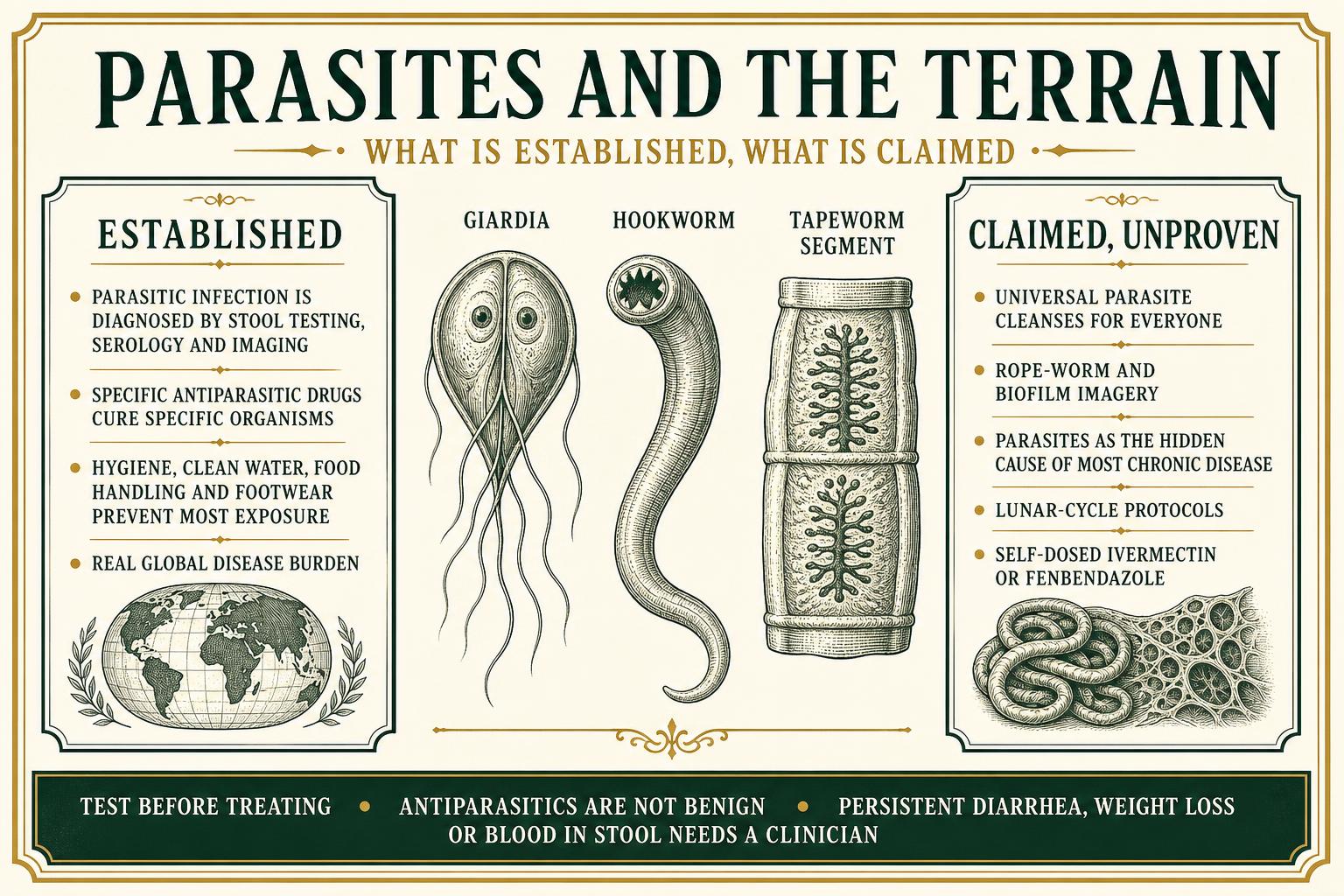
Mineral repletion is not an alternative to appropriate diagnosis and treatment; it is the terrain work that runs alongside it. Confirmed or suspected parasitic infection deserves actual testing and, where indicated, established antiparasitic therapy — these organisms are treatable, and the treatments work.
The Deep Dive
Rewiring host ion channels
The malaria parasite is the best-characterized example of ionic hijacking. On invading a red blood cell, Plasmodium falciparum induces a Ca²⁺-permeable unselective cation channel that does not normally exist in that membrane, and establishes the Plasmodial Surface Anion Channel (PSAC), a voltage-dependent conduit that dramatically increases host cell permeability to sugars, amino acids, nucleosides, and inorganic ions.
The parasite additionally runs an electrogenic V-type H⁺ pump at its own plasma membrane, exporting protons and lowering intracellular pH of the infected cell from roughly 7.2 to 6.5, and exchanges host cytoplasmic K⁺ for Na⁺ through pharmacologically identifiable potassium channels.
Tier II · Members only · Free
Continue into the deep dive
Tier I is free and always open. Tier II — the full mechanisms, dosing detail, nuance, and citations — unlocks with a free Vital Codex membership.
- Every Tier II deep dive across all hubs
- Saved reading progress across articles
- Member knowledge modules and their quizzes
- The Dispatch, if you opt in
Frequently asked
Do parasites really change my cells' electrical behaviour?
In documented cases, yes. Plasmodium falciparum induces novel ion channels in the red blood cells it infects, altering their permeability and internal pH substantially.
Does mineral depletion mean I should take a mineral supplement during infection?
Mineral repletion is reasonable and often necessary, but iron specifically should be guided by testing, because the body deliberately sequesters iron during infection and unguided supplementation can be counterproductive.
Are herbal parasite cleanses effective?
Several traditional botanicals show in vitro activity, but human trial evidence is thin compared with established antiparasitic drugs. Use them as adjuncts, and do not delay diagnosis or treatment of a confirmed infection.
How would I know if a parasite is the issue?
Testing, not symptom lists. Stool antigen and ova-and-parasite panels, serology for specific organisms, complete blood count with differential, and travel and exposure history are the appropriate starting points.
Continue exploring: Inflammation — Cytokine signaling and chronic low-grade systemic stress.
Explore Inflammation