Lipid nanoparticles (LNPs) are the delivery vehicles behind mRNA vaccines and a fast-growing pipeline of nucleic acid therapeutics. They were long described as passive packaging — a bubble whose only job is to carry cargo into a cell. That description is no longer accurate.
A peer-reviewed framework published in Acta Pharmaceutica Sinica B in mid-2026 by Falko Seger, L. Maria Gutschi, and Stephanie Seneff (MIT CSAIL) argues that LNPs act as "active biointerfaces" — that their component lipids integrate into cell membranes and disrupt intracellular signaling irrespective of what payload they carry. The authors call this lipid-nanoparticle-driven membrane dysfunction, or L-DMD. That framework has since become the organizing lens for a wellness-oriented "LNP Detox Protocol" combining MSM, magnesium, zeolite, clay, and fermented dairy.
This article separates the two claims, because they carry very different evidentiary weight. The mechanism has substantial independent support. The protocol does not.
This is educational content, not personal medical advice. Nothing here should be used to start, stop, or alter medical treatment without a qualified clinician.
The most defensible conclusion is also the narrowest one: the carrier is not inert.
Contents(15 sections)
Key takeaways
The ionizable lipid component of LNPs is independently immunostimulatory — multiple separate research groups have shown empty LNPs activate NF-κB largely through TLR4.
Adding mRNA to the particle did not meaningfully increase activation beyond the empty LNP in a 2025 human monocyte study.
Inflammation appears partly mechanical: endosomal membrane rupture during cargo release is sensed by cytosolic galectins, and gentler lipid chemistry produces less inflammation.
Pharmaceutical engineering now targets carrier inflammation directly, which implicitly concedes the carrier is a driver.
Biodistribution work found the ionizable lipid ALC-0315 persisting in liver and spleen for weeks in mice, longer than the mRNA itself.
Of the four detox pillars, clinoptilolite zeolite and MSM are best supported; transdermal magnesium is the weakest link and largely unsupported.
No controlled trial has tested the combined protocol against LNP-associated symptoms. Plausibility is not proof.
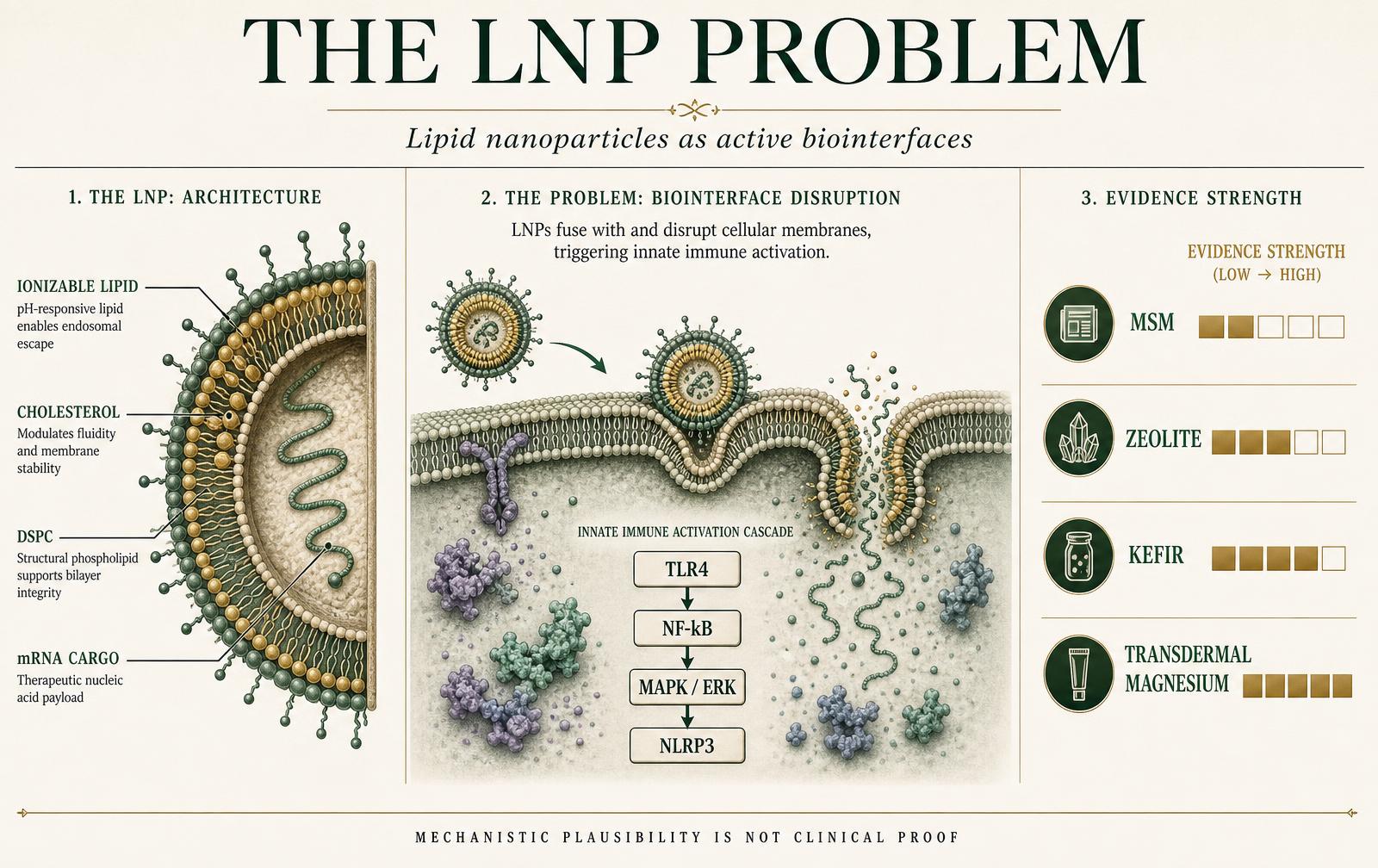
The Primer
What the "active biointerface" claim actually says
The core argument of the Seger-Gutschi-Seneff paper is that LNPs should not be treated as inert. Their constituent lipids — ionizable lipids, cholesterol, and DSPC — integrate into cell membranes, disturb the phosphatidylinositol (PI) cycle that governs membrane signaling, and set off cascading dysfunction across NF-κB, MAPK/ERK, JAK/STAT, and mTORC1/2 pathways.
Gutschi has emphasized that this is a statement about the platform rather than the spike protein: empty LNPs produce inflammatory signatures similar to — sometimes only marginally lower than — mRNA-loaded ones.
The authors frame membrane disruption as a threshold phenomenon. Not every exposure produces clinically meaningful dysfunction; the proposed driver of pathology is cumulative burden exceeding repair capacity. Independent commentary describes the 342-reference review as mechanistically dense and substantial, while noting plainly that it is a hypothesis paper, not clinical trial evidence.
The part with strong independent support
The claim that ionizable lipids provoke inflammation on their own — separate from any mRNA cargo — has substantial backing in the 2024–2026 literature.
Studies using human monocyte (THP-1) models found that empty ionizable LNPs activate NF-κB and interferon regulatory factor (IRF) responses predominantly through Toll-like receptor 4, and that removing the ionizable lipid abolishes this activation. A 2025 study reported that adding mRNA did not meaningfully increase activation beyond the empty particle, with NF-κB responses to empty BNT162b2-style LNPs similar in magnitude to the fully loaded formulation. A related 2024 study localized the immunogenicity specifically to the amine headgroups of ionizable lipids, which bind TLR4 and CD1d and promote pro-inflammatory lipid-raft formation.
Earlier work from 2022 documented that ionizable cationic lipids such as SM-102 potently activate the NLRP3 inflammasome and drive IL-1β release, and that intranasal LNP administration in mice produced dose-dependent pulmonary inflammation and neutrophil infiltration.
Membrane trauma as a physical event
A parallel biophysical explanation comes from endosomal escape biology. Research published in 2024 shows that the very process required for mRNA release — rupture of the endosomal membrane — is directly sensed by cytosolic galectin proteins, which then drive downstream inflammation. Biodegradable ionizable lipids that create smaller, ESCRT-repairable holes produce substantially less inflammation than conventional formulations.
That gives molecular specificity to the "membrane trauma" concept at the center of L-DMD: the damage is not metaphorical, it is a hole in a membrane and a repair system that either keeps up or does not.
Industry is already engineering around it
The clearest sign that the carrier matters is what drug developers are now doing about it. A March 2026 study in Advanced Science showed that co-formulating NF-κB inhibitors directly into LNPs suppresses LNP-associated inflammation without disrupting cargo expression. Newer non-inflammatory designs incorporating V-ATPase-activating natural compounds have reported 3–10 fold reductions in IL-6 and IL-1β versus conventional formulations.
Both lines of work point the same direction: ionizable lipid chemistry, not cargo, is the primary inflammatory variable worth designing against.
The Deep Dive
Biodistribution and persistence
A separate strand of 2026 research asks how long LNP components remain in the body. A biodistribution study from researchers at the State University of New York at Buffalo, published in Pharmaceutical Research, found that the ionizable lipid ALC-0315 accumulated primarily in liver and spleen tissue and persisted for weeks in mice, while mRNA itself cleared within days and spike protein expression remained detectable for up to two weeks across multiple organs.
A broader February 2026 review of human vaccine biodistribution literature reports that modified mRNA has been detected up to a month post-injection in cardiac and skeletal muscle at sites of inflammation, with recombinant spike protein reportedly detectable in blood for over half a year in some studies.
Tier II · Members only · Free
Continue into the deep dive
Tier I is free and always open. Tier II — the full mechanisms, dosing detail, nuance, and citations — unlocks with a free Vital Codex membership.
- Every Tier II deep dive across all hubs
- Saved reading progress across articles
- Member knowledge modules and their quizzes
- The Dispatch, if you opt in
Frequently asked
Do lipid nanoparticles cause inflammation without any mRNA in them?
Yes, according to multiple independent studies. Empty ionizable LNPs activate NF-κB and IRF responses in human monocyte models predominantly through TLR4, and removing the ionizable lipid abolishes the activation. One 2025 study found adding mRNA did not meaningfully increase activation beyond the empty particle.
What is L-DMD?
L-DMD stands for lipid-nanoparticle-driven membrane dysfunction — a 2026 hypothesis framework proposing that LNP lipids integrate into cell membranes, disturb the phosphatidylinositol cycle, and cascade into NF-κB, MAPK/ERK, JAK/STAT, and mTORC1/2 dysfunction independent of cargo. It is a mechanistic review, not clinical trial evidence.
How long do LNP lipids stay in the body?
In a 2026 mouse biodistribution study, the ionizable lipid ALC-0315 accumulated in liver and spleen and persisted for weeks — longer than the mRNA, which cleared within days. The study authors state this does not establish injury or long-term toxicity.
Does the LNP detox protocol work?
No controlled trial has tested the combined MSM-magnesium-zeolite-kefir regimen against LNP-associated symptoms, and no agent in it has been shown to bind or clear LNP-derived lipids in humans. The individual mechanisms range from reasonably supported to largely unsupported.
Is transdermal magnesium effective?
The evidence is weak. A 2017 Nutrients review called transdermal magnesium scientifically unsupported, and ex vivo skin flux measurements are very low across intact skin. Oral or intravenous magnesium has far better support for systemic repletion.
Which detox component has the most evidence?
Clinoptilolite zeolite, for heavy metal binding specifically. Reviews and small human trials document increased urinary excretion and reduced blood levels of mercury, cadmium, and arsenic without depleting copper, zinc, or iron. Whether it binds LNP-derived lipids has not been tested.
Research Notes & Sources(expand)
Seger F, Gutschi LM, Seneff S. Lipid Nanoparticles as Active Biointerfaces: From Membrane Interaction to Systemic Dysregulation. Acta Pharmaceutica Sinica B. 2026. Hypothesis review, 342 references.
Zelkoski AE, et al. Ionizable lipid nanoparticles of mRNA vaccines elicit NF-κB and IRF responses through Toll-like receptor 4. npj Vaccines. 2025. doi:10.1038/s41541-025-01124-x.
Amine headgroups in ionizable lipids drive immune activation via TLR4 and CD1d. PMC11863198. 2024.
Pro-inflammatory concerns with lipid nanoparticles: SM-102 and NLRP3 inflammasome activation. PMC9047613. 2022.
Lipid Nanoparticle-Associated Inflammation is Triggered by Sensing of Endosomal Damage: Engineering Endosomal Escape Without Side Effects. bioRxiv. 2024. doi:10.1101/2024.04.16.589801.
Espy CL, et al. Localized NF-κB Inhibition Reduces Lipid Nanoparticle Inflammation. Advanced Science. 2026. doi:10.1002/advs.202517931.
Boosting RNA nanotherapeutics with V-ATPase activating non-inflammatory lipid nanoparticles. Nature Communications. 2025. doi:10.1038/s41467-025-61688-z.
Biodistribution of ALC-0315 and mRNA-LNP components. Pharmaceutical Research. 2026 (SUNY Buffalo).
Gröber U, et al. Myth or Reality — Transdermal Magnesium? Nutrients. 2017. PMC5579607.
Methylsulfonylmethane ameliorates inflammation via NF-κB pathway suppression. PMC9024008.
Methylsulfonylmethane protects against ethanol-induced brain injury via Nrf2/HO-1 and NLRP3 modulation. PubMed 35203043.
Clinoptilolite zeolite in heavy metal detoxification: mechanisms and clinical evidence. Review literature on ion-exchange binding of lead, cadmium, mercury, and arsenic.
Continue exploring: Inflammation — Cytokine signaling and chronic low-grade systemic stress.
Explore Inflammation