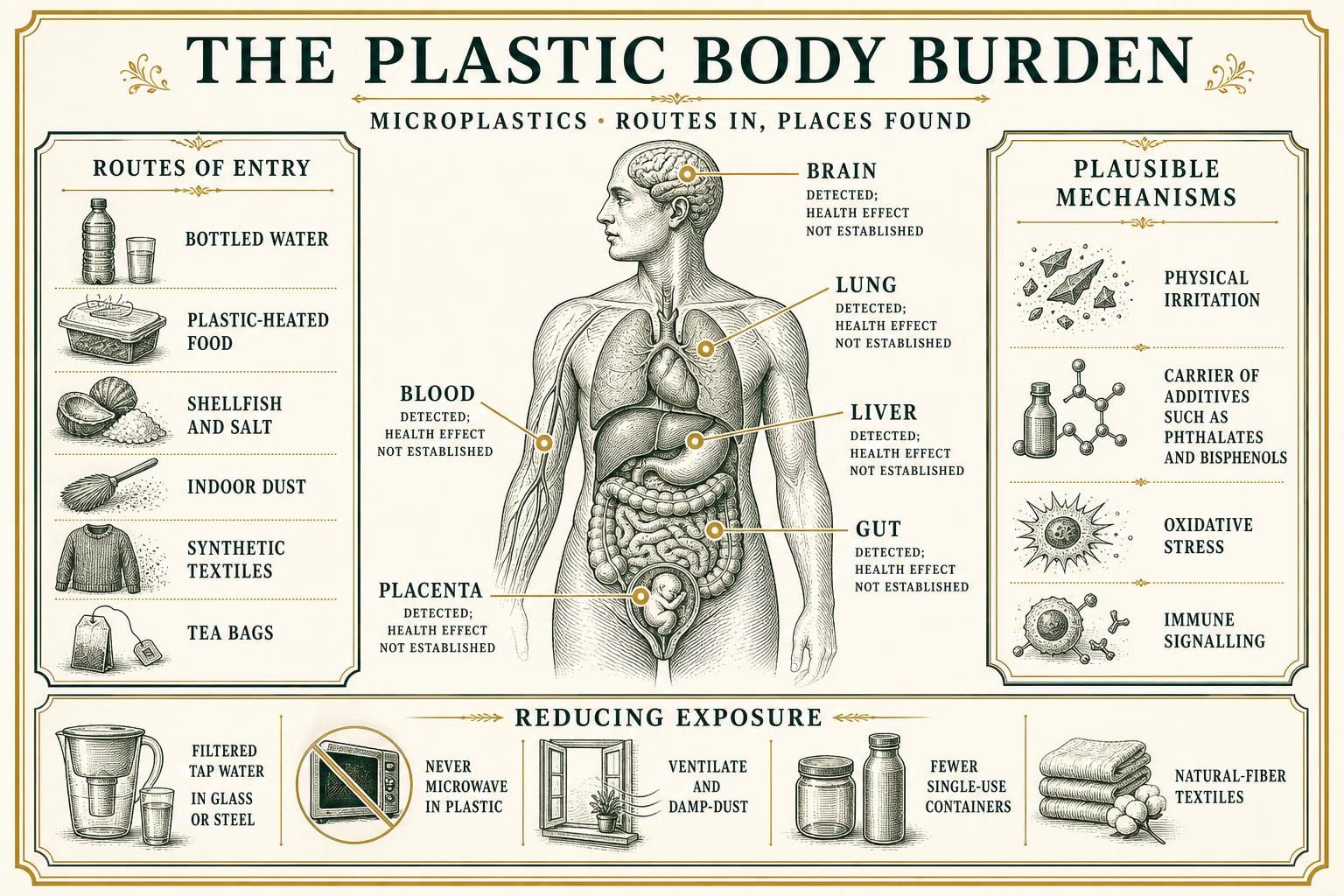
Microplastics — plastic fragments under 5 mm, and nanoplastics under 1 µm — have now been detected in human blood, placenta, breast milk, testis, carotid plaque, and brain tissue. Detection is established. Causation of specific disease in humans is, with one notable exception, not yet.
The exception is worth stating precisely: in a 2024 prospective cohort, patients whose excised carotid plaque contained polyethylene had a substantially higher rate of heart attack, stroke, or death over roughly 34 months of follow-up than those whose plaque did not (Marfella et al., New England Journal of Medicine, 2024). That is an association in a surgical population, not proof of causation — but it is the strongest human signal to date.
Contents(13 sections)
Key takeaways
Microplastics are measurable in human blood, placenta, breast milk, arterial plaque, and brain tissue.
The strongest human outcome signal is the 2024 NEJM carotid plaque cohort linking polyethylene in plaque to cardiovascular events.
Bottled water and heated plastic food contact are among the largest identified dietary exposure routes.
Mechanistic concern centers on oxidative stress, particle-driven inflammation, and endocrine-active additives rather than the polymer itself.
No supplement or protocol has been shown to remove microplastics from tissue; exposure reduction is the intervention with actual evidence.
The Primer
Where exposure actually comes from
The largest identified routes are drinking water — particularly bottled water, where nanoparticle counts measured by a 2024 Columbia study averaged around 240,000 particles per liter, mostly nanoplastic — heated or abraded plastic food contact (microwaving containers, plastic kettles, worn nonstick and cutting surfaces), synthetic textile dust indoors, and road and tire wear particles in outdoor air.
Food packaging and indoor dust often matter more than the ocean-plastic imagery that dominates public discussion. Exposure is mostly domestic and mostly mundane.
What is established versus inferred
Established: plastics fragment, humans ingest and inhale them, and they are detectable in tissue. Inferred, with animal and cell evidence but incomplete human data: that this burden contributes to inflammation, endocrine disruption, and metabolic and vascular harm at current environmental doses.
Holding both halves at once is the appropriate posture. The exposure is real and worth reducing; the certainty about individual disease risk is not yet there.
The reductions with the largest effect
Filtered tap water in glass or steel rather than bottled water. Never heat food in plastic — transfer to glass or ceramic first. Replace scratched nonstick cookware and worn plastic cutting boards. Reduce canned food, which often carries an epoxy liner. Vacuum with a HEPA filter and ventilate; indoor dust is a meaningful inhalation route. Choose natural fibers where practical.
What does not work
There is no evidence that any cleanse, binder, chelator, or supplement removes microplastics from human tissue. Claims otherwise are marketing. What is supportable is general support for the pathways that handle oxidative and xenobiotic stress — adequate fiber for elimination, cruciferous vegetables, sulfur amino acids for glutathione synthesis, and sleep.
The Deep Dive
Measured human burden
Detection methods matter for interpreting numbers. Pyrolysis-GC/MS quantifies polymer mass; Raman and FTIR microscopy identify particles; SRS microscopy enabled the 2024 bottled-water nanoparticle counts. Reported concentrations vary widely across studies partly because methods differ in size detection floor, and lab contamination control is a persistent problem in the literature. Read specific particle counts as order-of-magnitude estimates.
A 2025 analysis reported higher polymer concentrations in brain tissue than in liver or kidney, with polyethylene dominating — a finding that raised the question of blood-brain barrier translocation for nanoscale particles, and which requires independent replication before it should anchor conclusions.
Tier II · Members only · Free
Continue into the deep dive
Tier I is free and always open. Tier II — the full mechanisms, dosing detail, nuance, and citations — unlocks with a free Vital Codex membership.
- Every Tier II deep dive across all hubs
- Saved reading progress across articles
- Member knowledge modules and their quizzes
- The Dispatch, if you opt in
Frequently asked
Can I test my microplastic levels?
Not usefully. Research assays require tissue or specialized blood analysis with strict contamination control, and there is no reference range to interpret a result against. Consumer tests cannot tell you your risk.
Does filtered water actually help?
Yes, meaningfully. Bottled water is among the highest-concentration dietary sources measured. A carbon block or reverse osmosis filter with glass or stainless steel storage removes the largest single identified route for most people.
Do binders like activated charcoal or chlorella remove microplastics?
There is no human evidence that they do. Binders act on some ingested compounds in the gut lumen; they do nothing about particles already in tissue.
Should I be alarmed?
Concerned enough to make the cheap substitutions, not alarmed. Exposure is universal and the substitutions are low-cost; the human outcome evidence remains associative and incomplete.
Continue exploring: Inflammation — Cytokine signaling and chronic low-grade systemic stress.
Explore Inflammation