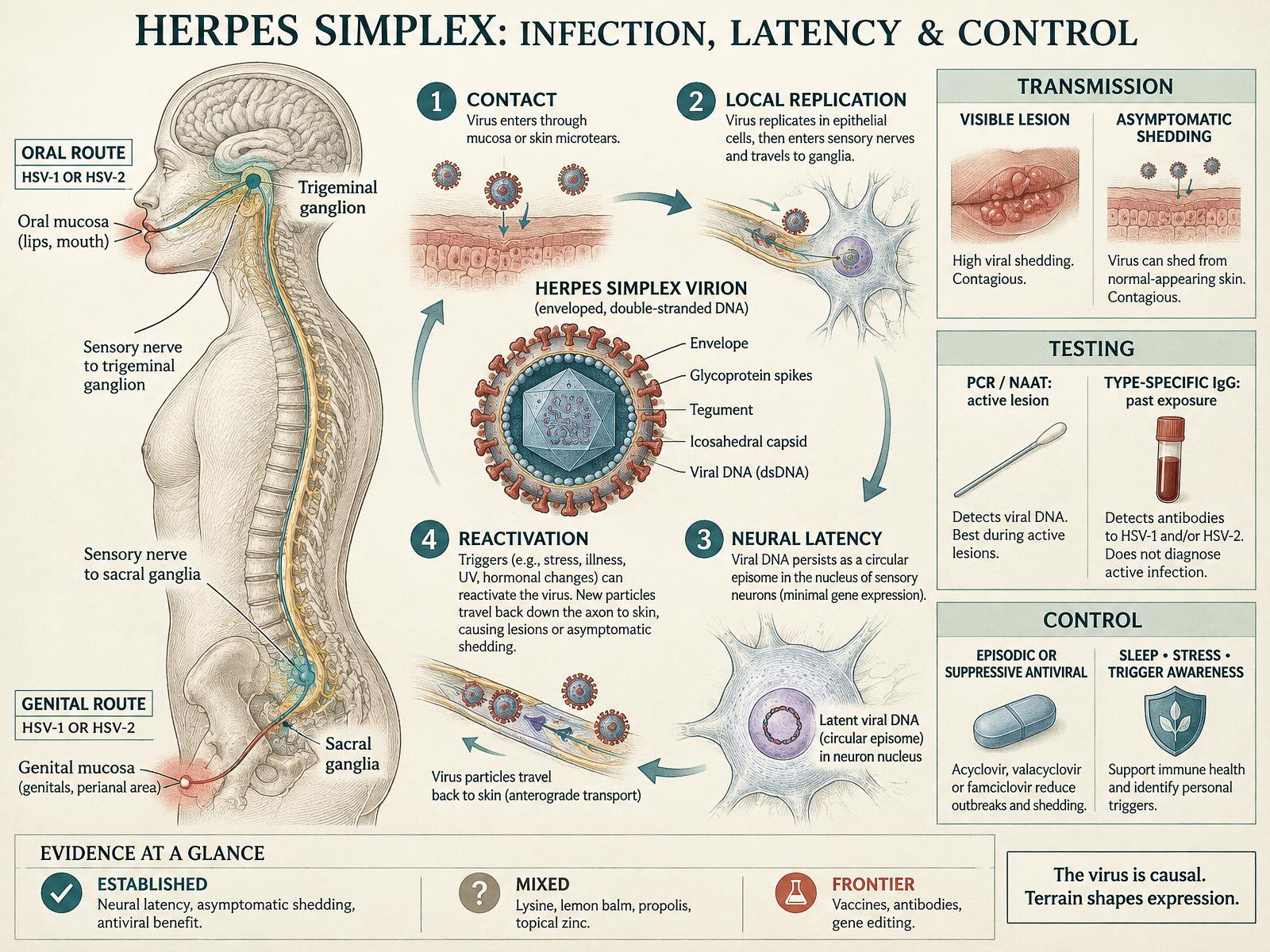
A herpes blister is not a drainage outlet for stored toxins. It is the visible end of a well-mapped biological circuit: herpes simplex virus replicates in skin or mucosa, enters nearby sensory nerves, travels to a ganglion, maintains its DNA inside long-lived neurons, and can later return down the axon to the surface. Viral DNA, proteins, infectious particles, immune responses, and transmission chains have all been measured along that path.
But infection is not the same as constant disease. Most HSV infections are unrecognized, recurrences vary enormously, and the host environment helps decide when latency remains quiet and when reactivation reaches the skin. Stress, sleep loss, fever, ultraviolet light, hormonal changes, local friction, immune suppression, and other physiological pressures can alter expression. That does not undo viral causation; it explains why the same virus behaves differently across people and across time.
The virus is causal. Terrain shapes expression. Neither fact cancels the other.
Contents(19 sections)
Key takeaways
HSV-1 and HSV-2 are closely related DNA viruses; either type can infect the mouth or genitals, so anatomy alone does not identify the type.
After local replication, HSV enters sensory nerves and persists as circular episomal DNA in trigeminal or sacral ganglia; reactivation sends new virions back toward skin or mucosa.
Transmission can occur without a visible sore because viral shedding is intermittent and often asymptomatic. Risk is highest with active lesions or prodromal tingling and burning.
A fresh lesion should be swabbed promptly for PCR/NAAT. Blood IgG shows previous exposure, not the site or timing of infection, and low-positive HSV-2 results may require confirmation.
Antivirals do not remove latent DNA, but they reliably shorten episodes; daily suppression reduces recurrences by about 70–80% in people with frequent outbreaks and lowers, but does not eliminate, transmission risk.
Lysine, lemon balm, propolis, and topical zinc have limited or mixed evidence. They may be optional adjuncts, not substitutes for diagnosis, proven antiviral therapy, or urgent care.
Herpes is common biology, not a verdict on character, fidelity, cleanliness, or worth.
The Primer
HSV-1 and HSV-2 are types, not locations
HSV-1 is traditionally associated with cold sores and HSV-2 with genital herpes, but that shorthand is no longer reliable. Oral sex can transmit HSV-1 to the genitals, where it is now a major cause of first-episode genital herpes in many populations. HSV-2 can infect the oral region, although it recurs and sheds there less often.
The type matters because natural history differs by site. Genital HSV-2 generally recurs and sheds more often than genital HSV-1. A person with genital HSV-1 may have a dramatic first episode and then few or no recurrences. A swab that identifies the viral type therefore provides more useful forecasting than lesion location alone.
Globally, HSV is exceptionally common. World Health Organization estimates indicate that billions of people under 50 carry HSV-1 and hundreds of millions of people aged 15–49 carry HSV-2. Most do not know it. Prevalence is evidence of successful human transmission, not evidence that every infected person is ill.
What latency actually means
During an initial infection, HSV replicates in epithelial cells at the contact site. Some particles enter sensory nerve endings and move inward by retrograde axonal transport. Oral infections commonly establish latency in trigeminal ganglia; genital infections commonly use sacral dorsal-root ganglia. Inside the neuronal nucleus, viral DNA persists mainly as a circular episome rather than integrating into human chromosomes.
Latency is active restraint, not disappearance. Most viral genes are silenced while latency-associated transcripts, chromatin state, local immune surveillance, and neuronal signals help maintain the quiet state. When that balance shifts, HSV can resume gene expression, assemble particles, and travel outward by anterograde transport. The result may be a visible lesion, subtle symptoms, or asymptomatic shedding.
This mechanism was not invented to rescue a failed experiment in 1921. Modern evidence includes recovery of HSV DNA and latency-associated transcripts from human sensory ganglia, direct visualization and culture of reactivated virus, animal models that reproduce neural latency, and genome sequencing that links transmitted infections.
The triggers are real — and fully compatible with virology
Commonly reported triggers include:
- febrile illness or another infection;
- psychological stress and sleep disruption;
- intense ultraviolet exposure, especially for oral HSV-1;
- menstruation or other hormonal shifts in some people;
- local friction, dental work, surgery, or tissue injury;
- systemic corticosteroids, chemotherapy, transplantation, HIV, or other immune suppression.
These triggers do not mean the lesion is eliminating stress hormones, mercury, medications, or metabolic waste. They change neuronal signaling, local immunity, inflammatory mediators, and viral gene regulation. Contact with another person belongs to the acquisition story; internal triggers belong to the reactivation story. A recurrent outbreak does not require a new exposure because the established infection is already latent in sensory neurons.
Transmission without panic
HSV spreads through direct contact with infected oral or genital skin, mucosa, secretions, or lesions. Transmission is most likely during an active outbreak and can begin during prodromal tingling, burning, or tenderness. It can also occur when skin looks normal because shedding is intermittent.
Practical risk reduction is layered:
- Avoid kissing, oral sex, genital contact, and contact with lesions from the first prodromal sign until the area is fully healed.
- Use condoms or internal condoms consistently; they reduce risk but do not cover every shedding site.
- Consider daily suppressive therapy when recurrences are frequent, distressing, or when reducing partner risk is a priority.
- Tell a partner before exposure in a calm, factual way so both people can make an informed decision.
- Do not touch a lesion and then touch the eye; wash hands after applying topical treatment.
For genital HSV-2 in discordant heterosexual couples, once-daily valacyclovir reduced overall transmission in a randomized trial when combined with counseling and safer-sex measures. It did not make transmission impossible.
Testing: match the test to the question
Fresh lesion: PCR/NAAT is preferred. A swab from a new blister, ulcer, or moist lesion can detect viral DNA and distinguish HSV-1 from HSV-2. Sensitivity falls as lesions crust and heal. Viral culture is highly specific but less sensitive, especially for recurrent or older lesions.
No lesion: type-specific IgG can answer a narrower question. Blood testing can show prior immune recognition of HSV-1 or HSV-2. It cannot identify when infection occurred or whether HSV-1 is oral or genital. Antibodies may take weeks to develop, so testing too soon after exposure can be falsely negative.
HSV-2 enzyme immunoassays can be falsely positive at low index values. CDC guidance recommends confirmation with a second method such as Biokit or Western blot when the initial result is low-positive. HSV IgM is not recommended: it is not reliably type-specific and can become positive during recurrences.
Routine blood screening of every asymptomatic adult is not recommended in the United States because false positives and psychosocial harms can outweigh benefit in low-risk populations. Testing is more useful when genital symptoms are unexplained, a partner has genital herpes, or clinical history makes the result actionable.
Treatment is a choice, not an automatic lifetime sentence
Acyclovir, valacyclovir, and famciclovir block viral DNA replication. They do not remove latent HSV from neurons, but decades of use and randomized trials show that they reduce symptoms, lesion duration, viral shedding, and recurrences.
First recognized genital episode. Antiviral treatment is generally recommended because initial disease can be prolonged or severe.
Episodic treatment. Medication begins at prodrome or within the first day of lesions. This suits people with infrequent outbreaks who can recognize the onset quickly.
Suppressive treatment. Daily medication is reasonable for frequent or severe recurrences, major anxiety or disruption, or transmission reduction. It lowers recurrence frequency by roughly 70–80% among people with frequent outbreaks, and many experience no symptomatic recurrences while taking it. The need should be revisited periodically because recurrence rates often decline over time.
Long-term daily therapy is not mandatory for every person with HSV. It is also not an unstudied experiment limited to one year: clinical experience, surveillance, and long-duration use support safety in immunocompetent people. Headache and nausea are among the more common effects. Kidney injury and neurotoxicity are uncommon but important, especially with dehydration, kidney impairment, older age, or excessive dosing; dose adjustment may be needed. Antiviral resistance remains rare in immunocompetent people and is more relevant with substantial immune suppression.
A no-shame disclosure framework
A useful disclosure is brief and specific: “I carry genital HSV-[type]. I avoid contact during symptoms, and we can use barriers and/or suppression to lower risk. It is common and manageable, but the risk is not zero.”
A diagnosis cannot establish when transmission occurred or who transmitted it. HSV may remain unnoticed for months or years, and blood testing does not date infection. An outbreak is not proof of recent infidelity. Shame drives secrecy and avoidance of care; accurate risk language improves both.
Situations that need prompt care
Seek urgent assessment for eye pain, light sensitivity, a red eye with blurred vision, or lesions near the eye; HSV keratitis can threaten sight, and steroid eye drops can worsen epithelial disease if used without specialist direction.
Emergency evaluation is warranted for severe headache with fever, confusion, altered behavior, seizures, or focal neurologic symptoms because HSV encephalitis is rare but life-threatening. Extensive lesions, inability to urinate, severe pain, dehydration, eczema with rapidly spreading blisters, or disease in a significantly immunocompromised person also need prompt care.
Pregnancy deserves specific planning. The greatest neonatal risk occurs when genital HSV is first acquired late in pregnancy because protective maternal antibodies have not had time to develop. Anyone pregnant with new genital lesions, a partner with HSV, or possible recent exposure should contact their obstetric team promptly. Active lesions or prodrome at labor change delivery management; this is not a setting for self-treatment.
The Deep Dive
Why the lysine argument does not overturn viral causation
HSV replication depends on host-cell amino acids because every virus uses host metabolism. Arginine is required for several stages of herpes replication in cell culture; depriving cells of arginine can inhibit viral production. Lysine and arginine share some transport pathways, creating a plausible basis for dietary or supplemental effects.
But a nutrient-sensitive pathogen remains a pathogen. Iron availability influences bacterial growth; glucose and oxygen influence immune-pathogen interactions; folate metabolism influences some parasites. Metabolic dependence is not evidence against infectious causation.
Tier II · Members only · Free
Join Vital Codex free
Unlock every Tier II deep dive, save your reading, and open the member knowledge modules. Free, no card, no paywall.
The Dispatch is a separate weekly email. Your membership works with or without it.
Frequently asked
Can herpes spread when there is no sore?
Yes. HSV can be released from normal-appearing skin or mucosa during asymptomatic shedding. The risk is lower than during a visible outbreak but not zero. Avoiding contact during prodrome and lesions, using barriers, and considering suppression can reduce risk.
Does a positive HSV blood test mean I have genital herpes?
Not necessarily. Type-specific IgG indicates past exposure to HSV-1 or HSV-2 but does not identify the body site. HSV-1 antibodies often reflect childhood oral infection. A low-positive HSV-2 result may be false and should be discussed with a clinician who can arrange confirmatory testing.
Must everyone with genital herpes take daily medication forever?
No. First episodes are usually treated, but long-term management is individualized. Episodic therapy may suit infrequent recurrences. Suppression may suit frequent episodes, major distress, or transmission reduction. The decision can be revisited as recurrence frequency, relationships, pregnancy plans, and preferences change.
Does lysine cure herpes or make it noncontagious?
No. Limited trials suggest lysine may reduce recurrences for some people, especially at higher supplemental doses, but findings are inconsistent. It does not remove latent HSV, prove that a lesion is metabolic rather than viral, or make transmission impossible.
Can herpes be inherited or passed to a baby?
HSV is not genetically inherited. It can be transmitted to a newborn, most often during delivery. Risk is highest when genital infection is first acquired late in pregnancy. Obstetric antiviral strategies and delivery planning greatly reduce risk, so new symptoms or exposure during pregnancy require prompt clinical advice.
Is herpes linked to Alzheimer's disease?
There is a plausible and actively studied association, especially for HSV-1 in genetically susceptible people, but causation is not established and antivirals are not approved for dementia prevention. Established dementia-risk reduction still centers on vascular health, hearing, exercise, sleep, education, and social connection.
Research Notes & Sources(expand)
This article was inspired by the questions raised in Unbekoming's What Is Herpes? and independently checked against clinical guidelines, virology, systematic reviews, and primary research. The synthesis and wording are original to Vital Codex.
- World Health Organization. “Herpes simplex virus.” Fact sheet
- CDC. “Genital Herpes — STI Treatment Guidelines.” 2021. Clinical guidance
- U.S. Preventive Services Task Force. “Genital Herpes Infection: Serologic Screening.” 2023. Recommendation
- Corey L, Wald A, Patel R, et al. “Once-daily valacyclovir to reduce the risk of transmission of genital herpes.” New England Journal of Medicine. 2004. PubMed
- Johnston C, Corey L. “Current concepts for genital herpes simplex virus infection.” Clinical Microbiology Reviews. 2016. Full text
- Nicoll MP, Proença JT, Efstathiou S. “The molecular basis of herpes simplex virus latency.” FEMS Microbiology Reviews. 2012. Full text
- James C, Harfouche M, Welton NJ, et al. “Herpes simplex virus: global infection prevalence and incidence estimates, 2016.” Bulletin of the World Health Organization. 2020. Full text
- Thein D, Hurt WC. “Lysine as a prophylactic agent in the treatment of recurrent herpes simplex labialis.” Oral Surgery, Oral Medicine, Oral Pathology. 1984. PubMed
- Mailoo VJ, Rampes S. “Lysine for herpes simplex prophylaxis: a review of the evidence.” Integrative Medicine. 2017. Full text
- Koytchev R, Alken RG, Dundarov S. “Balm mint extract for topical treatment of recurring herpes labialis.” Phytomedicine. 1999. PubMed
- Perfect MM, Bourne N, Ebel C, Rosenthal SL. “Use of complementary and alternative medicine for the treatment of genital herpes.” Herpes. 2005. PubMed
- Itzhaki RF. “Overwhelming evidence for a major role for herpes simplex virus type 1 in Alzheimer's disease.” Frontiers in Aging Neuroscience. 2018. Full text
- Lopatko Lindman K, Weidung B, Olsson J, et al. “A genetic signature including APOE ε4 potentiates the risk of herpes simplex-associated Alzheimer's disease.” Alzheimer's & Dementia. 2019. Full text
- Aubert M, Strongin DE, Roychoudhury P, et al. “Gene editing and elimination of latent herpes simplex virus in vivo.” Nature Communications. 2020. Full text
- Unbekoming. “What Is Herpes?” 2026. Source essay
Educational content only. This article does not diagnose or treat herpes. New lesions, pregnancy exposure, eye symptoms, neurologic symptoms, severe disease, or immune suppression warrant qualified clinical care.
Continue exploring: Inflammation — Cytokine signaling and chronic low-grade systemic stress.
Explore InflammationThe Codex Dispatch
More on Inflammation, one email a week
One considered email each Sunday: research translation, no hype, no supplement pitches. Separate from membership — unsubscribe anytime.