Essential oils occupy an awkward position in health culture. They are marketed with claims no plant extract can support, and dismissed by people who have not read the controlled trials. Both positions are wrong in the same way: they treat aroma as a belief system instead of a dose.
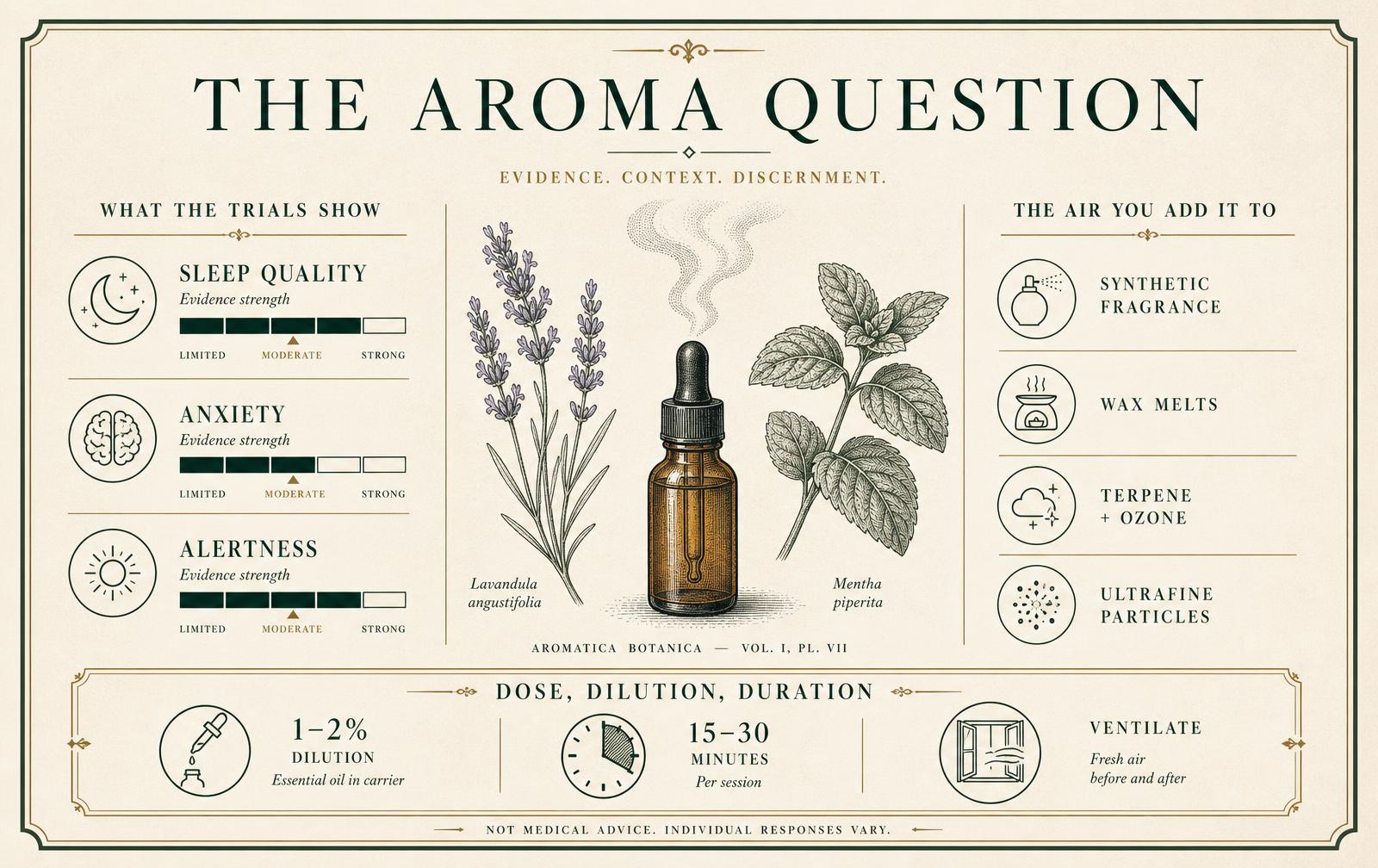
The accurate summary is narrower and more useful. Essential oils are concentrated mixtures of volatile organic compounds. Inhaled at low dose for short periods, several of them produce measurable, reproducible, modest changes in sleep quality, anxiety scores, and subjective alertness. They do not correct chronic fatigue, they do not detoxify organs, and they are not a substitute for sleep, food, movement, or medical care.
The more consequential finding sits one layer out. Most people are already inhaling engineered aroma chemistry all day — plug-in fresheners, scented wax melts, laundry products, "fragrance" on a personal-care label. That exposure is continuous, unlabelled, and better documented as a health input than most of the claims made for the oils themselves.
The most defensible use of essential oils is not adding a scent to your day. It is replacing the synthetic fragrance you were already breathing.
Contents(15 sections)
Story at a glance
Essential oils are volatile organic compounds. Their effects arrive through inhalation and skin absorption, and they are dose-dependent like any other bioactive compound.
Randomised trials of inhaled lavender show small-to-moderate improvements in sleep quality and state anxiety across surgical, stroke, and hypertensive populations. Effects are short-acting and measured over days, not months.
Peppermint and rosemary volatiles show modest, inconsistent effects on alertness and cognitive-task performance — enough to be interesting, not enough to treat brain fog.
No essential oil has been shown to correct the drivers of chronic fatigue: sleep debt, insulin resistance, anaemia, thyroid dysfunction, apnoea, or under-recovery from training.
Topical use requires dilution. Undiluted application is the main cause of chemical burns and long-term sensitisation, and oxidised citrus and tea tree oils become more sensitising as they age.
Adulteration is common. Independent GC-MS surveys of retail lavender and tea tree oils repeatedly find synthetic linalool, added diluents, and compositions that fail ISO reference profiles.
Synthetic fragrance products are the larger exposure story: diethyl phthalate from candles and incense, and rapid ultrafine-particle formation when scented wax melts and terpenes react with indoor ozone.
The strongest practical position: subtract synthetic fragrance from your indoor air first, then use a small number of genuine oils, diluted, for short sessions, with ventilation.
The Primer
What an essential oil actually is
An essential oil is what you get when you steam-distil or cold-press aromatic plant material and collect the volatile fraction. "Volatile" is the operative word: these molecules evaporate at room temperature, which is why you smell them, and why inhalation is their most efficient route of entry.
A single oil is not a single compound. Lavender oil is mostly linalool and linalyl acetate. Peppermint is dominated by menthol and menthone. Rosemary varies by chemotype but often carries substantial 1,8-cineole. Each of these has its own pharmacology, and the ratio between them varies with species, growing region, harvest timing, and distillation method. Two bottles labelled "lavender" can be chemically different products.
Concentration is the point most often missed. Distillation concentrates plant volatiles by roughly one to two orders of magnitude relative to the fresh herb. A drop of oregano oil is not a culinary amount of oregano. This is why the safety rules exist.
The three routes, and what each one is good for
Inhalation is where most of the credible evidence sits. Volatiles reach the olfactory epithelium within seconds, and olfactory signalling connects directly into limbic structures involved in arousal, emotional tone, and autonomic regulation. This is a fast, short-acting pathway — which fits the trial data, where effects appear within a 15-to-30-minute session and fade afterwards.
Topical application works, but requires a carrier. Essential-oil constituents are lipophilic and cross the stratum corneum readily; blood-level studies detect constituents within minutes of application. That efficiency is exactly why undiluted use is a problem rather than a shortcut.
Internal use is where the risk-to-evidence ratio is worst. Enteric-coated peppermint oil for irritable bowel symptoms is a genuine, studied exception with defined dosing. Casual ingestion of oils in water is not that, and paediatric ingestion of oils such as eucalyptus, camphor, and wintergreen is a recognised poisoning-centre presentation.
Sleep and anxiety: the strongest signal
Inhaled lavender is the most-replicated intervention in this field, and it has been tested in populations where sleep is genuinely disrupted rather than in healthy volunteers alone.
A 2025 randomised controlled trial in patients recovering from intracranial tumour surgery found improved postoperative sleep quality with lavender inhalation aromatherapy. A single-blind randomised trial in stroke patients reported improvements in both depression scores and sleep quality. A placebo-controlled trial in middle-aged hypertensive adults, using 15-minute inhalation sessions daily for a week, reported reductions in state anxiety and fatigue scores alongside small blood-pressure changes.
The pattern across this literature is consistent and worth stating plainly: real effects, small-to-moderate effect sizes, subjective outcomes measured by questionnaire, short trial durations, and difficult blinding — you cannot hide a smell from a participant. That combination means the direction of effect is credible while the magnitude is probably overstated.
Interpreted honestly, this makes lavender inhalation a reasonable low-risk adjunct to a sleep routine. It does not make it a treatment for insomnia.
Energy and brain fog: the weakest claim
"Energy" is the claim most heavily marketed and least supported. Peppermint and rosemary volatiles have been tested on reaction time, sustained attention, and subjective alertness, with results that are modest, inconsistent between labs, and confounded by expectancy and by simple arousal from a sharp odour.
More importantly, brain fog and chronic fatigue are downstream symptoms, not diagnoses. The common drivers are sleep-disordered breathing, chronic sleep restriction, poor glycaemic control, iron or B12 deficiency, thyroid dysfunction, medication effects, and sustained psychological load. None of these respond to a scent. Using aroma as the intervention while leaving the driver in place is the most common way people waste a year.
The defensible framing: aromatics can shift state — a short lift in perceived alertness, a calmer transition into sleep. They cannot supply capacity.
The safety rules that actually matter
- Dilute for skin. One to two percent in a carrier oil is a standard adult range for body use — roughly six to twelve drops per 30 ml. Face and children require lower.
- Never apply undiluted to broken or inflamed skin, and keep all oils away from eyes and mucous membranes.
- Store cold, dark, and closed. Citrus oils and tea tree oxidise on air exposure, and the oxidation products are markedly more sensitising than the fresh oil. An open bottle from three years ago is a different chemical.
- Sensitisation is cumulative and permanent-ish. Daily undiluted use of a favourite oil is the classic route to a lifelong allergy to it.
- Treat photosensitising citrus oils with care. Expressed bergamot and lime contain furocoumarins that cause phototoxic reactions under sun exposure.
- Do not diffuse continuously. Short sessions with ventilation, not an all-day fog.
- Ask before use in pregnancy, epilepsy, asthma, or with children — several oils, including wintergreen, camphor, and high-cineole products, have specific contraindications.
Purity: assume nothing from the label
Independent analyses have repeatedly found that retail essential oils do not match their labels. GC-MS surveys of commercial Lavandula angustifolia oils have documented widespread adulteration and failure against ISO reference profiles; comparable case studies exist for lemon and tea tree. Common tactics are synthetic linalool and linalyl acetate, cheaper species substitution such as lavandin for true lavender, and dilution with odourless carriers.
Marketing terms do not solve this. "Therapeutic grade" is a trademarked marketing phrase with no regulatory definition. What has meaning is a batch-specific GC-MS report, the botanical species and chemotype named on the label, country of origin, and a company that publishes analytical data rather than testimonials.
The bigger exposure: the fragrance you did not choose
This is the part of the conversation with the strongest data, and it usually gets the least attention.
Scented consumer products are a major and continuous source of indoor volatile organic compounds. Chamber and residential studies show that scented wax melts — marketed as the clean, flame-free option — release enough terpenes to drive rapid formation of atmospheric nanoparticles indoors, at concentrations comparable to combustion sources. Candle and incense burning has been characterised as a significant source of diethyl phthalate exposure indoors, a plasticiser used to fix fragrance and flagged for endocrine and neurodevelopmental concern. Air-freshener emissions react with indoor ozone to generate formaldehyde, secondary organic aerosol, and ultrafine particles.
Under US labelling rules, "fragrance" can stand in for dozens of undisclosed constituents, so consumers cannot audit this exposure from the packaging. The practical implication is straightforward and does not require alarm: reducing plug-ins, wax melts, heavily fragranced laundry products, and scented personal care lowers a real, measurable, chronic inhalation load. Ventilation does the rest.
That is why the strongest version of this topic is subtractive. The reliable win is not adding an aroma. It is removing engineered fragrance from the air you sit in for sixteen hours a day, and then, if you want, using a small number of verified oils deliberately.
The Deep Dive
Mechanism: how a smell changes physiology
Olfactory receptor neurons project to the olfactory bulb, which connects — without a thalamic relay — to the piriform cortex, amygdala, and entorhinal cortex, and from there into hypothalamic and hippocampal circuitry. This anatomy explains the speed and the affective quality of odour responses: a scent reaches emotion- and arousal-regulating structures faster than a conscious label reaches the odour.
Beyond olfactory signalling, several constituents have direct pharmacology. Linalool has been characterised in rodent work as producing anxiolytic-like effects that depend on intact olfactory input and on GABA-A receptor signalling, which places at least part of lavender's effect in the same broad receptor space as conventional anxiolytics — at far lower occupancy. Menthol acts on TRPM8 cold receptors, producing the cooling and perceived-airflow effect that patients often report as easier breathing even when spirometry does not change. 1,8-cineole is absorbed rapidly through the respiratory route and has documented anti-inflammatory activity in airway models.
Tier II · Members only · Free
Continue into the deep dive
Tier I is free and always open. Tier II — the full mechanisms, dosing detail, nuance, and citations — unlocks with a free Vital Codex membership.
- Every Tier II deep dive across all hubs
- Saved reading progress across articles
- Member knowledge modules and their quizzes
- The Dispatch, if you opt in
Frequently asked
Do essential oils really improve sleep?
Inhaled lavender has been shown in multiple randomised controlled trials to modestly improve self-reported sleep quality, including in postoperative and stroke populations. Effects are small, short-acting, and measured mainly by questionnaire. It is a reasonable adjunct to a wind-down routine, not a treatment for insomnia.
Can essential oils fix brain fog or chronic fatigue?
No. Peppermint and rosemary volatiles may briefly raise subjective alertness, but no essential oil corrects the common causes of fatigue — sleep debt, sleep apnoea, iron or B12 deficiency, thyroid dysfunction, poor glycaemic control, or chronic stress load. Those require assessment and specific treatment.
Is it safe to put essential oils directly on skin?
Undiluted application is the leading cause of essential-oil chemical burns and lasting sensitisation. Dilute to roughly one to two percent in a carrier oil for adult body use, use lower concentrations on the face and with children, and avoid oxidised older oils, which are more sensitising than fresh ones.
Should I swallow essential oils?
Generally no. Enteric-coated peppermint oil capsules for irritable bowel symptoms are a specific, studied exception with defined dosing. Casual ingestion carries real risks of mucosal injury, hepatic load, and drug interactions, and accidental ingestion in children is a recognised poisoning presentation.
How much of the market is adulterated?
Independent GC-MS surveys of retail lavender, lemon, and tea tree oils have repeatedly found adulteration — synthetic constituents, species substitution, and odourless diluents — with many samples failing ISO reference profiles. Reported failure rates vary widely by market and sampling method, so treat specific percentages with caution and rely on batch-specific analytical reports instead of label claims.
Are scented candles and plug-in air fresheners actually harmful?
They are a measurable indoor-air exposure. Candle and incense burning has been identified as a significant indoor source of diethyl phthalate, scented wax melts drive rapid ultrafine-particle formation, and air-freshener terpenes react with ozone to produce formaldehyde and secondary organic aerosol. Reducing these products and ventilating is a low-cost, evidence-supported change.
Is "therapeutic grade" a real standard?
No. It is a marketing term with no regulatory or analytical definition. Meaningful indicators are the botanical species and chemotype, country of origin, extraction method, and a batch-specific GC-MS report you can actually read.
Research Notes & Sources(expand)
Dong Y, Wang X, Huang Y, et al. "Effects of lavender essential oil inhalation aromatherapy on postoperative sleep quality in patients with intracranial tumors: a randomized controlled trial." Frontiers in Pharmacology, 2025. doi:10.3389/fphar.2025.1584998
Randomised placebo-controlled pilot trial of inhaled lavender essential oil on anxiety, fatigue, blood pressure, and sleep quality in middle-aged adults with hypertension, using 15-minute daily inhalation sessions over seven days. PMID: 41177368
Single-blind randomised controlled trial of lavender inhalation aromatherapy on depression and sleep quality in stroke patients. Complementary Therapies in Clinical Practice, 2024.
"Lavender essential oil market integrity: a comprehensive study of commercial Lavandula angustifolia essential oils adulteration and assessment of industrial standards." Industrial Crops and Products, 2024.
Do TKT, et al. "Adulteration of essential oils: a multitask issue for quality control. Three case studies: Lavandula angustifolia Mill., Citrus limon (L.) Osbeck and Melaleuca alternifolia (Maiden & Betche) Cheel." Molecules, 2021;26(18):5610.
"In chemico evaluation of tea tree essential oils as skin sensitizers: impact of the chemical composition on aging and generation of reactive species." Chemical Research in Toxicology, 2016.
Patra SS, et al. "Flame-free candles are not pollution-free: scented wax melts as a significant source of atmospheric nanoparticles." Environmental Science & Technology Letters, 2025. doi:10.1021/acs.estlett.4c00986
"Rapid nucleation and growth of indoor atmospheric nanocluster aerosol during the use of scented volatile chemical products in residential buildings." ACS ES&T Air, 2024.
"Incense and candle burning: a major source of phthalate exposure in indoor environments." Johns Hopkins University, chamber and residential characterisation of diethyl phthalate emissions.
"Characterization of air freshener emission: the potential health effects." Journal of Toxicological Sciences, 2015. PMID: 26354370
Radis-Baptista G. "Do synthetic fragrances in personal care and household products impact indoor air quality and pose health risks?" Journal of Xenobiotics, 2023;13(1):121–131.
Harada H, et al. Work on linalool odour exposure, olfactory-dependent anxiolytic-like effects, and GABA-A involvement in rodent models.
Kasper S, et al. Randomised controlled trials of Silexan, a standardised oral lavender oil preparation, in anxiety disorders and subsyndromal anxiety.
Woo CC, et al. Overnight olfactory enrichment and cognitive outcomes in older adults, including verbal learning measures and uncinate fasciculus imaging. Frontiers in Neuroscience, 2023.
This article is educational and not medical advice. Essential oils can interact with medications and are contraindicated in several clinical situations. Discuss use with a qualified clinician, particularly in pregnancy, epilepsy, asthma, and with children.
Continue exploring: The Vital Codex library on sleep, recovery, and the environment your physiology sits in.
Explore Sleep & Recovery