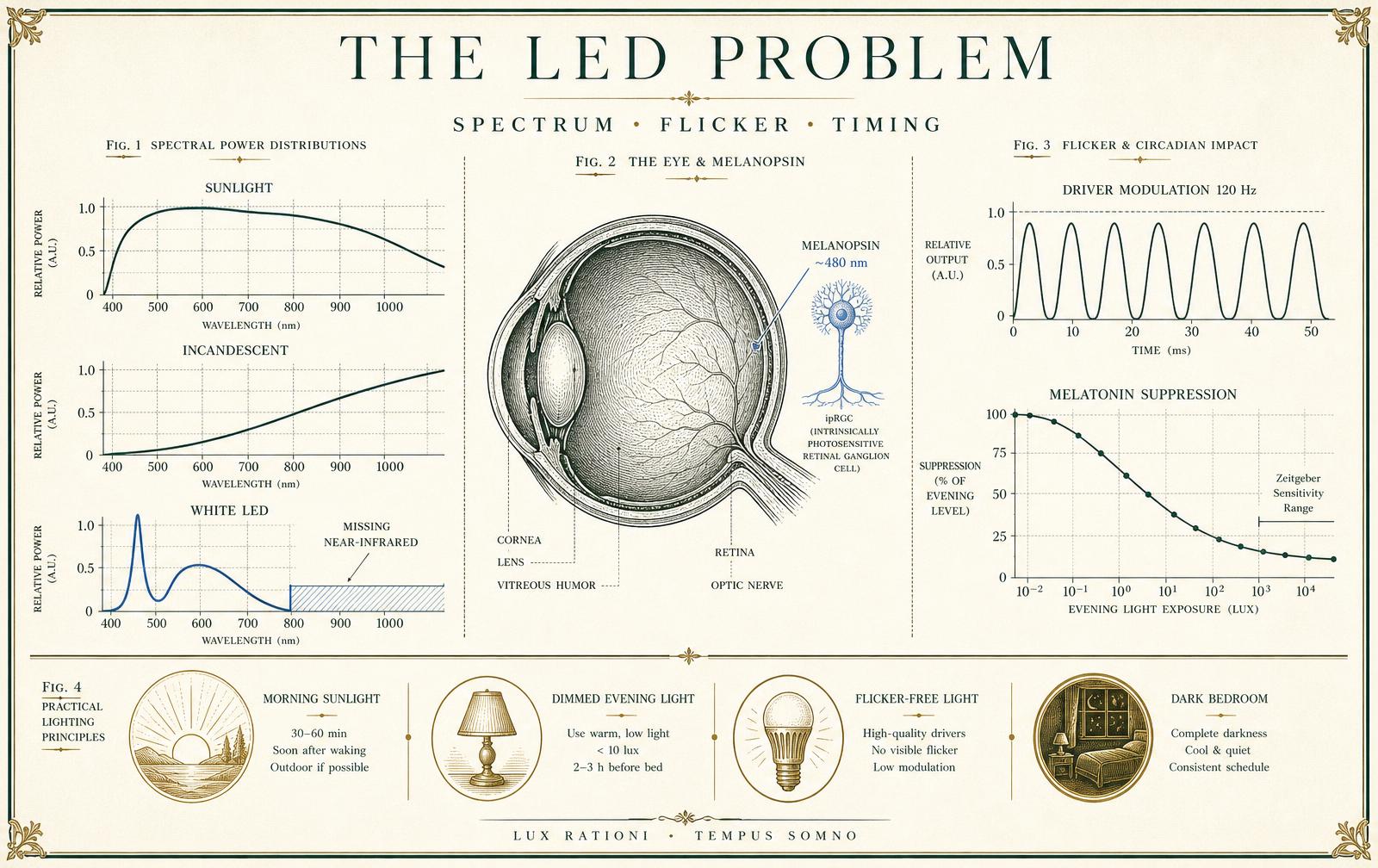
The honest version of the LED story is narrower and more interesting than either the marketing or the alarm. White LEDs do not emit white light. They emit a narrow spike of blue from a gallium nitride die, partially converted by a phosphor coating into a broad yellow hump. The result is a spectrum weighted toward the exact wavelengths the circadian system is most sensitive to, with almost no red and effectively zero near-infrared — the half of sunlight that penetrates tissue and interacts with mitochondria.
Add the second, less discussed issue: most LEDs are driven by circuitry that ripples at twice the mains frequency, producing a flicker that the conscious visual system cannot see but the retina and visual cortex still register. Neither problem makes LEDs dangerous in the tabloid sense. Both make the average indoor evening a poor biological match for the organism sitting in it — and both are fixable with choices about spectrum, intensity, timing, and driver quality rather than fear.
An LED is not a small sun. It is a blue laser wearing a phosphor coat.
Contents(15 sections)
Key takeaways
White LEDs produce a blue spike near 450–460 nm, which sits close to the peak sensitivity (~480 nm) of the melanopsin-containing retinal cells that set circadian timing (Brainard et al., 2001; Thapan et al., 2001).
Ordinary room-level evening light suppresses melatonin in most people, and sensitivity varies enormously between individuals — by more than fiftyfold in controlled testing (Phillips et al., 2019).
LEDs emit essentially no near-infrared. Sunlight is roughly half infrared, and incandescent bulbs were largely infrared; modern indoor life has removed a wavelength band humans were continuously exposed to.
Flicker from low-quality LED drivers is linked in controlled studies to headache, eyestrain, and impaired visual performance, even when it is invisible (Wilkins et al., 2010; IEEE 1789 guidance).
The fixes are practical: bright light early, low and warm light late, flicker-free or DC-driven fixtures, and eye level below the light source after dark.
The Primer
What an LED actually emits
An incandescent bulb glowed because a tungsten filament was hot. That produced a smooth blackbody curve — modest blue, generous red, and a large infrared tail. It was a terrible heater-shaped lightbulb and an excellent spectral approximation of firelight.
A white LED works differently. A semiconductor die emits a narrow band of blue photons. A phosphor layer absorbs some of them and re-emits a broad yellow-green glow. Blue plus yellow reads as white to the eye. But the underlying spectrum is spiky, deficient in deep red, and completely absent above roughly 700 nm.
So "warm white" LED does not mean the same thing as warm incandescent light. A 2700 K LED has been tuned to look warm by shifting the phosphor mix. The blue spike is reduced, not removed, and the infrared is still missing.
The circadian consequence
A separate class of retinal cell — intrinsically photosensitive retinal ganglion cells, containing the pigment melanopsin — reports ambient light level to the brain's master clock. These cells are most responsive to short-wavelength light around 480 nm, and they care about intensity, duration, and timing far more than about how bright the light subjectively feels.
This is why a phone at midnight and a ceiling fixture at midnight are the same category of problem. It is also why the practical variables are simple: how much light, how blue, how long, and at what hour.
Flicker: the invisible half of the problem
Most household LEDs are fed by inexpensive drivers that pass ripple from the AC supply through to the light output. The result is a rapid oscillation in brightness. Above roughly 60–90 Hz you cannot consciously see it, but the retina still responds, and controlled work on fluorescent lighting decades ago established that invisible flicker can double headache incidence in office workers.
You can test any fixture in ten seconds. Wave a pencil quickly under the light: a smooth blur is good, a stroboscopic series of frozen pencils is flicker. Or point a phone camera at it and look for rolling bands.
The missing wavelength
Sunlight at the surface is roughly half infrared by energy. Firelight and incandescent bulbs were overwhelmingly infrared. Near-infrared light penetrates skin and soft tissue by centimetres, and there is a substantial photobiomodulation literature on red and near-infrared wavelengths interacting with mitochondrial cytochrome c oxidase.
The claim worth making is the conservative one: modern indoor environments have subtracted a wavelength band that every previous human generation received all day, and the long-term consequences of that subtraction have not been studied. That is a genuine gap, not a proven harm — and it is a strong argument for going outside rather than for buying a gadget.
What to do about it
Four changes cover most of the benefit.
Get bright light early. Outdoor morning light is 10–100× brighter than any indoor fixture. This anchors the clock and makes the evening easier.
Drop the light level after sunset. Intensity matters more than colour temperature. Dim first, then warm.
Move light below eye level. Melanopsin cells are concentrated to favour the upper visual field — light from above hits them harder. Lamps, not ceiling grids, after dark.
Buy for quality, not just watts. Look for high CRI (90+), a stated flicker percentage or "flicker-free" claim, and 2200–2700 K for evening fixtures.
The Deep Dive
The spectral power distribution, precisely
The phosphor-converted white LED spectrum has two features that matter. The first is the InGaN emission peak, typically 450–460 nm with a full width at half maximum of around 20 nm — narrow and tall relative to any thermal source. The second is a pronounced trough between the blue peak and the phosphor hump, in the cyan region around 480–500 nm.
That trough is metabolically interesting because melanopsin's peak spectral sensitivity sits at approximately 480 nm. Manufacturers reduce the appearance of harshness by tuning the phosphor, which changes correlated colour temperature without necessarily changing melanopic content proportionally. Correlated colour temperature is therefore a poor proxy for biological effect. The correct metric is melanopic equivalent daylight illuminance (melanopic EDI), now formalised in CIE S 026, which weights the spectrum by melanopsin sensitivity. Two bulbs with identical 2700 K ratings can differ meaningfully in melanopic EDI.
Tier II · Members only · Free
Continue into the deep dive
Tier I is free and always open. Tier II — the full mechanisms, dosing detail, nuance, and citations — unlocks with a free Vital Codex membership.
- Every Tier II deep dive across all hubs
- Saved reading progress across articles
- Member knowledge modules and their quizzes
- The Dispatch, if you opt in
Frequently asked
Are LED lights actually harmful?
Not in the sense of causing disease at household exposure levels. The demonstrated issues are circadian — blue-weighted light in the evening suppresses melatonin and delays sleep timing — and ergonomic, in the case of flicker from low-quality drivers. Claims of LED-caused macular degeneration in humans are not supported by current evidence.
Do blue-light-blocking glasses work?
For eyestrain and eye protection, a 2023 Cochrane review found no reliable evidence of benefit. For evening circadian protection they can help modestly by reducing melanopic stimulus, but lowering the ambient light level is more effective and costs nothing.
Is warm-white LED enough, or do I need incandescent bulbs?
Warm-white LED reduces the blue spike and is a genuine improvement for evening use. What it cannot restore is near-infrared. If you like the quality of incandescent or halogen light in evening lamps, that is a defensible preference; the more important variable is simply how bright the room is after sunset.
How do I test a bulb for flicker?
Wave a pencil rapidly beneath it. A smooth blur means low modulation; a series of distinct frozen images means significant flicker. A phone camera in video mode showing rolling dark bands is a second, cruder test.
What about LED screens versus LED room lights?
Room lights usually matter more. A ceiling fixture fills the upper visual field where melanopsin cells are most concentrated and typically delivers more melanopic stimulus at the eye than a phone held at arm's length. Dim the room before you worry about the screen.
Does daytime LED exposure cause the same problem?
The opposite. Bright, blue-containing light during the day strengthens circadian amplitude and reduces evening light sensitivity. The goal is not less blue light overall — it is blue light in daylight hours and its near-absence after dark.
Continue exploring: Sleep & Recovery — Glymphatic clearance and autonomic regulation.
Explore Sleep & Recovery