The brain has no conventional lymphatic vessels. It clears metabolic waste through a perivascular pathway that pushes cerebrospinal fluid through brain tissue and flushes the interstitium — and that pathway runs at a fraction of its capacity while you are awake. Deep, consolidated sleep is not when clearance is convenient. It is when clearance happens.
Contents(12 sections)
Key takeaways
Glymphatic clearance increases dramatically during slow-wave sleep, driven by interstitial space expansion and slow-wave-coupled CSF pulsation.
Alcohol before bed, fragmented sleep, and untreated sleep apnea are the most reliable ways to suppress it.
Side-sleeping shows greater clearance than supine or prone in animal imaging.
Aerobic fitness and consistent sleep timing improve clearance; sedative-hypnotics that suppress slow-wave sleep can impair it even while increasing time asleep.
The Primer
What the glymphatic system is
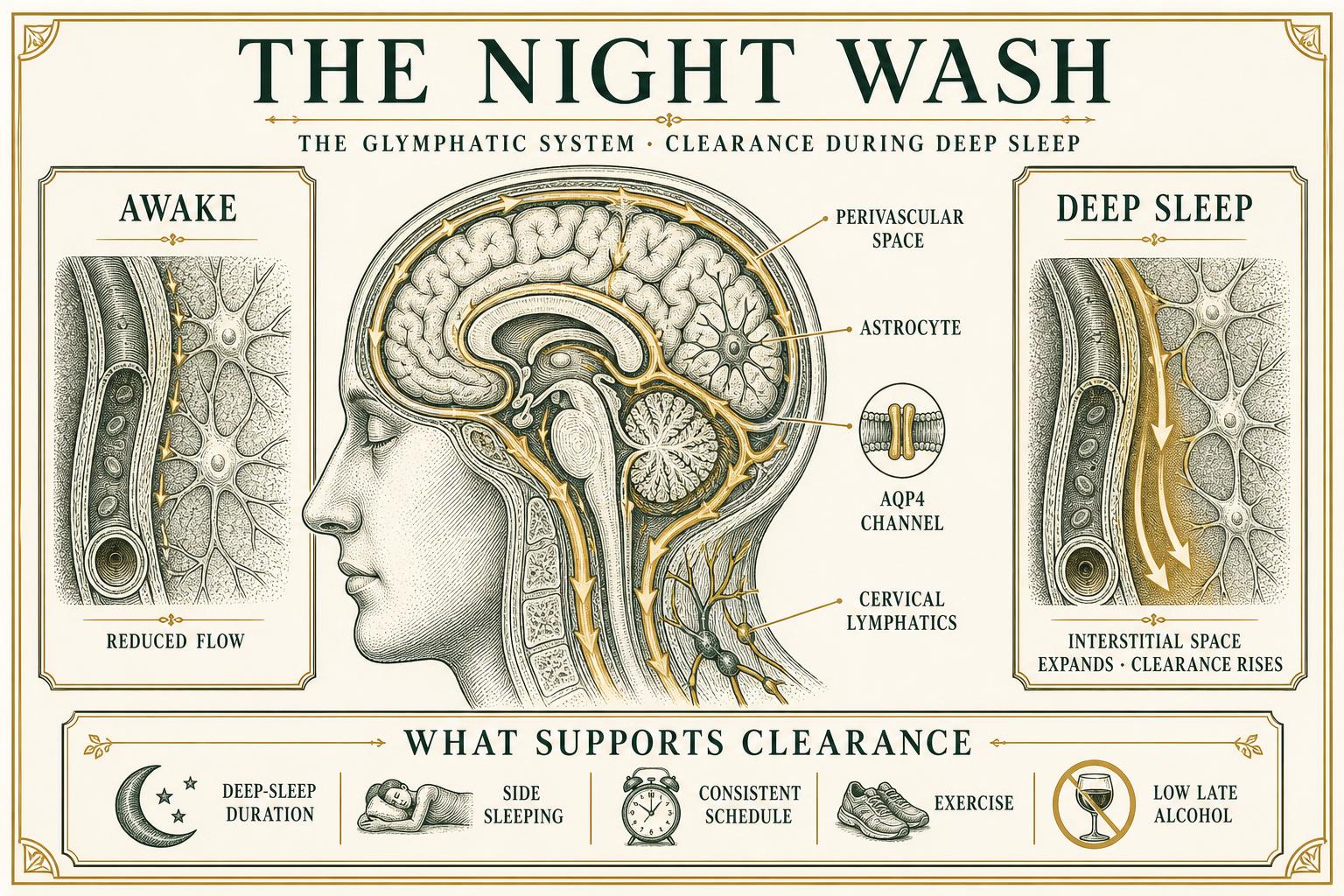
Cerebrospinal fluid flows into the brain along the outside of arteries, moves through brain tissue, picks up metabolic waste, and drains along veins toward lymphatic vessels in the dura and eventually the neck. Because this movement depends on astrocytes — glial cells — the system was named "glymphatic."
Among the things it clears are amyloid-beta and tau, the proteins that accumulate in neurodegenerative disease. That connection is what turned a plumbing detail into a central question in brain health.
Why sleep is the switch
During deep sleep the space between brain cells expands substantially, lowering resistance to fluid flow. At the same time, large slow waves of neural activity drive rhythmic pulses of cerebrospinal fluid into and out of the brain. Awake, that same pathway moves comparatively little fluid.
This is the mechanistic reason short or fragmented sleep is not simply tiring — the clearance work does not get done.
The practical protocol
Protect slow-wave sleep, which is concentrated in the first half of the night. That means a consistent bedtime, a cool dark room, no alcohol within three hours of sleep, and caffeine ending by early afternoon.
Treat snoring with breathing pauses seriously — untreated sleep apnea fragments exactly the sleep stage that matters here. Daily aerobic exercise increases both slow-wave sleep and measured clearance. And if you have a choice, sleep on your side.
The Deep Dive
The anatomy of flow
CSF enters along periarterial spaces bounded by the vascular basement membrane and astrocytic endfeet. Aquaporin-4 (AQP4) water channels, densely polarized to those endfeet, mediate convective flux from periarterial space into the interstitium. Solute-laden interstitial fluid then exits along perivenous routes and drains via meningeal lymphatics and cervical lymph nodes.
Loss of AQP4 polarization — seen in aging, traumatic brain injury, and reactive astrogliosis — reduces clearance substantially in knockout and mislocalization models, and is one of the leading candidate mechanisms linking aging to protein accumulation.
Tier II · Members only · Free
Continue into the deep dive
Tier I is free and always open. Tier II — the full mechanisms, dosing detail, nuance, and citations — unlocks with a free Vital Codex membership.
- Every Tier II deep dive across all hubs
- Saved reading progress across articles
- Member knowledge modules and their quizzes
- The Dispatch, if you opt in
Frequently asked
Does the glymphatic system only work during sleep?
It operates at much lower throughput while awake. The large increase in clearance is specific to slow-wave sleep, which is why deep sleep in the first half of the night matters disproportionately.
Do naps help?
Short naps contain little slow-wave sleep unless you are sleep-deprived. They help alertness; they are not a substitute for consolidated nocturnal deep sleep.
Does alcohol really matter that much?
Yes. It shortens sleep latency but suppresses slow-wave sleep later in the night and fragments the second half — the exact opposite of what clearance requires.
Is this proven to prevent dementia?
No. The association between poor sleep, impaired clearance, and protein accumulation is strong and mechanistically coherent, but a causal prevention claim in humans is not established. The sleep behaviors themselves are well-supported on their own merits.
Continue exploring: Sleep & Recovery — Glymphatic clearance and autonomic regulation.
Explore Sleep & Recovery