The circadian system does not run on habit. It runs on light hitting a specialized set of retinal cells that report ambient brightness to the hypothalamus. Indoor daytime light is roughly a hundredth of outdoor light, and evening indoor light is hundreds of times brighter than anything our physiology evolved to see after sunset. Both errors push in the same direction: a clock that runs late and a sleep window that will not hold.
Contents(12 sections)
Key takeaways
Get 10–30 minutes of outdoor light within an hour of waking; brightness beats duration.
Dim indoor light aggressively in the last two to three hours before bed.
Timing determines direction: morning light advances the clock, evening light delays it.
Blue-blocking glasses are the weakest of these levers. Reducing total light intensity matters more.
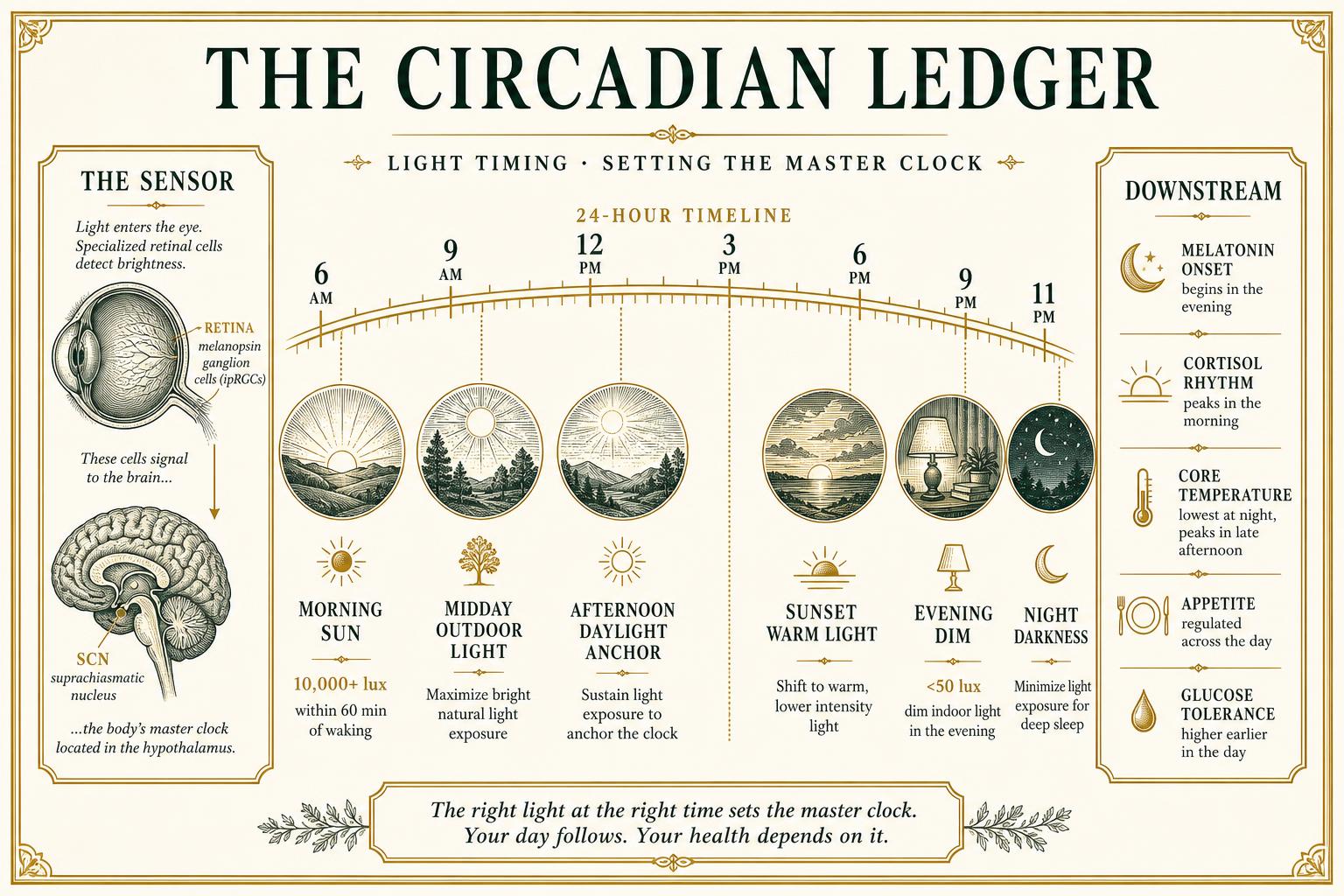
The Primer
The cells that actually keep time
A small population of retinal ganglion cells contains melanopsin, a photopigment most sensitive to blue-range light around 480 nm. These cells do not contribute to what you see. They project to the suprachiasmatic nucleus, the master clock, reporting how bright the environment is. That signal sets the timing of melatonin release, cortisol rhythm, core temperature, and hundreds of downstream gene expression cycles.
Because these cells respond to overall brightness rather than fine detail, intensity and duration matter more than the specific screen or bulb.
The intensity gap nobody accounts for
Outdoor daylight runs 10,000–100,000 lux. A well-lit office runs 300–500. A living room in the evening runs 50–200 — while a moonlit night runs under 1. Modern life delivers a weak daytime signal and a strong nighttime one, which is precisely the pattern that flattens circadian amplitude.
The fix is not complicated: make mornings brighter and evenings dimmer. Going outside is the single highest-yield action, and it works even on overcast days, when outdoor illuminance still exceeds indoor by an order of magnitude.
Direction depends on timing
The same light shifts the clock in opposite directions depending on when it lands. Light in the hours after your habitual wake time advances the clock — you get sleepy earlier. Light in the hours before your habitual bedtime delays it — you get sleepy later. This is why late-night screen use and late morning wake times reinforce each other into a progressively later rhythm.
The Deep Dive
The phase response curve
The circadian pacemaker's response to light follows a predictable curve anchored to core body temperature minimum, which falls roughly two hours before habitual wake time. Light after that minimum produces phase advance; light before it produces phase delay. The crossover is sharp, and the delay region is more sensitive than the advance region — one reason delayed phase is easier to acquire than to correct.
Sensitivity is also nonlinear in intensity. The dose-response saturates: much of the achievable melatonin suppression occurs below 200 lux, with half-maximal effects in the region of 100 lux in dark-adapted subjects. Practically, this means evening light reduction has to be substantial — dropping from 200 lux to 100 lux accomplishes less than the numbers suggest.
Tier II · Members only · Free
Continue into the deep dive
Tier I is free and always open. Tier II — the full mechanisms, dosing detail, nuance, and citations — unlocks with a free Vital Codex membership.
- Every Tier II deep dive across all hubs
- Saved reading progress across articles
- Member knowledge modules and their quizzes
- The Dispatch, if you opt in
Frequently asked
How much morning light do I actually need?
Ten to thirty minutes outdoors within an hour of waking covers most people. Overcast days still deliver far more illuminance than indoor lighting.
Do blue-blocking glasses work?
Modestly, in the evening. Reducing overall light intensity is the stronger intervention; wearing them during the day undermines the daytime signal.
Is melatonin a sleeping pill?
No. It is a timing signal. Low doses (0.3–0.5 mg) taken hours before bed shift the clock; the high doses commonly sold add side effects without adding benefit.
Does a light box work as well as sunlight?
For circadian and mood purposes a 10,000-lux box used for 20–30 minutes in the morning is a legitimate substitute when daylight is unavailable. Sunlight remains brighter and free.
Continue exploring: Sleep & Recovery — Glymphatic clearance and autonomic regulation.
Explore Sleep & Recovery