Arterial oxygen saturation in a healthy person at rest is 96–99%. Breathing harder does not raise it meaningfully. What breathing rate actually regulates is carbon dioxide — and carbon dioxide, not oxygen, is what determines how much of the oxygen already in your blood gets released into tissue.
This inverts the intuitive model. Over-breathing does not deliver more oxygen to the brain; by lowering CO₂ it delivers less.
Contents(13 sections)
Key takeaways
CO₂ drives the urge to breathe and controls oxygen release from hemoglobin (the Bohr effect).
Chronic over-breathing lowers arterial CO₂, constricts cerebral vessels, and reduces tissue oxygen delivery.
Nasal breathing generates nitric oxide in the sinuses, which is inhaled and improves pulmonary vasodilation and oxygen uptake.
Nasal breathing during sleep is associated with lower airway resistance events and better sleep continuity than mouth breathing.
CO₂ tolerance is trainable, and slow nasal breathing at around six breaths per minute maximizes vagal activation.
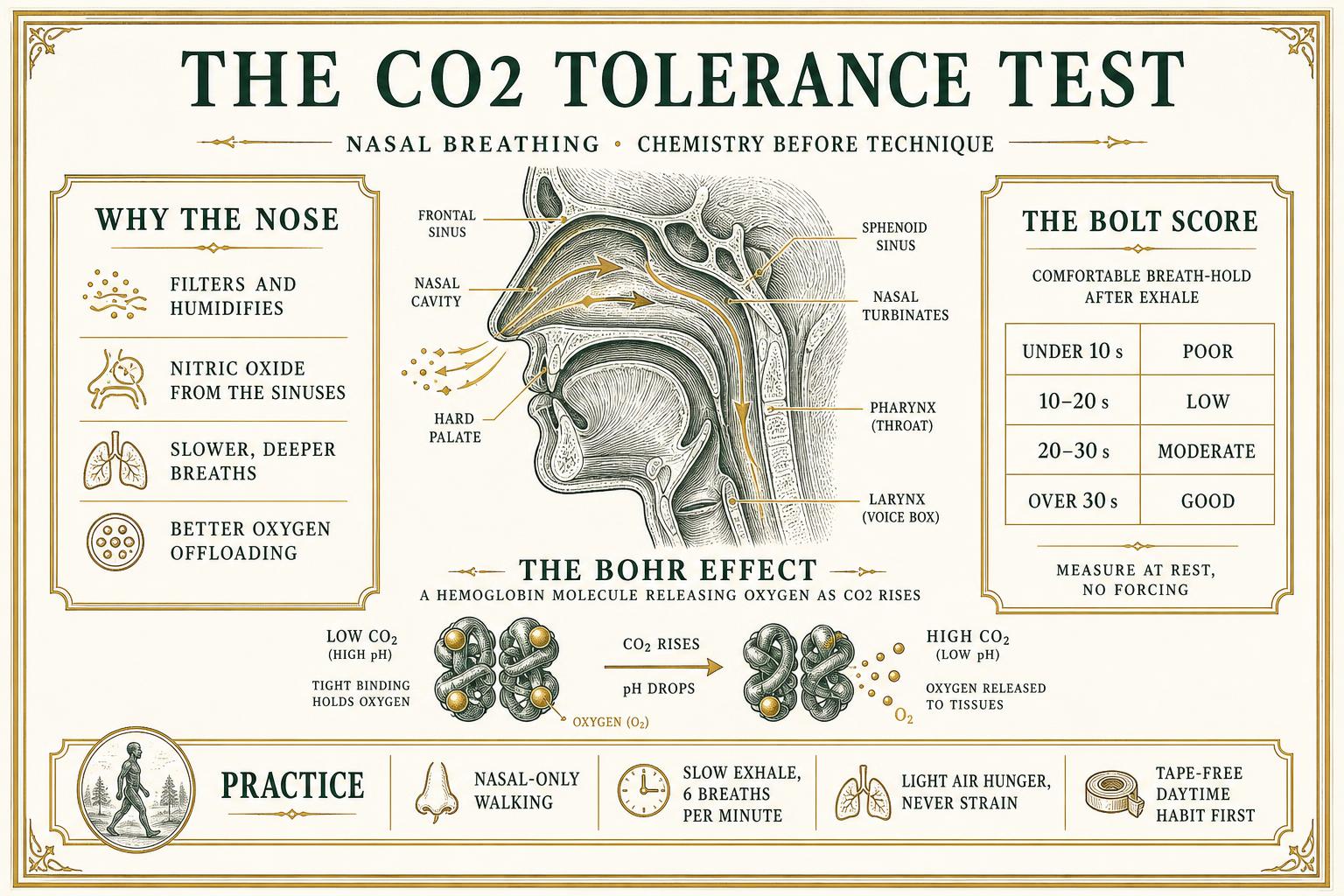
The Primer
What CO₂ actually does
Carbon dioxide is not simply waste. It sets blood pH, and blood pH determines how readily hemoglobin releases oxygen. When CO₂ falls, hemoglobin holds oxygen more tightly and less reaches the tissue that needs it. Low CO₂ also constricts cerebral arteries, which is why hyperventilation produces lightheadedness and tingling — not from lack of oxygen in the blood, but from reduced delivery.
Why the nose matters
The nose filters, humidifies, and warms air, adds resistance that slows the breath, and produces nitric oxide in the paranasal sinuses. That nitric oxide travels down with each inhaled breath, dilating pulmonary vessels and improving the match between airflow and blood flow in the lungs. Mouth breathing bypasses all of it.
Mouth breathing also dries the oral cavity, which shifts the oral microbiome and raises caries and gingivitis risk — a connection worth noting given how tightly oral health tracks cardiovascular risk.
Two things worth practicing
Slow nasal breathing at roughly six breaths per minute — about five seconds in, five seconds out — is the rate that maximizes heart-rate variability and parasympathetic activation. Ten minutes daily is a reasonable dose.
Nasal breathing during light exercise, even if it means going slower at first, raises CO₂ tolerance over a few weeks and makes the same pace feel easier.
Sleep
Nose breathing at night is the higher-leverage change for most people. Signs of mouth breathing during sleep: waking with a dry mouth, morning headache, snoring, and grinding. Addressing nasal obstruction, sleeping on the side, and — for some — gentle mouth taping, are the standard approaches. Anyone with suspected sleep apnea needs assessment first, not a breathing practice.
The Deep Dive
The chemoreflex
Central chemoreceptors in the medulla respond to CSF pH, a proxy for arterial CO₂, and are the dominant drive to breathe under normal conditions. Peripheral chemoreceptors in the carotid bodies respond to oxygen but only meaningfully below roughly 60 mmHg PaO₂. In practice, ventilation is a CO₂-regulated system with an oxygen backup.
Chronic hyperventilation resets the central chemoreceptor set point downward: the same CO₂ level that was previously tolerated now triggers air hunger, which sustains over-breathing. This is the mechanism behind hyperventilation syndrome and part of the physiology of panic. Training slow, reduced-volume breathing shifts the set point back — the measurable outcome referred to as improved CO₂ tolerance.
Tier II · Members only · Free
Continue into the deep dive
Tier I is free and always open. Tier II — the full mechanisms, dosing detail, nuance, and citations — unlocks with a free Vital Codex membership.
- Every Tier II deep dive across all hubs
- Saved reading progress across articles
- Member knowledge modules and their quizzes
- The Dispatch, if you opt in
Frequently asked
Is mouth taping safe?
For people with clear nasal passages and no diagnosed sleep-disordered breathing, generally yes, using porous tape that can be dislodged. It is not appropriate with nasal obstruction, untreated apnea, nausea risk, or alcohol use before bed.
Why do I get lightheaded doing breathing exercises?
Usually from over-breathing during the practice — larger volumes than intended lower CO₂ and constrict cerebral vessels. Reduce volume, not just rate, and stop if symptoms persist.
How long until CO₂ tolerance improves?
Most people see BOLT scores rise within two to three weeks of daily ten-minute practice, with continued gains over a few months.
Does nasal breathing hurt exercise performance?
At first, yes — nasal airflow limits maximum ventilation. After several weeks of adaptation most people match prior paces nasally at submaximal intensities, though maximal efforts still require the mouth.
Continue exploring: Sleep & Recovery — Glymphatic clearance and autonomic regulation.
Explore Sleep & Recovery