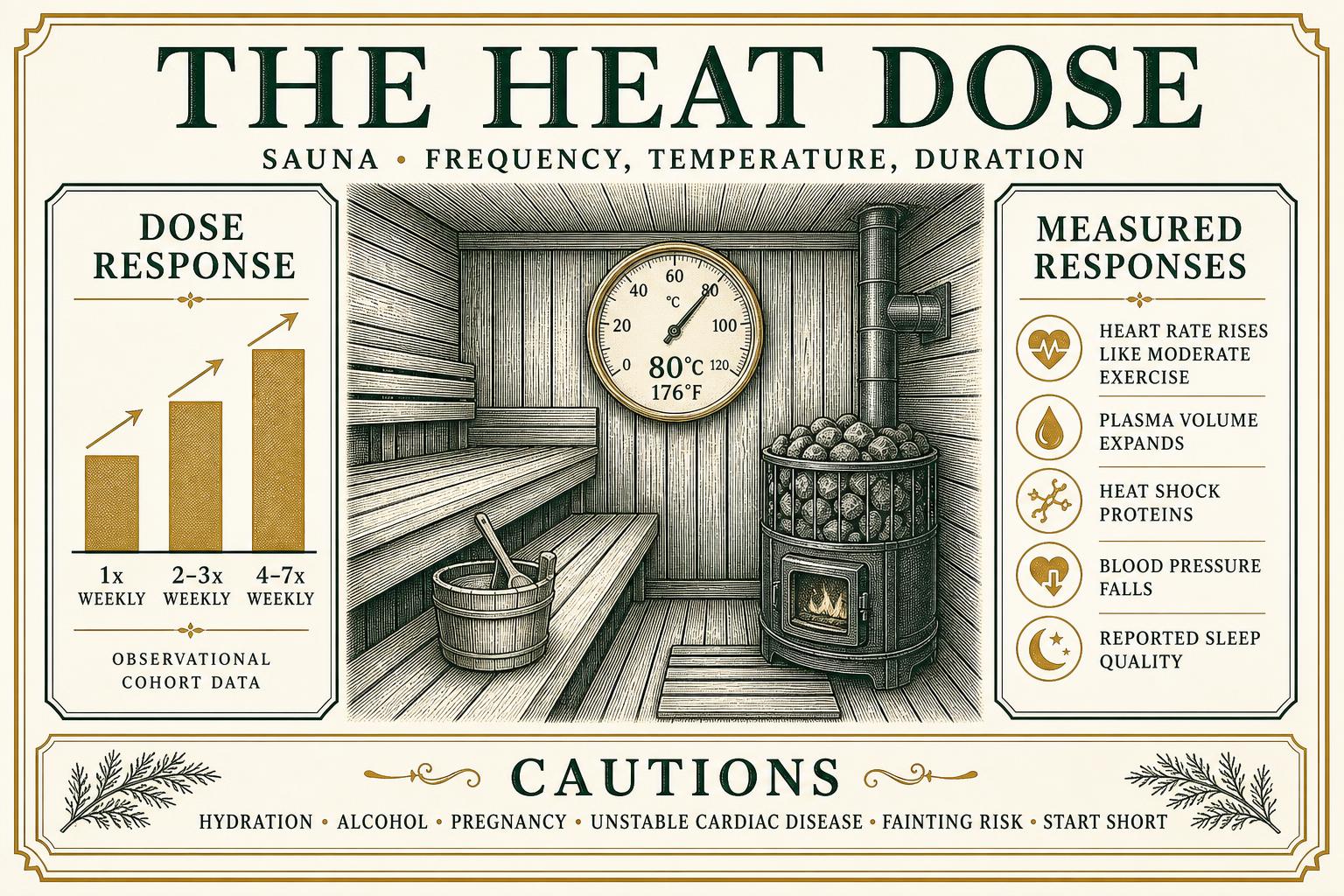
Regular sauna use has one of the cleaner dose-response curves in observational longevity research: in a 20-year Finnish cohort, four to seven sessions weekly tracked with roughly 40% lower all-cause mortality compared to once weekly, with cardiovascular death and dementia incidence moving in the same direction. Frequency, not heat intensity, carried the signal.
Contents(12 sections)
Key takeaways
Four to seven sessions weekly is the frequency associated with the largest observational benefit.
Heat acts as a cardiovascular stimulus: heart rate and cardiac output rise while peripheral resistance falls.
Mechanisms include heat shock protein induction, improved endothelial function, and plasma volume expansion.
Cautions: dehydration, orthostatic hypotension, alcohol, pregnancy, unstable cardiac disease.
The Primer
What heat actually does to the body
Passive heat raises core temperature by roughly 1°C. To dump that heat, skin vessels dilate, plasma volume shifts, and the heart raises output — a session at 80°C sustains heart rates comparable to moderate walking. Blood pressure falls during and after exposure as peripheral resistance drops.
The pattern is a controlled hormetic stress: enough of a challenge to trigger adaptation, brief enough to recover from fully.
What the outcome data show
The Kuopio Ischaemic Heart Disease cohort followed over 2,300 Finnish men for two decades. Sudden cardiac death, fatal coronary disease, and all-cause mortality all fell in a stepwise way with session frequency. Later analyses from the same cohort found lower incidence of dementia and Alzheimer's disease in frequent users, and lower incidence of hypertension in normotensive men at baseline.
This is observational — sauna use correlates with income, leisure, and baseline health. But the dose-response gradient, duration of follow-up, and mechanistic coherence with the trial data on blood pressure and endothelial function make it more than an artifact of habit clustering.
A practical dose
Fifteen to twenty minutes at 80–100°C in a traditional dry sauna, four or more times weekly, is the pattern that matches the cohort data. Infrared cabins run cooler (45–60°C) and need longer sessions to reach comparable core temperature; their outcome evidence is much thinner.
Hydrate before and after, and stand up slowly.
The Deep Dive
Heat shock proteins and proteostasis
Core temperature elevation activates heat shock factor 1, which induces HSP70 and HSP90. These chaperones refold denatured proteins, prevent aggregation, and support autophagy — the same proteostatic machinery implicated in neurodegeneration and sarcopenia. HSP70 induction after a single session persists for roughly 24–48 hours, which is a plausible molecular reason frequency outperforms intensity.
Heat exposure also raises circulating norepinephrine and, in some protocols, growth hormone, and activates the same NRF2-mediated antioxidant response recruited by exercise.
Tier II · Members only · Free
Continue into the deep dive
Tier I is free and always open. Tier II — the full mechanisms, dosing detail, nuance, and citations — unlocks with a free Vital Codex membership.
- Every Tier II deep dive across all hubs
- Saved reading progress across articles
- Member knowledge modules and their quizzes
- The Dispatch, if you opt in
Frequently asked
Is infrared as good as a traditional sauna?
The mechanisms overlap, but nearly all outcome data come from traditional Finnish sauna. Infrared cabins reach lower air temperatures and require longer sessions to raise core temperature comparably.
How hot and how long?
Fifteen to twenty minutes at 80–100°C. Frequency across the week matters more than pushing temperature or duration in a single session.
Does sauna help build muscle?
It does not build muscle directly, but unlike post-workout cold immersion it does not blunt hypertrophy signaling, and heat acclimation improves training capacity in hot conditions.
Can sauna replace exercise?
No. It reproduces some cardiovascular adaptations and is valuable where exercise is limited, but it does not provide the mechanical loading muscle and bone require.
Continue exploring: Sleep & Recovery — Glymphatic clearance and autonomic regulation.
Explore Sleep & Recovery