Occasional trouble falling asleep is usually a signal that the nervous system has not yet finished the transition from performing to resting. The most durable fixes address that transition, not the moment the light goes out.
Contents(13 sections)
Key takeaways
A consistent sleep and wake time is a stronger lever than any single supplement.
Morning daylight and afternoon movement do more for sleep onset than most people expect.
Screens, alcohol, and late high-glycemic meals are the most common suppressors of deep sleep.
Persistent insomnia, loud snoring, or breathing pauses warrant medical evaluation — not more herbs.
The Primer
What sleep support really means
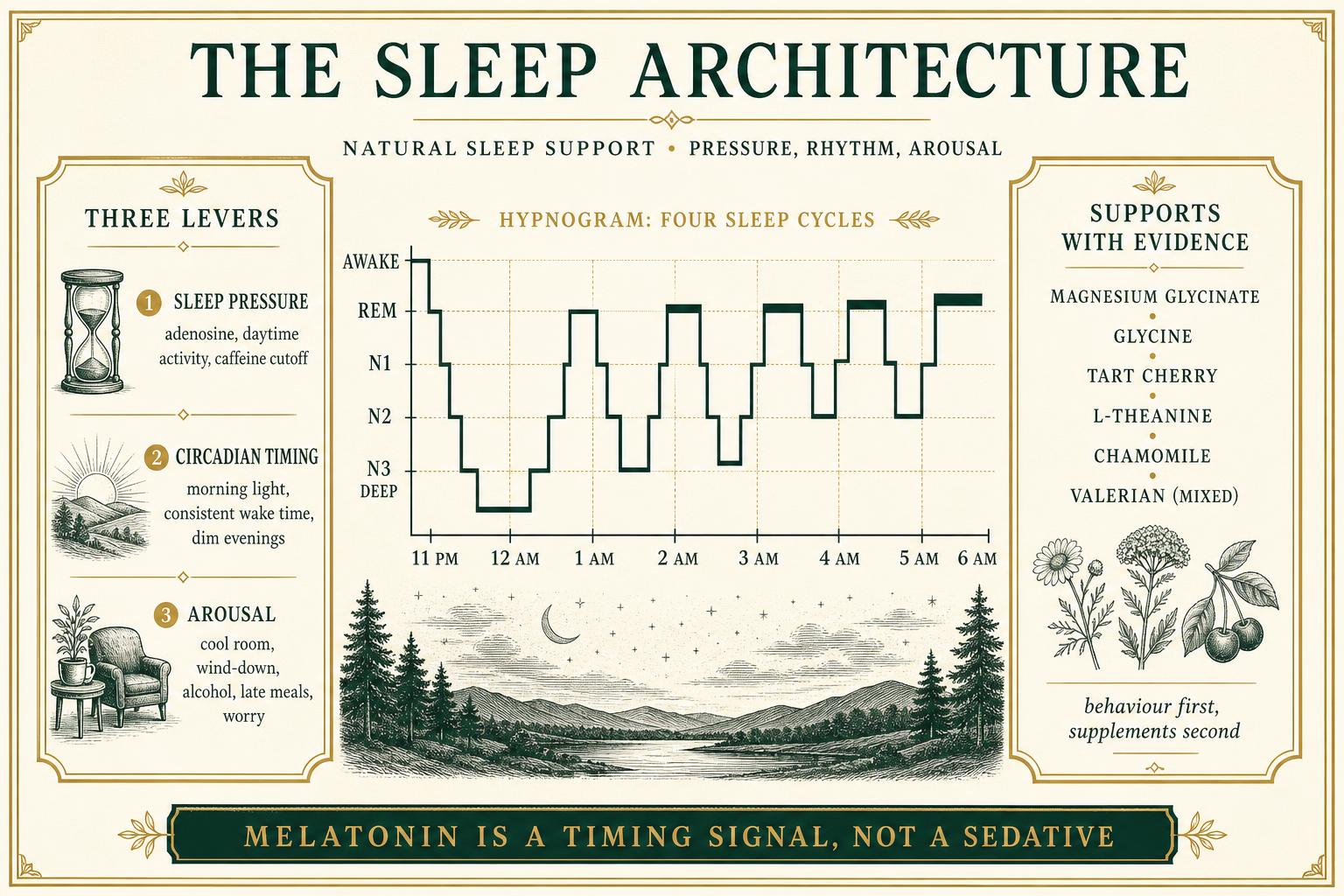
In practical terms, natural sleep support is the set of inputs that let the parasympathetic nervous system take over on time: a darker room, a wind-down routine, less late-day stimulation, and stable blood sugar overnight.
The body's readiness to sleep is prepared during the day. Morning light exposure, midday movement, and an evening free of stimulants and bright screens do more than any bedtime intervention layered on top of a chaotic day.
Everyday habits that move the needle
Keep a regular bed and wake time — even on weekends. Get outdoor light within an hour of waking. Move meaningfully during the day. Reduce caffeine after noon. Avoid heavy meals, alcohol, and screens in the last hour before bed. Keep the bedroom cool, dark, and quiet.
These are unglamorous but genuinely load-bearing. Most people who complain of trouble falling asleep have not stacked more than two of them consistently.
Where botanicals fit
Traditional calming herbs — valerian, passionflower, lemon balm, chamomile, skullcap — have long safety records and can help take the edge off a busy mind. They work best as part of a routine, not as a substitute for one.
Interactions worth knowing: stacking calming herbs with prescription sedatives, benzodiazepines, opioids, or alcohol compounds sedation. Combining with antidepressants or anti-seizure medications warrants a conversation with a clinician who understands botanical medicine.
When sleep needs more than a routine
Loud snoring with breathing pauses, gasping awake, profound daytime exhaustion despite adequate hours in bed, or nighttime chest symptoms point to causes — sleep apnea, mood, or neurological — that need evaluation rather than more supplementation.
The Deep Dive
The two-process model
Sleep onset is governed by the interaction of Process S — homeostatic sleep pressure, which accumulates with waking hours and is indexed by extracellular adenosine — and Process C, the circadian alerting signal driven by the suprachiasmatic nucleus. Difficulty falling asleep almost always reflects insufficient S, misaligned C, or a hyperarousal state overriding both.
That framing makes the interventions legible. Daytime movement and a long enough wake period build S. Morning light and a fixed wake time align C. Wind-down routines and reduced evening stimulation lower arousal. Caffeine acts directly on the first by antagonizing adenosine receptors — with a half-life of five to six hours, an afternoon coffee still occupies receptors at bedtime.
Tier II · Members only · Free
Continue into the deep dive
Tier I is free and always open. Tier II — the full mechanisms, dosing detail, nuance, and citations — unlocks with a free Vital Codex membership.
- Every Tier II deep dive across all hubs
- Saved reading progress across articles
- Member knowledge modules and their quizzes
- The Dispatch, if you opt in
Frequently asked
Do calming herbs work right away?
Some people feel an effect quickly; others notice little at first or benefit more from steady nightly use over a couple of weeks. Response varies.
Can sleep herbs cause morning grogginess?
Yes, especially at higher doses or when stacked with other sedating substances. Start low and pay attention to next-day clarity.
When should I stop self-managing?
Frequent, prolonged insomnia, insomnia tied to a mood shift, breathing symptoms during sleep, or serious daytime impairment all deserve a proper evaluation.
Continue exploring: Sleep & Recovery — Glymphatic clearance and autonomic regulation.
Explore Sleep & Recovery