Peripheral neuropathy is the failure of nerves outside the brain and spinal cord — the long sensory, motor, and autonomic fibers that run to the feet, hands, gut, bladder, and skin. It announces itself as burning, numbness, tingling, electric or stabbing pain, temperature confusion, restless legs, weakness, or a slow loss of balance in the dark. Roughly one in fifteen adults over 40 has measurable signs of it, and a substantial fraction are told the cause is unknown.
That label deserves scrutiny. When neuropathy clinics run a systematic workup, the "idiopathic" fraction falls sharply — and the causes that emerge are heavily weighted toward things that can be changed: glucose in the prediabetic range, B12 and thiamine depletion, copper deficiency after bariatric surgery or from zinc excess, medications, alcohol, thyroid disease, gluten-related immune injury, and treatable autoimmune disease. Meanwhile a small but critical subset — hereditary amyloidosis, monoclonal gammopathy, CIDP — are missed for years precisely because "idiopathic" ended the search.
Nerves are living tissue. A single motor axon can be a metre long, sustained by a cell body the width of a hair, and it depends on continuous mitochondrial ATP production, intact microcirculation, myelin maintenance, and a steady supply of B vitamins, minerals, and fatty acids. Damage that tissue and it degenerates slowly. Remove the insult and supply the raw materials, and it regenerates slowly too — roughly one to three millimetres a day, which is why honest timelines for improvement are measured in months to years, not weeks.
Idiopathic rarely means there is no cause. It usually means the workup stopped early.
Contents(25 sections)
Key takeaways
"Idiopathic" neuropathy is usually an incomplete workup. Systematic evaluation identifies a cause in most patients, and many of those causes are metabolic, nutritional, or drug-related.
Nerve damage begins below the diabetes threshold. Corneal confocal microscopy studies show small-fiber loss tracking glycemia as a continuum, including in impaired glucose tolerance and even sub-prediabetic ranges. An HbA1c alone misses a large share; a 2-hour oral glucose tolerance test finds it.
B12, thiamine, copper, and vitamin E deficiencies each cause distinct, treatable neuropathies. B6 is the exception that cuts both ways — deficiency causes neuropathy, and chronic intake above roughly 50 mg/day can cause it too.
Long-term metformin depletes B12; large cohort data (DPPOS, and 2023–2025 real-world studies) link duration and dose to deficiency and neuropathy. Annual B12 with methylmalonic acid is reasonable in long-term users.
Gluten-related neuropathy is real and can occur without intestinal damage. Antigliadin antibodies may be needed to detect it; TTG-IgA alone will miss the non-celiac subset.
Red flags that demand specialist referral: rapid progression, prominent autonomic symptoms, bilateral carpal tunnel preceding neuropathy, motor-predominant weakness, or asymmetry. These point toward amyloidosis, paraproteinemia, CIDP, or vasculitis.
What has real evidence for repair support: correcting deficiencies, tight glycemic control, alcohol cessation, exercise, alpha-lipoic acid 600 mg, acetyl-L-carnitine 1–3 g, benfotiamine 300–600 mg. Effect sizes are modest and additive, not curative.
Frontier 2023–2026: TTR silencers have transformed hereditary amyloid neuropathy; the SARM1/NAD⁺ axis is the most promising target for stopping axon degeneration itself; 10 kHz spinal cord stimulation has RCT support in refractory painful diabetic neuropathy; GLP-1 agonists show early structural nerve-fiber signals.
Not supported: mold/mycotoxin exposure as an established cause of neuropathy, EMF devices, and high-dose B6 as a "nerve vitamin."
The Primer
What a nerve actually is, and why it fails
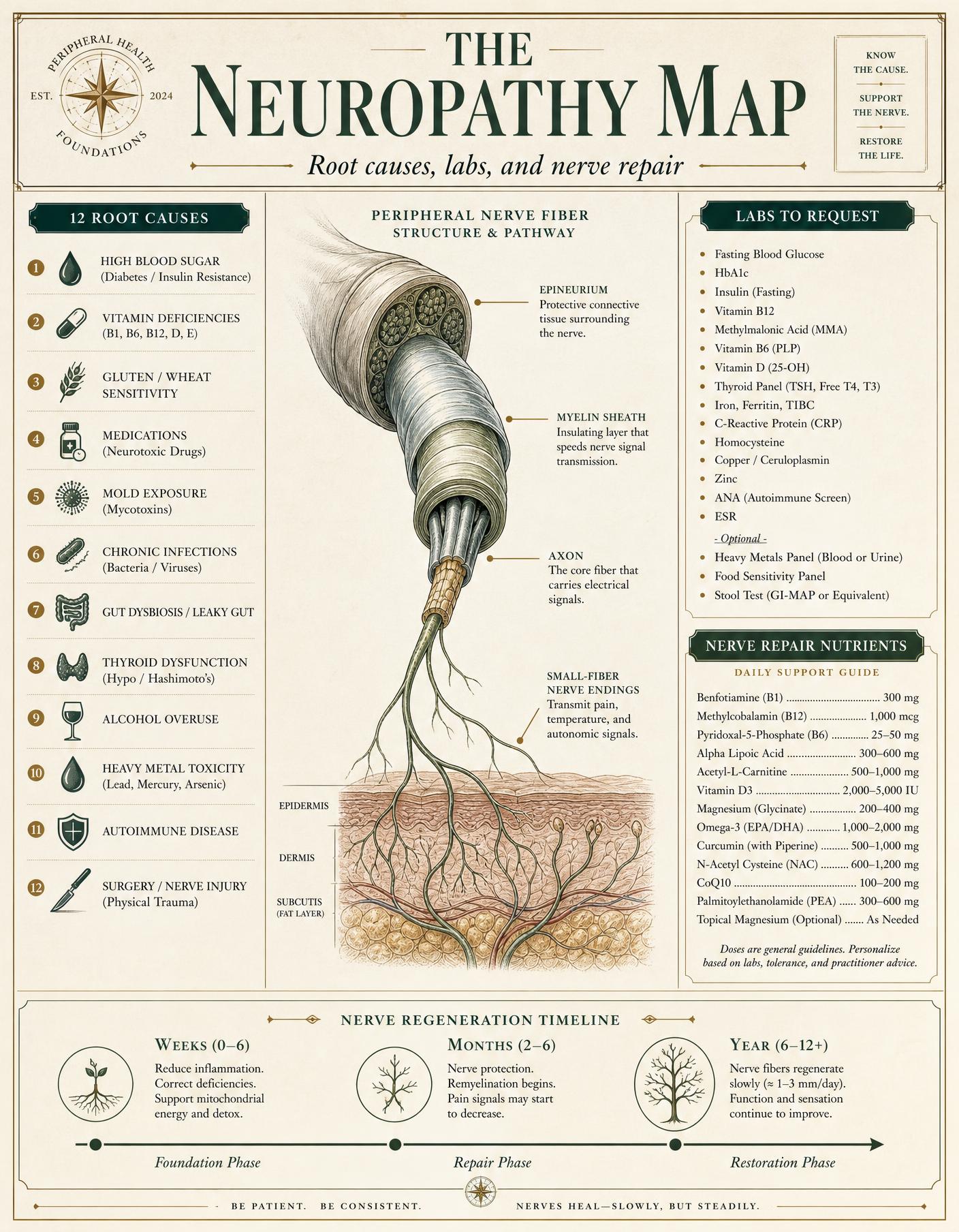
A peripheral nerve is a bundle of axons wrapped in three connective layers, each axon either insulated by a myelin sheath made by Schwann cells or left unmyelinated. Myelinated large fibers carry vibration, position sense, and motor commands quickly. Unmyelinated and thinly myelinated small fibers carry pain, temperature, and autonomic signals slowly — and they are the first to go in metabolic injury, which is why burning feet and temperature sensitivity often precede any abnormality on a standard nerve conduction study.
Nerves fail through a short list of mechanisms:
- Energy failure. Axons are metabolically extreme. Mitochondrial dysfunction — from hyperglycemia, thiamine deficiency, alcohol, or chemotherapy — starves the distal ends first. Length-dependent damage (feet before hands) is the signature.
- Microvascular starvation. The vasa nervorum are tiny end-arteries. Diabetes, smoking, and vasculitis narrow them, producing ischemic nerve injury.
- Myelin injury. Autoimmune attack (CIDP, anti-MAG), B12 deficiency, and copper deficiency degrade insulation, slowing or blocking conduction.
- Building-block shortage. Myelin is largely lipid and protein; axonal transport, methylation, and neurotransmitter synthesis require B12, folate, B6, thiamine, copper, and vitamin E.
- Direct toxicity. Drugs, metals, and alcohol poison the dorsal root ganglion neurons or the axon directly.
- Compression and trauma. Entrapment (carpal tunnel), surgery, and injury — often superimposed on a metabolically vulnerable nerve.
Types and patterns: naming what you have
The name matters because it points at the cause and at the right test.
- Sensory neuropathy. Numbness, burning, tingling, pins and needles, hypersensitivity to touch, loss of vibration and position sense. Usually starts in the toes and moves upward in a "stocking" pattern.
- Motor neuropathy. Weakness, cramping, twitching, muscle wasting in the hands or feet, foot drop, tripping, difficulty with stairs or grip.
- Autonomic neuropathy. Dizziness on standing, resting tachycardia, gastroparesis and early fullness, constipation or diarrhea, bladder retention, erectile dysfunction, abnormal sweating, poor temperature control. Prominent autonomic features raise the priority of the workup considerably.
- Small-fiber neuropathy. Pain, burning, temperature confusion, and autonomic symptoms, with normal strength, normal reflexes, and normal nerve conduction studies. Requires skin punch biopsy (intraepidermal nerve fiber density) or corneal confocal microscopy to see.
- Large-fiber neuropathy. Numbness, vibration and proprioception loss, imbalance in the dark, reduced ankle reflexes. This is what nerve conduction studies and EMG detect.
- Mononeuropathy vs polyneuropathy. One nerve (carpal tunnel, ulnar entrapment, peroneal palsy) suggests compression or focal injury. Symmetric involvement of many nerves suggests a systemic metabolic, nutritional, toxic, or immune cause. Mononeuritis multiplex — several separate nerves, asymmetrically — suggests vasculitis and is urgent.
- Acute vs chronic. Onset over days to weeks (Guillain–Barré, vasculitis, thallium or arsenic poisoning, acute thiamine deficiency) is a medical emergency. Onset over months to years is the metabolic/nutritional pattern.
Symptom staging. Early: intermittent tingling or burning at night, feet feeling "thick" or as if wearing socks, mild imbalance, cold or hot patches, cramping. Advanced: constant pain or dense numbness, painless wounds and blisters, calluses and ulcers, muscle wasting and foot deformity, falls, and autonomic involvement. The window in which nerves recover best is the early one — which is exactly when symptoms are easiest to dismiss.
The twelve root-cause categories
1. Glucose dysregulation — including before diabetes. Diabetes is the single largest cause worldwide, but the more useful clinical point is that nerve injury starts earlier. Corneal confocal microscopy studies found small-fiber loss in people with impaired glucose tolerance and normal HbA1c, and the Maastricht Study data show corneal nerve fiber density falling along a continuum of glycemia rather than switching on at a diagnostic cut-point. If you have unexplained burning feet and a "normal" A1c, the test that finds this is a 2-hour oral glucose tolerance test, along with fasting insulin.
2. Nutrient deficiencies. B12 (subacute combined degeneration, often with a large-fiber ataxic component), thiamine/B1 (dry beriberi), copper (a myeloneuropathy that convincingly mimics B12 deficiency), vitamin E (sensory ataxia in fat malabsorption), and folate. Each has a distinct fingerprint and each is correctable.
3. B6 in both directions. Pyridoxine deficiency causes neuropathy — and so does chronic excess. Classic toxicity was described at 200 mg/day and above, but case reports and Australian pharmacovigilance action have documented sensory neuropathy at doses as low as 50 mg/day with prolonged use. A 2025 expert consensus recommends keeping chronic intake under 50 mg/day. Check the B6 content of energy drinks, "nerve support" formulas, and high-potency B-complexes; stacking them is easy.
4. Medications. Metformin depletes B12 in a dose- and duration-dependent way. Chemotherapy — taxanes, platinums, vinca alkaloids, bortezomib — causes neuropathy in the majority of exposed patients. Fluoroquinolones carry an FDA boxed warning for peripheral neuropathy that can begin within days and persist. Amiodarone, isoniazid, nitrofurantoin, phenytoin, and some antiretrovirals are also implicated. Statins have an epidemiologic association with neuropathy that remains debated; absolute risk appears low, and the decision should be made against cardiovascular risk rather than by reflex.
5. Alcohol. Direct axonal toxicity plus thiamine and B-vitamin depletion. Dose-dependent, length-dependent, and one of the most reversible causes if intake stops early enough.
6. Gluten and celiac disease. The Sheffield group's work established gluten-related neurological disorders as a distinct spectrum: neuropathy and ataxia can occur with or without intestinal enteropathy. Their 2024 work documented sensory symptoms in gluten-sensitive patients with otherwise normal structural findings, consistent with small-fiber involvement. Practically: TTG-IgA plus total IgA is the standard celiac screen, but antigliadin antibodies may be needed to catch the non-celiac subset, and a strict gluten-free trial is the confirmatory test in responders.
7. Malabsorption and post-surgical states. Roux-en-Y gastric bypass and other malabsorptive surgery, inflammatory bowel disease, chronic pancreatic insufficiency, and long-term proton pump inhibitor use all deplete B1, B12, copper, folate, and fat-soluble vitamins. Rapid weight loss with vomiting can precipitate acute thiamine deficiency.
8. Excess zinc. High-dose zinc supplements and zinc-containing denture creams induce copper deficiency via intestinal metallothionein, producing a myeloneuropathy that is frequently mistaken for B12 deficiency and does not improve until copper is replaced.
9. Thyroid disease. Hypothyroidism causes both entrapment neuropathy (carpal tunnel from myxedematous tissue) and a mild distal sensorimotor polyneuropathy, usually reversible with adequate replacement.
10. Autoimmune disease. CIDP is the important one to catch because it is treatable with IVIG, corticosteroids, or plasma exchange. Sjögren's syndrome causes sensory ganglionopathy and small-fiber neuropathy, sometimes without dry eyes or mouth. Sarcoidosis, lupus, rheumatoid vasculitis, and celiac-associated autoimmunity round out the list.
11. Infections. Lyme disease (radiculoneuritis, facial palsy, mononeuritis multiplex), shingles/VZV (postherpetic neuralgia), HIV, hepatitis C with cryoglobulinemia, and leprosy globally.
12. Toxins and heavy metals. Arsenic (painful sensorimotor neuropathy, Mees' lines on nails), thallium (painful neuropathy with hair loss), lead (motor-predominant, wrist drop), mercury, and organic solvents. These matter most when onset is rapid, painful, and accompanied by skin, nail, or systemic clues.
About mold
Mold and mycotoxin exposure is widely claimed as a neuropathy cause. The honest reading of the literature as of 2024–2025 is that this is unproven: reviews of indoor mold health effects find no well-controlled study demonstrating direct causation of peripheral neuropathy, and the foundational papers had serious methodological problems — self-selected litigant populations, no biomarker confirmation, and no dose-response. Water-damaged buildings cause real respiratory and allergic illness. Presenting mold as an established cause of nerve damage is not supported, and doing so risks stopping the search for a cause that is.
Red flags — when this is not a nutrition problem
Get specialist evaluation quickly if any of these are present:
- Rapid progression over weeks, or ascending weakness
- Motor-predominant weakness, foot drop, or hand wasting
- Asymmetric or patchy involvement (mononeuritis multiplex suggests vasculitis)
- Prominent autonomic features: orthostatic drops, gastroparesis, bladder dysfunction, erectile dysfunction
- Bilateral carpal tunnel syndrome preceding the neuropathy, plus cardiac thickening or family history — the classic hereditary transthyretin amyloidosis pattern
- Unexplained weight loss, bone pain, or anemia — screen for monoclonal gammopathy and myeloma
Amyloid and paraproteinemic neuropathies are routinely misdiagnosed as idiopathic or CIDP for years. Since TTR-silencing drugs now exist, that delay is costly in a way it was not a decade ago.
The lab workup worth requesting
A reasonable first-pass panel for unexplained neuropathy:
| Test | What it finds |
|---|---|
| HbA1c + fasting glucose + fasting insulin | Diabetes and insulin resistance |
| 2-hour oral glucose tolerance test | Impaired glucose tolerance missed by A1c |
| Vitamin B12 + methylmalonic acid + homocysteine | Functional B12 deficiency (serum B12 alone is insensitive) |
| Folate | Deficiency, and unmasking of masked B12 deficiency |
| Copper + ceruloplasmin + zinc | Copper deficiency myeloneuropathy, zinc-induced |
| Vitamin E | Fat malabsorption states |
| TSH, free T4 | Hypothyroid neuropathy and entrapment |
| TTG-IgA + total IgA (± antigliadin antibodies) | Celiac and gluten-related neuropathy |
| SPEP with immunofixation + serum free light chains | Monoclonal gammopathy, amyloidosis, myeloma |
| ANA, SSA/SSB, ESR, CRP | Sjögren's, connective tissue disease, vasculitis |
| Heavy metals (blood/urine, if exposure history) | Arsenic, lead, thallium, mercury |
| HIV, hepatitis C, Lyme serology (if risk) | Infectious causes |
| Vitamin B6 (PLP) | Both deficiency and supplement-driven excess |
Add nerve conduction studies with EMG for large-fiber and demyelinating patterns, and skin punch biopsy for intraepidermal nerve fiber density or corneal confocal microscopy when small-fiber neuropathy is suspected and standard testing is normal.
What actually helps nerves repair
The order matters. Interventions further down the list do little if the ones above are ignored.
- Remove the cause. Stop the offending drug where possible, stop alcohol, treat the thyroid, remove gluten if serologies or trial response support it, correct the deficiency, treat the autoimmune disease.
- Fix glucose. Tight glycemic control is the only intervention with clear disease-modifying evidence in type 1 diabetic neuropathy, and it slows progression in type 2. This is diet, resistance training, sleep, and weight — the same levers as insulin resistance generally.
- Replete the specific nutrients found. Methylcobalamin or hydroxocobalamin for B12 (injection if malabsorptive), thiamine or benfotiamine for B1, copper for copper deficiency, vitamin E for malabsorption. Blind megadosing without labs is how B6 neuropathy happens.
- Move. Aerobic and resistance exercise programs have shown improvements in intraepidermal nerve fiber branching and symptom scores in diabetic and prediabetic neuropathy. This is one of the few interventions with structural, not just symptomatic, evidence.
- Protect the tissue. Daily foot inspection, correct footwear, avoid heat injury in numb feet, control blood pressure and lipids to protect microcirculation.
- Consider evidence-backed adjuncts (Tier 2 covers the trial detail): alpha-lipoic acid 600 mg/day, acetyl-L-carnitine 1–3 g/day, benfotiamine 300–600 mg/day. Modest effects, good safety records, several months to judge.
- Treat pain properly while repair happens. Duloxetine, pregabalin/gabapentin, and topical agents manage symptoms without addressing cause — that is a legitimate role, not a failure.
Timelines
Set expectations honestly. Nutrient repletion changes labs in weeks but symptoms in months. Axonal regeneration proceeds at about 1–3 mm per day when the insult is removed, so a nerve regrowing to the toes takes many months. Small fibers can reinnervate skin over 6–18 months. Long-standing severe damage may only partly recover — the goal shifts to halting progression and protecting function.
Surgery as a hidden entry point
Post-operative nerve symptoms are routinely written off as aging or bad luck. Two separate mechanisms deserve naming. First, surgically induced neuropathic pain — chronic neuropathic pain follows surgery in an estimated 10–40% of procedures, from nerve division, traction, scar entrapment, or prolonged positioning under anesthesia. Second, and more overlooked, surgical malnutrition: procedures that alter the digestive tract quietly remove the machinery nerves depend on. Poor pre-operative nutrient status also predicts more post-operative complications, which is why repletion before elective surgery is worth discussing with the surgical team.
| Procedure | How it can injure nerves | Nutrients at risk |
|---|---|---|
| Gastric bypass | Less acid, intrinsic factor, and absorptive surface; rapid weight loss | B12, thiamine, copper, folate, iron, protein, vitamin D |
| Sleeve gastrectomy | Reduced capacity and intake | B12, iron, thiamine, protein, magnesium |
| Partial gastrectomy / stomach surgery | Loss of acid and intrinsic factor | B12, iron, folate, zinc, protein |
| Ileal or small-bowel resection | Removes the primary B12 and bile-acid absorption site | B12, fat-soluble vitamins, magnesium, amino acids |
| Gallbladder removal | Altered bile timing and fat handling in some people | Vitamin E, D, K, omega-3 fats |
| Pancreatic surgery | Reduced enzyme output, fat and protein maldigestion | Protein, vitamin E and D, omega-3s, B vitamins |
| Colectomy / ileostomy, chronic diarrhea | Fluid, mineral, and electrolyte loss | Magnesium, zinc, potassium, B vitamins |
| Spinal surgery | Root compression, inflammation, scar tissue | Mechanical — radiating pain, foot drop |
| Joint replacement, long anesthesia | Positional compression, traction, swelling | Mechanical — new focal numbness |
| Cancer surgery with chemotherapy | Reduced intake plus direct neurotoxicity | B vitamins, protein, antioxidant capacity |
Any new numbness, burning, or weakness after surgery — even a year later — is a reason to test nutrient status, not to accept "idiopathic."
Diet: what to remove and what to build
Food is the substrate for repair, and several common patterns work against it.
Reduce or remove: added sugar and refined starch (glycemic swings are the primary nerve toxin in this whole story); alcohol; industrial seed oils high in linoleic acid; ultra-processed foods generally; gluten-containing grains in anyone with celiac disease or positive gluten serology; and processed "gluten-free" replacements, which are typically refined starch with worse micronutrient density than what they replaced.
Build in: adequate protein at every meal — 1.2–1.6 g/kg/day for most adults with nerve symptoms, since amino acids are required for axonal transport, myelin protein, and muscle that protects joints and balance; B12-rich animal foods (or reliable supplementation for vegetarians and vegans, whose neuropathy risk is meaningfully higher without it); thiamine sources (free-range pork, legumes, sunflower seeds, nutritional yeast); copper sources (shellfish, organ meats, cocoa, cashews); vitamin E from nuts, seeds, and olive oil; omega-3s from oily fish; magnesium from leafy greens and seeds; and enough colorful plant food for polyphenol and carotenoid intake. A whole-food pattern with protein at every meal and no refined carbohydrate is, in practice, the dietary prescription.
Lifestyle levers that actually move the needle
| Lever | Why it helps nerves | Starting point |
|---|---|---|
| Walking after meals | Blunts glucose spikes, improves microcirculation | 10–20 minutes after eating, if safe |
| Resistance training | Insulin sensitivity, muscle mass, balance | 2–3 sessions/week |
| Balance work | Fall prevention, proprioceptive retraining | Supported single-leg stands; physical therapy if unsteady |
| Sleep regularity | Repair, glucose regulation, pain thresholds | Fixed wake time, dark room |
| Morning outdoor light | Circadian and metabolic regulation, vitamin D | 10–20 minutes early in the day |
| Glucose tracking | Reveals individual triggers a single A1c hides | Glucose meter or a short CGM trial |
| Alcohol elimination | Removes a direct axonal toxin and a thiamine drain | Stop while neuropathy is active |
| Foot protection | Prevents ulcers and burns in numb feet | Daily inspection, proper shoes, test water temperature by hand |
| Smoking cessation, blood pressure and lipid control | Protects the vasa nervorum | Standard cardiovascular targets |
A ten-step investigation plan
- Document symptoms. What, where, when, how severe, what makes it worse. Night-time burning, glove-and-stocking distribution, and imbalance in the dark are all diagnostic clues.
- Map the pattern. Symmetric or asymmetric? Sensory, motor, or autonomic? Feet first or hands first? Gradual or rapid? This determines urgency more than any lab.
- Review the twelve categories honestly, including alcohol, every supplement label, and every prescription.
- Test nutrient status — B12 with methylmalonic acid, folate, copper and ceruloplasmin, zinc, vitamin E, B6 (PLP). Consider intracellular/functional nutrient testing where serum results are equivocal.
- Test glucose properly — HbA1c, fasting glucose, fasting insulin, and a 2-hour oral glucose tolerance test if the first three look "normal."
- Test immune and gluten triggers — TTG-IgA with total IgA, antigliadin antibodies where gluten neuropathy is suspected, ANA, SSA/SSB, ESR, CRP, and SPEP with immunofixation plus free light chains.
- Correct deficiencies at doses matched to the deficit, in bioavailable forms, without blind high-dose B6.
- Remove the insults — alcohol, the implicated drug where an alternative exists, gluten if indicated, refined carbohydrate, toxin exposure.
- Retest at 3–6 months. Repletion without retesting is guessing; this is also how over-supplementation is caught.
- Track function, not just pain. Balance time, walking distance, grip strength, monofilament sensation. Function is what recovery actually looks like.
Self-audit checklist
Bring this to the appointment. Each checked line is a lead.
- Numbness, tingling, burning, or stabbing pain — starting in the feet or hands
- Balance problems, or worse balance in the dark
- Diabetes, prediabetes, PCOS, or known insulin resistance
- Celiac disease, gluten sensitivity, or any autoimmune diagnosis
- Digestive symptoms, malabsorption, or previous bariatric/digestive surgery
- Long-term metformin, acid blockers, chemotherapy, fluoroquinolones, or amiodarone
- Regular alcohol intake
- Vegetarian or vegan without reliable B12
- High-dose B6 from any supplement, energy drink, or B-complex
- Never had fasting insulin, an oral glucose tolerance test, methylmalonic acid, copper, or gluten serology run
- Told the neuropathy is "idiopathic" without the above workup
The most common mistakes
- Accepting "idiopathic" as a final answer instead of a starting point.
- Treating only the pain and never the cause.
- Waiting for a diabetes diagnosis while nerves are already being damaged in the prediabetic range.
- Assuming a normal serum B12 rules out B12 deficiency — it does not; methylmalonic acid does.
- Taking high-dose B6 as a "nerve vitamin," which causes the very neuropathy it is sold to fix.
- Missing drug-induced nutrient depletion, especially metformin and acid blockers.
- Ignoring alcohol.
- Treating gluten as irrelevant because a biopsy was normal.
- Under-eating protein while trying to regenerate nerve and muscle.
- Supplementing blind, never retesting, and never totalling the label doses.
- Chasing unproven causes (mold, EMF) while the findable ones go untested.
- Waiting until numbness is dense and permanent — and injuring numb feet in the meantime.
Interactive
Which neuropathy pattern fits you?
Six questions sort your symptoms into the pattern axes clinicians actually use — fiber size, functional system, tempo, and distribution — and hand you the investigation list that matches. This is an education tool, not a diagnosis.
Which sensation dominates your worst hours?
Pick the one you would mention first if a clinician asked what bothers you most.
Educational only. This does not diagnose, and it does not replace nerve conduction studies, skin biopsy, or a clinical exam.
The Deep Dive
Small-fiber neuropathy and the redefinition of "prediabetic"
The most consequential shift in the field is the recognition that nerve injury does not wait for a diabetes diagnosis. Asghar and colleagues (Diabetes Care 2015;38:1502) used corneal confocal microscopy — a non-invasive imaging method that quantifies the sub-basal corneal nerve plexus as a proxy for small-fiber integrity — and found measurable nerve fiber loss in people with impaired glucose tolerance who did not meet diabetes criteria.
Population data extended this. The Maastricht Study (Diabetologia 2023;66:2030–2041) demonstrated a continuous relationship between glycemic measures and corneal nerve fiber loss across the full range, including below prediabetic thresholds; a later report (Diabetologia 2026;69:1519–1531) linked those corneal changes to nerve conduction abnormalities and neuropathic pain in prediabetes and type 2 diabetes. The clinical translation is straightforward: glycemia is a graded neurotoxin, and diagnostic cut-points are administrative conveniences, not biological thresholds.
Tier II · Members only · Free
Continue into the deep dive
Tier I is free and always open. Tier II — the full mechanisms, dosing detail, nuance, and citations — unlocks with a free Vital Codex membership.
- Every Tier II deep dive across all hubs
- Saved reading progress across articles
- Member knowledge modules and their quizzes
- The Dispatch, if you opt in
Research Notes & Sources(expand)
Asghar O, et al. "Corneal confocal microscopy detects neuropathy in subjects with impaired glucose tolerance." Diabetes Care 2015;38:1502–1508.
Maastricht Study reports. Diabetologia 2023;66:2030–2041 and 2026;69:1519–1531 — glycemia as a continuum for corneal nerve fiber loss, and the link to nerve conduction abnormalities and neuropathic pain.
Hadjivassiliou M, Trott N, Hoggard N, Sanders DS. Nutrients 2024;16(8):1209 — sensory symptoms in gluten sensitivity; and Nutrients 2021 — 7-year neurological follow-up of newly diagnosed celiac patients.
Aroda VR, et al. "Long-term metformin use and vitamin B12 deficiency in the Diabetes Prevention Program Outcomes Study." JCEM 2016;101:1754–1761; plus 2023 multicenter dose-response data and the 2025 All of Us cohort analysis.
Expert consensus on pyridoxine dosing and neuropathy risk. Drug, Healthcare and Patient Safety 2025;17:97–108; with Australian TGA scheduling actions on over-the-counter vitamin B6.
Cochrane review of alpha-lipoic acid for diabetic polyneuropathy (CD012967); ALADIN and NATHAN trial programs.
Sima AAF, et al. Pooled analysis of acetyl-L-carnitine RCTs in diabetic neuropathy. Diabetes Care 2005;28:89–94.
Critical review of alpha-lipoic acid and benfotiamine in diabetic neuropathy. Nutrients 2026;18:1538.
Adalbert R, et al. SARM1 activation and axon degeneration; and SARM1 inhibition in paclitaxel-induced neuropathy models. Brain 2021;144:3226.
Adams D, et al. HELIOS-A vutrisiran outcomes; and eplontersen NEURO-TTRansform pivotal results. JAMA 2023 — TTR silencing in hereditary transthyretin amyloid polyneuropathy.
Jones CK, et al. "Suzetrigine (VX-548), a selective Nav1.8 inhibitor, for acute pain." New England Journal of Medicine 2023;389:393–405.
Petersen EA, et al. "Effect of high-frequency (10 kHz) spinal cord stimulation in patients with painful diabetic neuropathy: SENZA-PDN randomized clinical trial." JAMA Neurology 2021;78(6):687–698, with 24-month follow-up reports.
Review of GLP-1 receptor agonist and DPP-4 inhibitor effects in diabetic peripheral neuropathy. Diabetes Therapy 2025;16:1077.
Review of indoor mold and mycotoxin health effects. Allergo Journal International 2024;33:124 — the basis for treating mold-attributed neuropathy as unproven.
This article is educational and does not replace individual medical evaluation. Progressive neuropathy requires a clinician's workup.
Continue exploring: Metabolism — Glucose variability, insulin sensitivity, and substrate flexibility.
Explore Metabolism