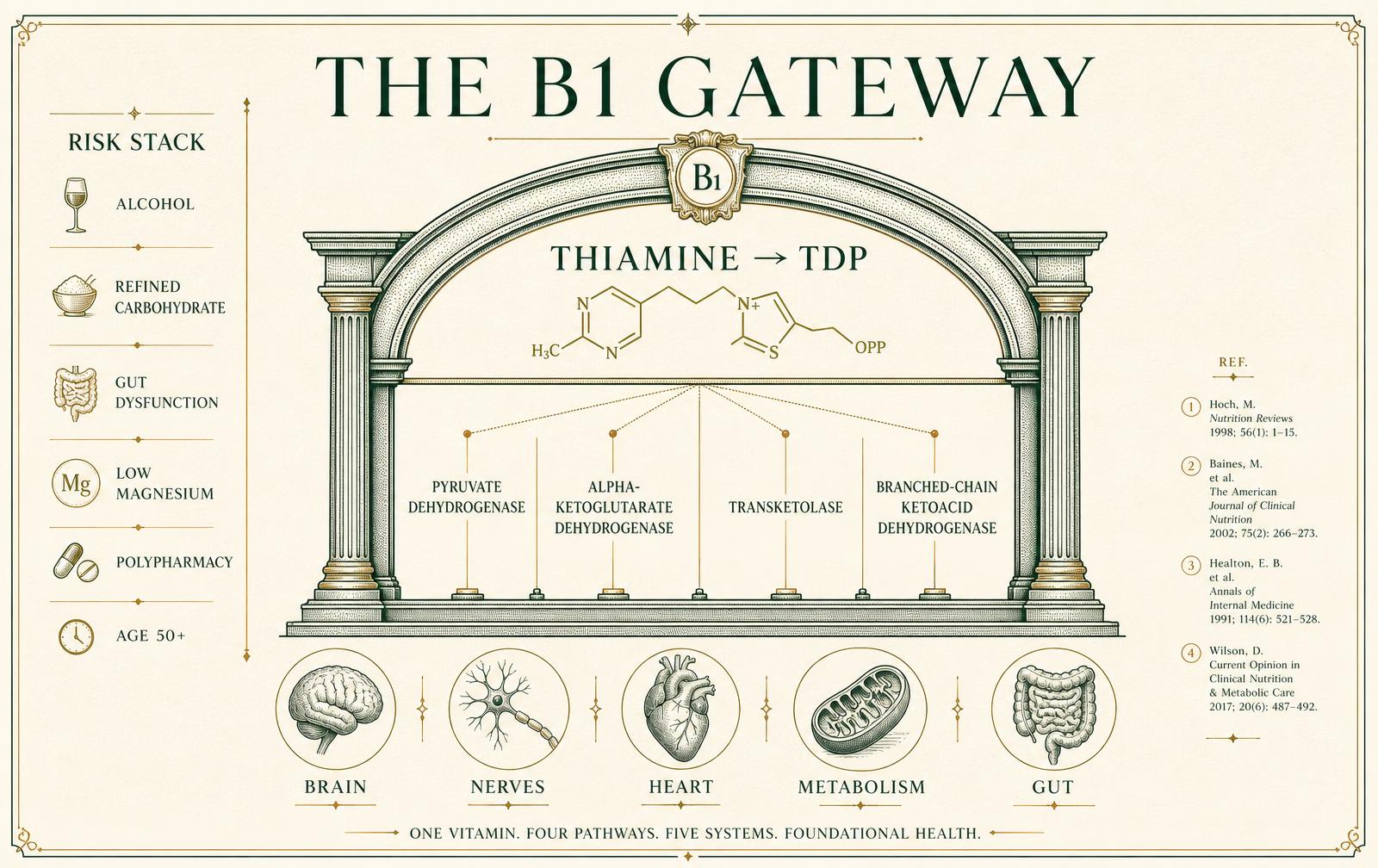
Vitamin B1 — thiamine — is treated like a minor nutrient and functions like a gate. Before the body can burn carbohydrate for ATP, thiamine must be converted into thiamine diphosphate (TDP, also called TPP), the cofactor that four core metabolic enzymes cannot work without. When that gateway narrows, the tissues with the highest energy demand — brain, peripheral nerves, heart, gut, and skeletal muscle — feel it first.
The familiar picture of B1 deficiency is severe alcoholism, starvation, or full beriberi. Those are the visible end of a much wider problem. Refined-carbohydrate load, glucose stress, alcohol, gut dysfunction, low magnesium, unintended weight loss, chronic illness, loop diuretics, metformin, acid reducers, and polypharmacy all push in the same direction — and they stack.
The right question is not “Am I sick enough to have beriberi?” It is “Do my high-demand tissues have enough active B1 to meet today's metabolic load?”
Contents(24 sections)
Key takeaways
Thiamine must be activated to thiamine diphosphate (TDP/TPP) before it can support pyruvate dehydrogenase, alpha-ketoglutarate dehydrogenase, transketolase, and branched-chain ketoacid dehydrogenase.
Functional B1 availability is intake plus absorption, cell transport, activation, and magnesium support — minus urinary losses, gut losses, and metabolic demand. Adequate intake does not guarantee adequate active B1.
Early symptoms are non-specific: fatigue, brain fog, anxiety, neuropathy, poor balance, palpitations, breathlessness, leg swelling, and unstable gut motility.
Risk stacks rather than strikes: age over 50, insulin resistance, alcohol, gut dysfunction, low magnesium, and five or more prescriptions combine into one meaningful bottleneck.
Whole-blood thiamine diphosphate (TDP/TPP) is more informative than basic serum B1 because it reflects the active form inside red blood cells.
Thiamine and benfotiamine have not reliably lowered HbA1c in human trials; the live question is whether adequate B1 status lets cells tolerate glucose exposure with less damage.
Magnesium is non-negotiable: thiamine functions poorly without it.
The Primer
The B1 blind spot
The body needs B1 to turn food into usable energy. Brain, nerves, heart, muscle, and digestive tissue depend on that conversion every minute. When B1 is too low — or when the body cannot absorb it, activate it, retain it, or transport it into cells properly — those systems struggle first.
Modern life can create a B1 risk environment long before a textbook deficiency appears. The better question is not whether beriberi is present, but whether high-demand tissues have enough active B1 to meet today's metabolic demand.
What low or poorly used B1 looks like
Early signs are vague enough to be attributed to stress, aging, deconditioning, anxiety, or depression:
- Low energy, exhaustion, or poor exercise tolerance
- Brain fog, poor focus, memory changes, or mental fatigue
- Anxiety, irritability, poor stress tolerance, or disrupted sleep
- Numbness, tingling, burning feet, nerve pain, weakness, or heavy legs
- Poor balance, unsteadiness, falls, or reduced reflexes
- Fast heartbeat, palpitations, breathlessness, or leg swelling
- Nausea, low appetite, vomiting, constipation, diarrhea, or unstable gut motility
- Feeling distinctly worse after sugar-heavy meals
These symptoms have many causes. When they appear alongside B1 risk factors, B1 belongs in the conversation rather than as an afterthought.
The B1 risk self-screen
A meaningful risk environment exists when several of these apply:
- Over 50 with less dietary variety, lower appetite, or unintended weight loss
- Prediabetes, diabetes, insulin resistance, frequent glucose spikes, or a high-sugar and refined-flour pattern
- Regular alcohol use, a history of heavier use, or poor eating while drinking
- Chronic nausea, vomiting, diarrhea, reflux, malabsorption, inflammatory bowel symptoms, or past bariatric surgery
- Tingling, burning feet, weakness, poor balance, palpitations, brain fog, or worsening memory
- A loop diuretic such as furosemide, bumetanide, or torsemide
- Metformin, acid-reducing medication, antidepressants, frequent antibiotics, chemotherapy, or five or more prescriptions
- Reliance on energy drinks, sweetened beverages, refined flour, desserts, or other ultra-processed calories
- Known low magnesium, cramps, chronic stress, poor sleep, or long-term acid suppression
No checklist diagnoses deficiency. Three or more items makes B1 worth investigating rather than dismissing.
Why adults over 50 should pay attention
After 50 the risk is rarely one dramatic event — it is accumulation. Insulin resistance, reduced food variety, lower appetite, dental or digestive difficulty, kidney or heart disease, inflammation, weight loss, and declining muscle mass tend to arrive alongside a growing medication list.
Someone can be taking metformin for glucose, a diuretic for blood pressure or heart failure, an acid reducer for reflux, and an antidepressant for sleep — while eating less protein and more packaged convenience food. Each factor is modest alone. Together they form a nutrient-and-energy bottleneck. This does not mean every older adult is clinically deficient. It means a large number likely live closer to the edge of inadequate B1 availability than standard care acknowledges.
Alcohol: the fastest route to B1 trouble
Alcohol lowers intake, reduces intestinal absorption, weakens liver storage, interferes with activation to the active form, worsens vomiting and diarrhea, and increases the odds of magnesium depletion — four burdens at once.
That combination is why alcohol-related B1 deficiency is linked to brain injury, confusion, severe balance problems, nerve damage, and cardiac dysfunction. Where alcohol exposure and poor nutrition overlap, waiting for severe symptoms is the wrong strategy.
Sugar, refined carbohydrate, and glucose stress
B1 is required to process carbohydrate. A pattern built on sugar, sweetened drinks, refined flour, desserts, and processed snacks creates high metabolic throughput — particularly when blood sugar is already elevated.
This is not an argument against carbohydrate foods. Beans, vegetables, fruit, roots, and intact whole foods are not the same as daily glucose spikes from nutrient-poor calories. The concern is glucose overload plus low nutrient density. B1 will not lower blood sugar like a medication, but it is required by the machinery that handles glucose safely. See insulin resistance: the silent engine.
Medications worth understanding
| Medication or class | Why it matters |
|---|---|
| Loop diuretics (furosemide, bumetanide, torsemide) | Can increase B1 loss through urine |
| Metformin | Clearly raises B12 deficiency risk; may also affect B1 transport |
| Fedratinib | Strongly inhibits a thiamine transporter; carries specific B1 safety warnings |
| PPIs and H2 blockers | Can worsen B12 and magnesium status; transporter effects under study |
| Some antidepressants, antibiotics, antimalarials, chemotherapies | Show thiamine-transporter effects in laboratory research |
Never stop a medication because of this table. The point is that medication burden combined with poor diet, aging, alcohol, diabetes, and gut dysfunction is a genuine nutrient-risk combination.
What to ask for
Do not ask for "a vitamin panel." Ask for a B1-focused review, naming the risk factors that apply. Useful tests to discuss:
- Whole-blood thiamine diphosphate (TDP/TPP)
- Magnesium
- Vitamin B12 with methylmalonic acid (MMA)
- Folate
- CBC and comprehensive metabolic panel
- HbA1c and glucose markers
- Medication review
- Diet, alcohol, vomiting/diarrhea, and bariatric-surgery history
- Intracellular Nutrient Analysis (INA) when symptoms are complex or multiple nutrient issues are likely
Whole-blood TDP/TPP is generally more informative than basic serum B1 because it reflects the main active form inside red blood cells.
The prevention target
The goal is not to wait for an abnormal lab. It is to protect the systems that suffer when energy metabolism is strained: brain (focus, memory, mood, sleep), nerves (sensation, balance, strength), heart (rhythm, exercise tolerance, fluid balance), metabolism (glucose handling, oxidative stress), and gut (appetite, motility, absorption).
Start with food quality. Reduce sugar-sweetened drinks and ultra-processed calories. Do not use energy drinks as meal replacements. Address alcohol exposure. Attend to magnesium and B12. Request a medication-and-nutrient review when the risk stack is high.
---
The Deep Dive
B1 is an energy gateway, not just a vitamin
Thiamine must become thiamine diphosphate (TDP/TPP) before it can power key metabolic enzymes:
- Pyruvate dehydrogenase: moves pyruvate into mitochondrial energy production as acetyl-CoA.
- Alpha-ketoglutarate dehydrogenase: supports the Krebs cycle and ATP output.
- Transketolase: supports the pentose-phosphate pathway, antioxidant capacity, nucleotide synthesis, and disposal of excess glucose intermediates.
- Branched-chain ketoacid dehydrogenase: processes branched-chain amino acids.
Tier II · Members only · Free
Continue into the deep dive
Tier I is free and always open. Tier II — the full mechanisms, dosing detail, nuance, and citations — unlocks with a free Vital Codex membership.
- Every Tier II deep dive across all hubs
- Saved reading progress across articles
- Member knowledge modules and their quizzes
- The Dispatch, if you opt in
Frequently asked
What is the difference between thiamine and thiamine diphosphate?
Thiamine is the dietary vitamin; thiamine diphosphate (TDP, also called TPP) is its active coenzyme form, produced inside the body with magnesium-dependent enzymes. Only TDP can support pyruvate dehydrogenase, alpha-ketoglutarate dehydrogenase, transketolase, and branched-chain ketoacid dehydrogenase, which is why active-form testing is more informative than serum thiamine.
Which blood test best reflects B1 status?
Whole-blood thiamine diphosphate (TDP/TPP) is the most practical direct test because it measures the active form inside red blood cells. Erythrocyte transketolase activity with the TPP effect adds functional information where available. Plasma or serum thiamine reflects recent intake and should not be used alone in a complex case.
Can vitamin B1 lower blood sugar or reverse diabetes?
No. Human trials of thiamine and benfotiamine have not shown dependable reductions in HbA1c or fasting glucose. The plausible role is different: adequate thiamine supports the enzymes that dispose of excess glucose intermediates, which may reduce the downstream damage high glucose causes rather than lowering glucose itself.
Does metformin cause thiamine deficiency?
Metformin is clearly associated with vitamin B12 deficiency and has shown effects on thiamine transport in laboratory research, but it is not established as a cause of clinical thiamine deficiency at standard doses. The risk becomes meaningful when metformin is combined with refined-carbohydrate intake, aging, alcohol, gut dysfunction, or additional transport-inhibiting medications.
Why does magnesium matter for thiamine?
Converting thiamine to its active TDP form and running the thiamine-dependent enzyme complexes both depend on magnesium. In magnesium depletion, thiamine repletion can underperform, which is why magnesium is checked alongside B1 in fatigue, neuropathy, alcohol exposure, and long-term diuretic or acid-suppression use.
Which form of B1 should someone choose?
Thiamine HCl or mononitrate is adequate for general nutritional support. Benfotiamine has the most research in neuropathy, diabetic complications, and Alzheimer's, though human outcomes are mixed. TTFD and sulbutiamine have distinct pharmacology with limited comparative trials. Suspected severe deficiency or Wernicke symptoms is a medical situation that may require parenteral thiamine, not an oral supplement decision.
Continue exploring: Metabolism — Glucose variability, insulin sensitivity, and substrate flexibility.
Explore Metabolism