Most laboratories flag uric acid only above roughly 7 mg/dL in men and 6 mg/dL in women, the thresholds where crystal formation and gout become likely. But the associations with hypertension, insulin resistance, and fatty liver appear at values well inside the "normal" range — around 5.5 mg/dL and above.
This makes uric acid one of the more informative numbers already sitting unused on standard bloodwork.
Contents(13 sections)
Key takeaways
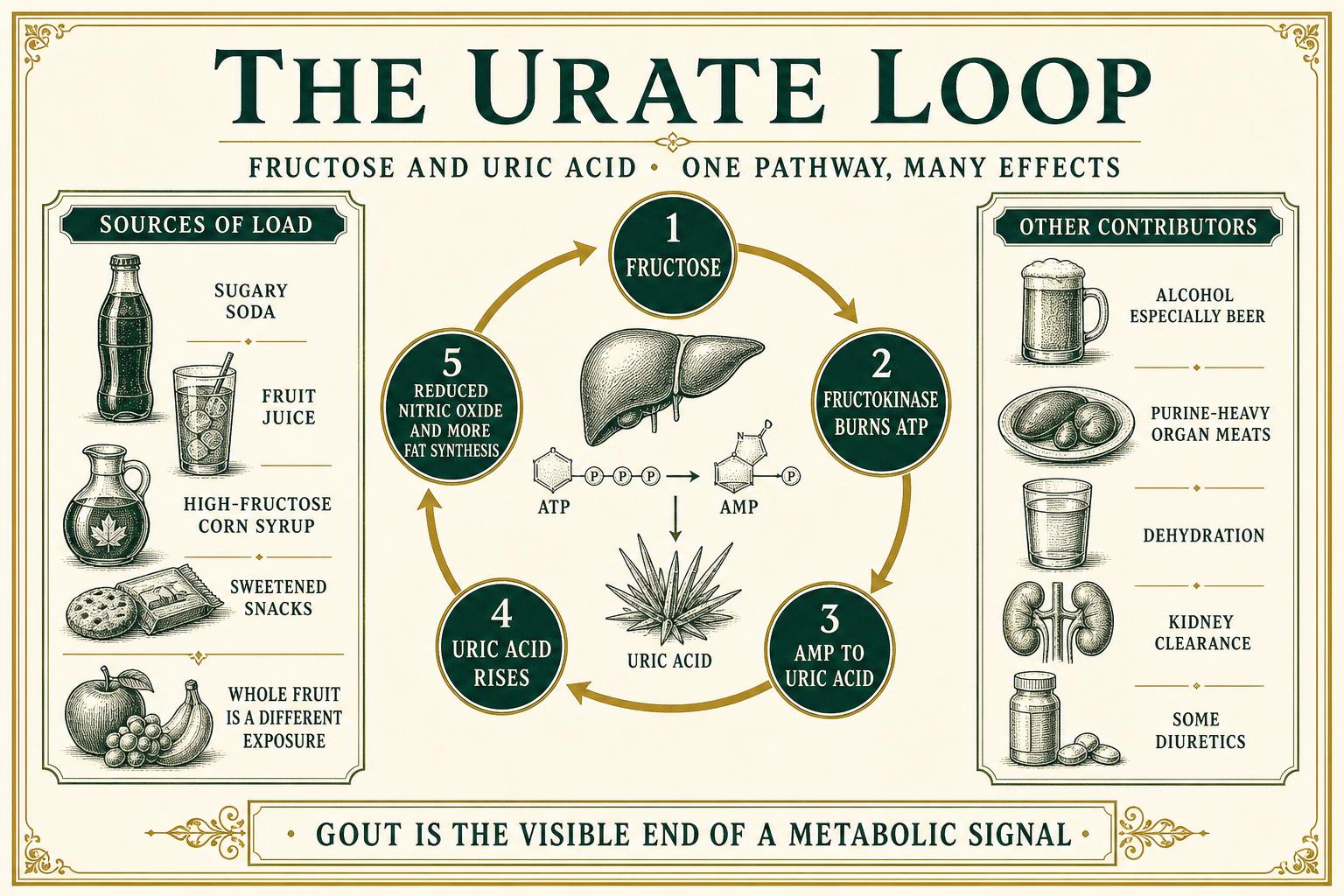
Fructose is the only common dietary sugar whose metabolism directly consumes ATP and generates uric acid as a byproduct.
Uric acid above roughly 5.5 mg/dL associates with hypertension, insulin resistance, and hepatic steatosis in cohort data.
Uric acid is also a potent antioxidant in plasma, which is why the story is a curve rather than a line.
The largest dietary levers are sugar-sweetened beverages and alcohol — larger, for most people, than purine-rich foods.
Fructose from whole fruit behaves differently from fructose in liquid form because of dose rate and fiber.
The Primer
Why fructose is different
Glucose metabolism is regulated: the rate-limiting enzyme slows down when cellular energy is adequate. Fructose metabolism in the liver is not regulated in the same way. Fructokinase phosphorylates fructose rapidly and without a feedback brake, consuming ATP and stripping phosphate groups in the process. The resulting purine breakdown produces uric acid.
The practical consequence: a large liquid fructose load can raise plasma uric acid within an hour, and habitual intake keeps it elevated.
What elevated uric acid does downstream
Uric acid reduces nitric oxide availability in blood vessel walls, which raises blood pressure and impairs the vasodilation that normal circulation depends on. It also promotes lipid accumulation in the liver and interferes with insulin signaling. These effects are why the marker tracks metabolic dysfunction rather than only joint disease.
The realistic dietary levers
Sugar-sweetened beverages first — soda, juice, sweetened coffee drinks, sports drinks. Then alcohol, particularly beer, which contributes both purines and impaired uric acid excretion. High-fructose corn syrup in processed food follows.
Whole fruit is a different matter. The fructose arrives slowly, with fiber, water, and potassium, and the epidemiology does not show the same association. Cherries in particular associate with lower gout attack frequency.
What supports clearance
Adequate hydration, coffee (consistently associated with lower uric acid), dairy protein, vitamin C, and potassium-rich plants. Weight loss lowers uric acid, though rapid loss and fasting temporarily raise it as ketones compete for renal excretion.
The Deep Dive
The biochemistry in detail
Fructose enters hepatocytes via GLUT2 and GLUT5 and is phosphorylated by ketohexokinase (fructokinase C) to fructose-1-phosphate. Unlike hexokinase acting on glucose, ketohexokinase is not inhibited by its product, so a large fructose load causes rapid, unbuffered ATP depletion and intracellular phosphate sequestration. Falling phosphate activates AMP deaminase, driving AMP down the purine degradation pathway: IMP → inosine → hypoxanthine → xanthine → urate, with xanthine oxidase catalyzing the final steps and generating reactive oxygen species as it does.
Uric acid then acts back on the same pathway. It stimulates ketohexokinase expression and inhibits AMPK, creating a self-reinforcing loop in which fructose raises urate and urate amplifies the lipogenic response to fructose.
Tier II · Members only · Free
Continue into the deep dive
Tier I is free and always open. Tier II — the full mechanisms, dosing detail, nuance, and citations — unlocks with a free Vital Codex membership.
- Every Tier II deep dive across all hubs
- Saved reading progress across articles
- Member knowledge modules and their quizzes
- The Dispatch, if you opt in
Frequently asked
Is fruit a problem for uric acid?
Generally no. Whole fruit delivers fructose slowly with fiber and potassium, and cohort studies do not show the association seen with sugar-sweetened beverages. Fruit juice behaves more like soda.
Do I need to avoid purine-rich foods?
For most people, purine restriction produces a smaller effect than cutting liquid sugar and alcohol. It matters more in established gout, and even then organ meats and certain seafood are the priority rather than all protein.
Should I take medication if my uric acid is high but I have no gout?
The trial evidence for treating asymptomatic hyperuricemia is weak. Address the metabolic input first and reassess — that is a conversation for your clinician, not a self-directed decision.
Why did my uric acid rise on a low-carb diet?
Ketones and urate compete for renal excretion, so ketogenic adaptation and fasting transiently raise serum urate. It typically settles over several weeks.
Continue exploring: Metabolism — Glucose variability, insulin sensitivity, and substrate flexibility.
Explore Metabolism