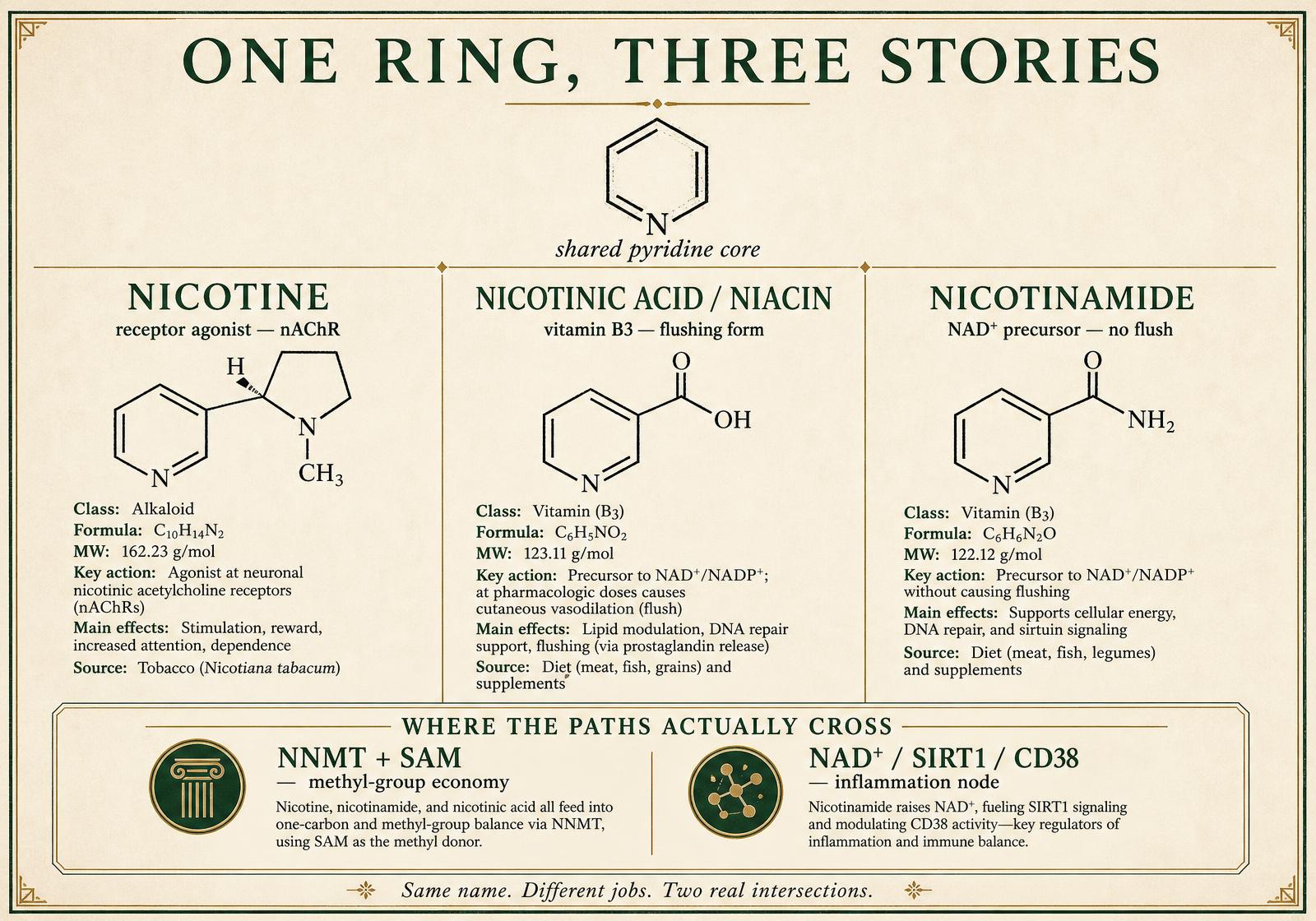
Nicotine, nicotinic acid (niacin), and nicotinamide (niacinamide) all carry the same word inside their names, and the internet regularly draws the wrong conclusion from that: either that a B3 supplement is a stealth dose of nicotine, or that nicotine somehow acts as a vitamin. Neither is true. Nicotine is an alkaloid agonist at nicotinic acetylcholine receptors. Nicotinic acid and nicotinamide are vitamin B3 forms whose job is to become NAD⁺, the redox cofactor that runs metabolism. The shared name comes from a shared pyridine ring and a shared discovery history in tobacco chemistry, not a shared target.
But the flat dismissal — "category error, nothing to see" — is also incomplete. Two intersections are real and biochemically specific. First, the enzyme NNMT (nicotinamide N-methyltransferase) disposes of excess nicotinamide by methylating it with S-adenosylmethionine, and nicotine's own metabolism and the broader handling of pyridine compounds also draw on methylation and one-carbon capacity. Second, NAD⁺ status governs SIRT1 activity and CD38 consumption, and SIRT1 sits directly downstream of the α7 nicotinic anti-inflammatory pathway. So the honest position is not equivalence and not dismissal. It is: different drugs, overlapping downstream economies, and a set of open human questions nobody has properly answered.
Same ring, different jobs. The equivalence claims are wrong; the interaction questions are open.
Contents(12 sections)
The relationship at a glance
Nicotine, nicotinic acid, and nicotinamide share a pyridine ring; nicotine can be chemically oxidized to nicotinic acid, which is why vitamin B3 ever carried a tobacco-derived name.
Vitamin B3 was renamed "niacin" around 1942 specifically so that fortified bread and flour would not appear to contain nicotine — a labeling decision, not a discovery.
Nicotinamide has no meaningful affinity for nicotinic acetylcholine receptors, and nicotine is not a NAD⁺ precursor in humans. Pharmacological equivalence claims are false in both directions.
The strongest real overlap is the methyl-group economy: NNMT methylates nicotinamide to 1-methylnicotinamide using SAM, and high-dose nicotinamide measurably raises methyl demand, with knock-on effects on homocysteine in some studies.
The second overlap is the NAD⁺–SIRT1–CD38 node, where α7 nicotinic signaling and NAD⁺-dependent sirtuin signaling converge on the same NF-κB-suppressing anti-inflammatory output.
Almost everything at these intersections is established in enzymology and rodent work, and almost nothing is settled at ordinary human exposures. That is an open frontier, not a closed case.
The Primer
The name is older than the biology
In 1828, nicotine was isolated from tobacco leaves. Later nineteenth-century chemists found that oxidizing nicotine yields a simple, stable pyridine carboxylic acid, and they called it nicotinic acid — "the acid you get from nicotine." That is the whole reason the vitamin family carries a tobacco word: it was named after the reagent it came out of, decades before anyone knew it was a vitamin.
When Conrad Elvehjem showed in 1937 that nicotinamide cured canine black tongue and that nicotinic acid treated human pellagra, the compound suddenly had a nutritional identity that clashed badly with its name. Public-health officials preparing to fortify flour did not want loaves that appeared to contain nicotine. Around 1942 the American Medical Association's food-and-nutrition group adopted the contraction niacin — from nicotinic acid plus vitamin — precisely to break the association. The chemistry never changed. The label did.
What each one actually does
Think of it as one shared skeleton doing three unrelated jobs.
- Nicotine binds nicotinic acetylcholine receptors — ion channels in the brain, autonomic ganglia, adrenal medulla, gut, and immune cells. It is a signaling agonist. It does not enter energy metabolism as a cofactor.
- Nicotinic acid (niacin) is a vitamin B3 form and NAD⁺ precursor. At pharmacological doses it also hits a separate receptor, HCA2/GPR109A, which is what causes the classic flush and much of its lipid effect.
- Nicotinamide (niacinamide) is the other B3 form and the direct salvage-pathway feedstock for NAD⁺. It does not flush, because it does not activate HCA2 meaningfully.
Structurally, nicotine attaches a methylated pyrrolidine ring to the pyridine; the vitamins attach a small carboxyl or amide group. That difference in the side group is the difference between a receptor drug and a metabolic cofactor.
The plain verdict, stated first
Taking niacinamide is not taking nicotine. Nicotine is not a vitamin and will not build NAD⁺. Any supplement claim or "hidden truth" thread built on the two being the same molecule is wrong on the chemistry.
And yet the two do share downstream real estate. Nicotinamide's disposal route consumes methyl groups. Nicotine's neuroimmune output runs through pathways that NAD⁺ also controls. Whether those overlaps matter at real-world human exposures is a genuinely open question, and it is more interesting than either the equivalence claim or the dismissal.
The Deep Dive
1. Chemistry and the naming history
All three molecules are pyridine derivatives — a six-membered aromatic ring with one nitrogen replacing a carbon.
| Compound | Ring substituent | Molecular identity | Primary target |
|---|---|---|---|
| Nicotine | 1-methyl-2-pyrrolidinyl at ring position 3 | Alkaloid, C₁₀H₁₄N₂ | Nicotinic acetylcholine receptors |
| Nicotinic acid (niacin) | Carboxyl (–COOH) at position 3 | Vitamin B3, C₆H₅NO₂ | NAD⁺ synthesis; HCA2/GPR109A at high dose |
| Nicotinamide | Carboxamide (–CONH₂) at position 3 | Vitamin B3, C₆H₆N₂O | NAD⁺ salvage pathway |
Tier II · Members only · Free
Continue into the deep dive
Tier I is free and always open. Tier II — the full mechanisms, dosing detail, nuance, and citations — unlocks with a free Vital Codex membership.
- Every Tier II deep dive across all hubs
- Saved reading progress across articles
- Member knowledge modules and their quizzes
- The Dispatch, if you opt in
Frequently asked
Is niacinamide a form of nicotine?
No. Niacinamide (nicotinamide) is a vitamin B3 form and a direct NAD⁺ precursor with no meaningful affinity for nicotinic acetylcholine receptors. It shares a pyridine ring and a nineteenth-century naming history with nicotine, and nothing pharmacologically important beyond that. Vitamin B3 was renamed "niacin" around 1942 specifically to stop people drawing this conclusion about fortified flour.
Does nicotine deplete NAD⁺?
Not in any established human way. Nicotine is not a NAD⁺ substrate or precursor. There is a plausible indirect route — oxidative stress raises PARP activity, and PARP consumes NAD⁺ — and rodent and cell studies show nicotine altering mitochondrial redox handling. Whether that produces a measurable NAD⁺ deficit at typical human exposures has not been demonstrated.
Do nicotine and niacinamide compete for methyl groups?
There is real substrate overlap at the level of N-methylation, and both nicotinamide disposal and xenobiotic handling draw on the same SAM pool. The clearly documented part is nicotinamide: gram-level doses raise 1-methylnicotinamide output and can raise homocysteine. The nicotine side is better documented for smoking as a whole — depleted folate, B12, and B6 with elevated homocysteine — than for the isolated molecule. Practically, anyone combining heavy nicotine use with high-dose B3 or NAD⁺ precursors should track methyl-donor status and homocysteine.
Why was vitamin B3 renamed niacin?
Because "nicotinic acid" on a bread label implied nicotine. Once fortification of flour began in the early 1940s, the American Medical Association's nutrition body adopted the contraction "niacin" — nicotinic acid plus vitamin — to break the association. It was a communication decision; the molecule was unchanged.
Should nicotine users take extra B3?
There is no evidence-based B3 protocol for nicotine users, and this article is not a recommendation to start one. What the evidence does support more broadly is that smokers commonly run low on folate, B12, and B6 and higher on homocysteine, so methyl-donor status is worth measuring rather than guessing. Adding gram-level nicotinamide on top of that picture increases methyl demand rather than reducing it. Test, don't assume.
Can the body convert nicotine into niacin?
No. Nicotine can be oxidized to nicotinic acid in a laboratory, which is how nicotinic acid was first obtained in 1867, but human metabolism sends nicotine down the CYP2A6 route to cotinine and trans-3′-hydroxycotinine. Humans do make small amounts of NAD⁺ precursor from tryptophan via the kynurenine pathway — roughly 60 mg tryptophan per 1 mg niacin equivalent — but that has nothing to do with nicotine.
Research Notes & Sources(expand)
- Posselt, W. & Reimann, L. (1828) — original isolation of nicotine from Nicotiana tabacum.
- Huber, C. (1867); Weidel, H. (1873) — oxidation of nicotine yielding and characterizing nicotinic acid.
- Funk, C. (1911) — isolation of nicotinic acid from rice polishings during the beriberi-factor search.
- Warburg, O. & Christian, W. (1935) — identification of nicotinamide within the hydrogen-transferring coenzyme.
- Elvehjem, C. A. et al. (1937), J Am Chem Soc — nicotinamide and canine black tongue; the pellagra connection.
- American Medical Association Council on Foods and Nutrition (c. 1942) — adoption of "niacin" for food-labeling purposes.
- Aksoy, S., Szumlanski, C. L. & Weinshilboum, R. M. (1994), J Biol Chem — human liver nicotinamide N-methyltransferase cDNA and enzymology.
- Kraus, D. et al. (2014), Nature — NNMT knockdown protects against diet-induced obesity; adipose SAM/polyamine flux.
- Chlopicki, S. et al. (2007), Br J Pharmacol — 1-methylnicotinamide and prostacyclin-dependent vascular effects.
- Sun, W.-P. et al. (2012), Nutrition — nicotinamide loading, methyl-group consumption, and homocysteine.
- Fukuwatari, T. & Shibata, K. — nicotinamide metabolism, MNA excretion, and methyl-donor balance.
- Camacho-Pereira, J. et al. (2016), Cell Metabolism — CD38 as a driver of age-related NAD⁺ decline.
- Yeung, F. et al. (2004), EMBO J — SIRT1 deacetylation of RelA/p65 and NF-κB suppression.
- Wang, H. et al. (2003), Nature — α7 nicotinic acetylcholine receptor as the essential regulator of the cholinergic anti-inflammatory pathway.
- Yoshino, J., Baur, J. A. & Imai, S. (2018), Cell Metabolism — NAD⁺ intermediates: biology and therapeutic potential.
- Benowitz, N. L., Hukkanen, J. & Jacob, P. (2009), Handb Exp Pharmacol — nicotine chemistry, metabolism, and disposition kinetics.
- Reviews of smoking, folate/B12/B6 status, homocysteine, and global DNA methylation (multiple, 2005–2023).
Continue exploring: Continue with the metabolism hub for the pathways that set energy, redox, and methylation balance.
Explore Metabolism