Nearly every function that distinguishes a resilient body from a declining one — protein turnover, DNA repair, immune surveillance, neurotransmitter synthesis, muscle contraction — is paid for in ATP. When mitochondrial output falls, the body does not fail uniformly; it quietly deprioritizes the expensive work. That prioritization, repeated over decades, is much of what aging looks like from the inside.
Contents(12 sections)
Key takeaways
Mitochondrial capacity, not mitochondrial count alone, determines functional reserve.
Aging reduces respiratory capacity, mitophagy efficiency, and NAD+ availability in parallel.
Zone 2 aerobic training is the single most reliable intervention for increasing mitochondrial density and quality.
Most supplement approaches modulate the system at the margins; training, sleep, and protein sufficiency set the baseline.
The Primer
What mitochondria actually do
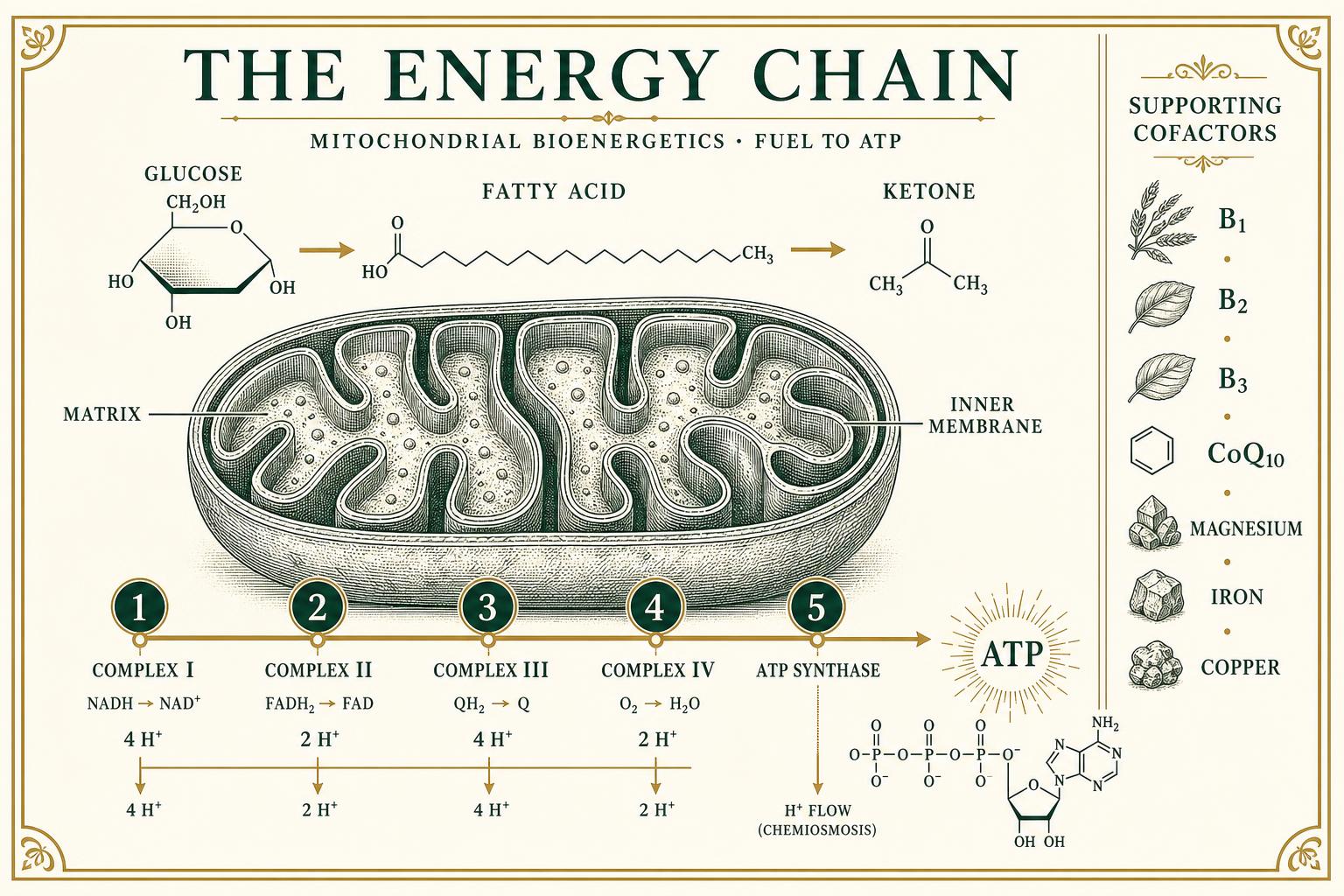
Mitochondria convert food and oxygen into ATP, the energy currency every cell spends. They also generate heat, buffer calcium, synthesize precursors for hormones, and act as decision-making hubs for whether a damaged cell repairs itself or dies.
Because of that breadth, declining mitochondrial function is rarely felt as one symptom. It shows up as fatigue that sleep does not fix, poor exercise recovery, cognitive dullness in the afternoon, and reduced tolerance for stress of any kind.
What changes with age
Three things degrade together. Mitochondrial density falls, particularly in muscle. The remaining mitochondria become less efficient, producing more reactive byproducts per unit of ATP. And the quality-control system that removes damaged mitochondria slows, so defective units accumulate.
Inactivity accelerates all three. A meaningful share of what is attributed to age is actually accumulated disuse.
The levers that work
Aerobic exercise at a conversational pace is the most reliable stimulus for building new mitochondria. Strength training preserves the tissue that houses them. Sleep runs the nightly repair and clearance cycle. Adequate protein supplies the substrate for rebuilding.
Heat and cold exposure, brief fasting windows, and Zone 2 volume all work through the same principle: a controlled stress that signals the cell to build more capacity.
The Deep Dive
Respiratory capacity versus content
Muscle biopsy studies distinguish mitochondrial content (citrate synthase activity, mtDNA copy number) from function (mass-specific respiration measured by high-resolution respirometry). Ageing reduces both, but the functional decline is disproportionate: per-mitochondrion respiratory capacity falls even where content is preserved, reflecting cristae remodeling, reduced supercomplex assembly, and accumulated damage to Complex I and IV subunits.
Spare respiratory capacity — the gap between basal and maximal uncoupled respiration — is arguably the most useful single index. It represents the reserve available when demand spikes, and it is the first parameter to collapse under chronic stress, inflammation, or lipid oversupply.
Tier II · Members only · Free
Continue into the deep dive
Tier I is free and always open. Tier II — the full mechanisms, dosing detail, nuance, and citations — unlocks with a free Vital Codex membership.
- Every Tier II deep dive across all hubs
- Saved reading progress across articles
- Member knowledge modules and their quizzes
- The Dispatch, if you opt in
Frequently asked
Can I measure my mitochondrial function?
Not directly without a biopsy. VO₂max, lactate threshold, and heart rate recovery are the most practical functional proxies and respond to the same interventions.
Do antioxidant supplements help?
High-dose vitamin C and E around training can blunt adaptation. Dietary polyphenols and normal food-level antioxidants are fine; megadoses timed to workouts are counterproductive.
Is NMN or NR worth taking?
They raise NAD+ metabolites reliably but have not yet demonstrated consistent functional benefit in humans. Reasonable to try after the fundamentals are in place, not before.
How quickly does Zone 2 training change anything?
Mitochondrial enzyme activity rises measurably within four to six weeks of consistent volume; lactate threshold shifts follow over three to six months.
Continue exploring: Mitochondria — Cellular energy production and the mechanisms of senescence.
Explore Mitochondria