Otto Warburg identified the metabolic signature of cancer in 1924. The oncology industry spent the next hundred years chasing genetic mutations instead. A recent wave of self-reported remissions on antiparasitic drugs has quietly reopened the case — not because parasites cause cancer, but because parasites and cancer share the same broken metabolism.
Contents(13 sections)
Key takeaways
Cancer cells run on fermentation instead of oxidative phosphorylation — the Warburg effect, documented in 1924 and confirmed thousands of times since.
Thomas Seyfried's nuclear-transfer experiments show mutations are downstream: healthy DNA becomes cancerous inside damaged cytoplasm, and cancerous DNA behaves normally inside healthy cytoplasm.
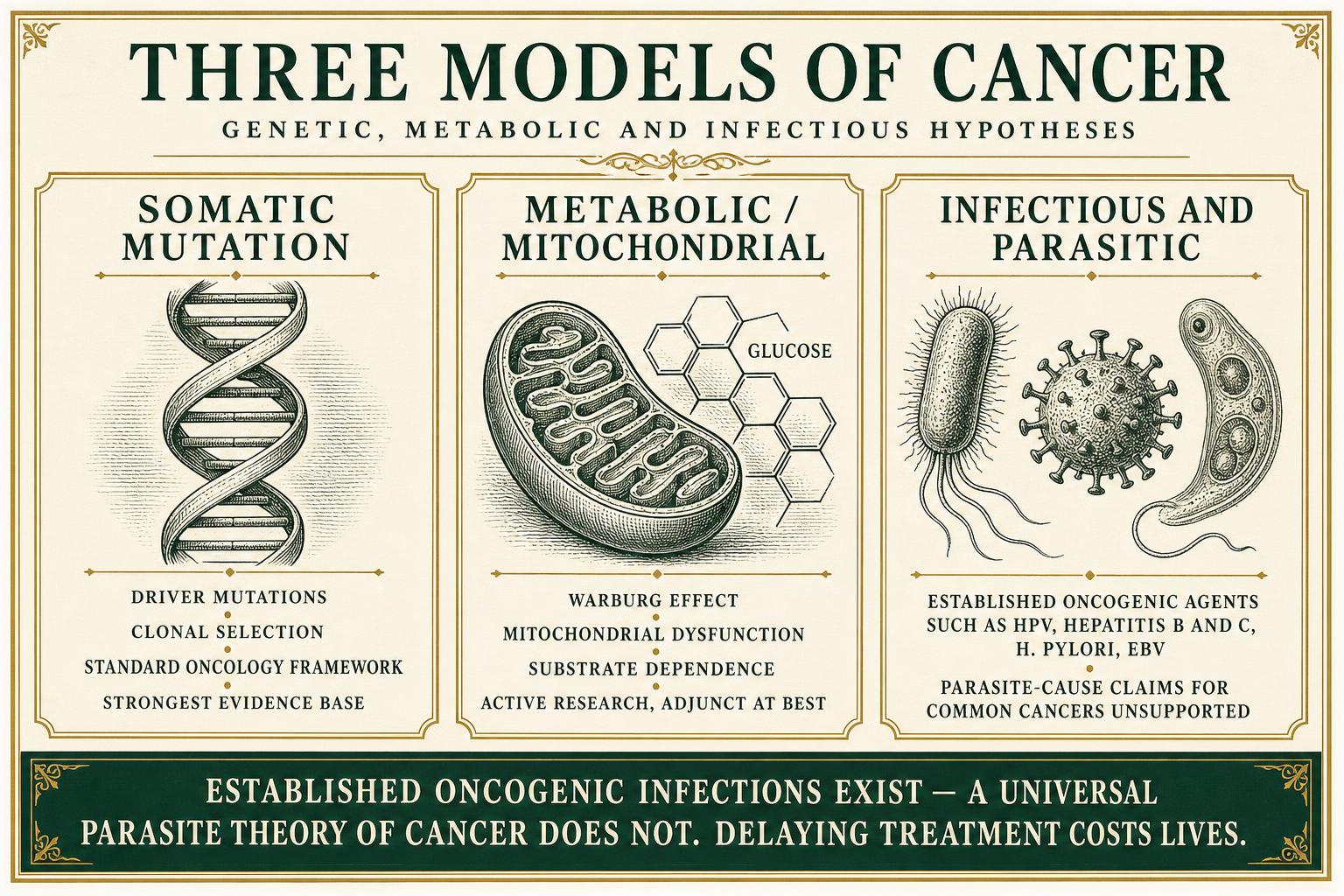
Antiparasitic drugs (fenbendazole, ivermectin, mebendazole) do not "kill parasites causing cancer" — they disrupt the fermentative metabolism cancer and parasites both use.
The terrain — mitochondrial health, blood sugar control, sleep, inflammation, toxin load — is upstream of both parasite pathology and cancer initiation.
The Primer
The 1924 finding that was never overturned
In 1924, German biochemist Otto Warburg observed that cancer cells ferment glucose even in the presence of abundant oxygen. Normal cells extract about 36 units of ATP per glucose through oxidative phosphorylation inside mitochondria. Cancer cells drop to about 2 ATP through fermentation, dumping lactate as a waste product. Warburg concluded cancer was, at root, a metabolic disease — a mitochondrial failure.
He was awarded the Nobel Prize in 1931 for adjacent work. His central claim about cancer was politely shelved.
The parasite rumor
Two threads got braided into one viral story. Hulda Clark claimed in 1990 that a single intestinal fluke caused all cancer — this was wrong. Then in 2016, businessman Joe Tippens went into full remission from stage IV lung cancer while taking fenbendazole, a canine dewormer. His story went viral, and a self-experimenting subculture emerged.
The inference "the dewormer works, so parasites must cause cancer" is the wrong inference. The right one is: antiparasitics and cancer therapy overlap because parasites and cancer cells share a metabolism. Both run on fermentation. A drug that disrupts fermentative metabolism affects both.
What Seyfried proved
Thomas Seyfried, professor of biology at Boston College, ran the experiment that should have ended the mutation debate in the late 1980s:
- Take the nucleus from a cancer cell — all the mutated DNA — and transplant it into cytoplasm with healthy mitochondria. Result: the cell behaves normally.
- Take a pristine healthy nucleus and drop it into cytoplasm with damaged mitochondria. Result: the cell forms tumors.
The mutations are what happens to DNA when the energy system fails, not the cause of the failure.
The Deep Dive
Why the mainstream did not turn
The oncology industry generates over a trillion dollars a year globally. It is built on genetic-mutation targeting, immunotherapy, and chemotherapeutic agents priced per vial at the cost of a used car. That infrastructure cannot pivot without unwinding hundreds of billions of dollars of capital allocation, research programs, and career incentive.
Ships this size do not turn. They keep steaming until they hit something.
Tier II · Members only · Free
Continue into the deep dive
Tier I is free and always open. Tier II — the full mechanisms, dosing detail, nuance, and citations — unlocks with a free Vital Codex membership.
- Every Tier II deep dive across all hubs
- Saved reading progress across articles
- Member knowledge modules and their quizzes
- The Dispatch, if you opt in
Frequently asked
Should I take fenbendazole for cancer?
This article is not medical advice. Fenbendazole is a veterinary drug used off-label by an informed community; the mechanism is plausible and the safety profile in humans appears reasonable at reported doses, but the trial data is thin. If you are considering it, work with a physician who understands metabolic oncology.
Is Warburg's theory really still current?
Yes. Warburg's core observation has been confirmed in tens of thousands of tumor samples. The debate is over primacy — whether the metabolic shift causes the mutations or vice versa — and the nuclear-transfer evidence points squarely at metabolism first.
Are parasite cleanses helpful?
Sometimes, in targeted situations. Broad aggressive cleanses often destabilize the gut ecosystem and create the terrain the parasites needed in the first place. Restoring stomach acid, bile flow, mineral status, and sleep does more for most people than any zapper or twelve-part supplement kit.
What is the single most important input?
Mitochondrial density and function. Everything else — diet, exercise, sleep, light exposure, stress modulation — is instrumentation in service of that.
Continue exploring: Mitochondria — Cellular energy production and the mechanisms of senescence.
Explore Mitochondria