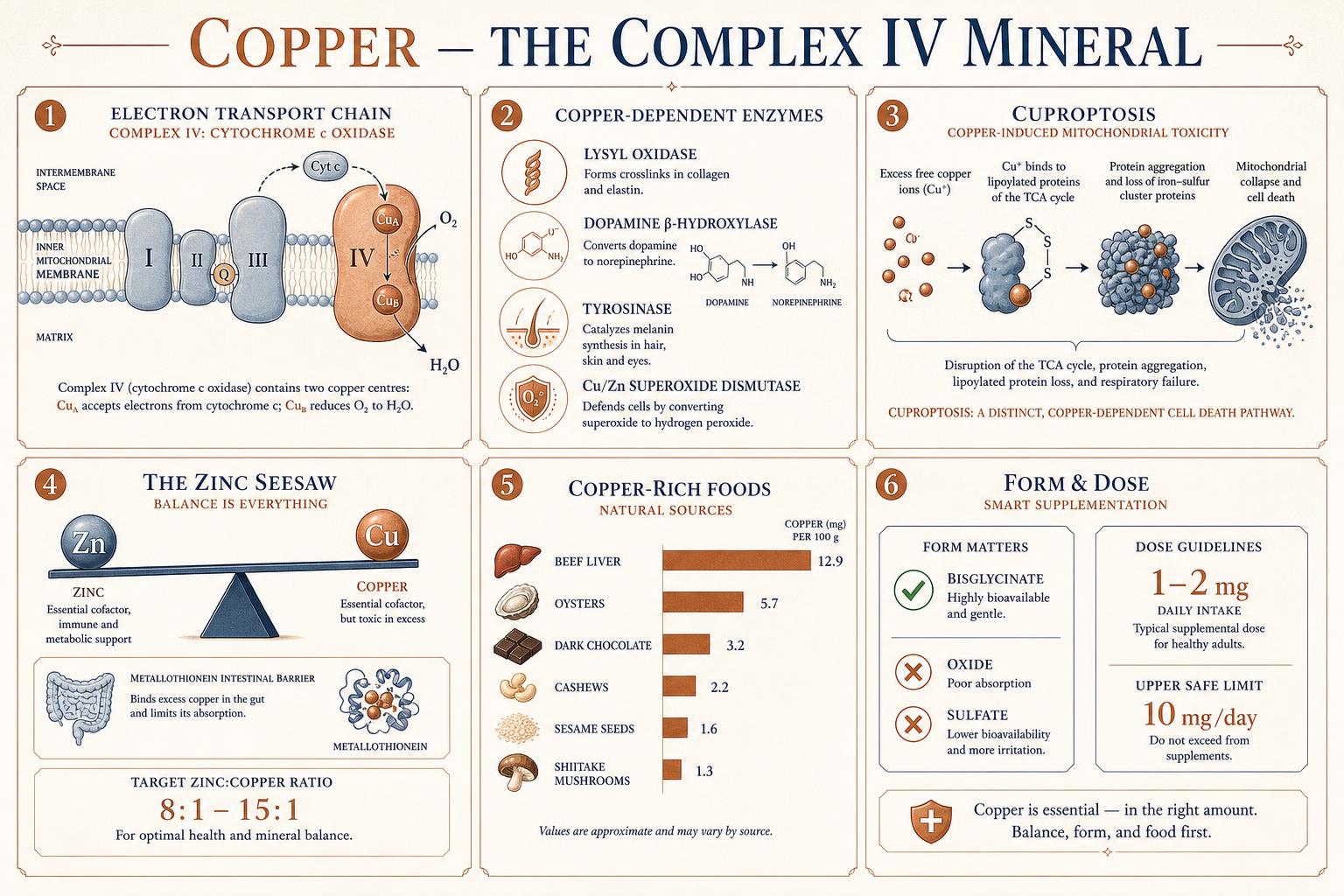
Copper sits at the catalytic centre of cytochrome c oxidase, the terminal enzyme of the mitochondrial electron transport chain. Without it, electrons cannot be handed to oxygen, ATP synthesis stalls, and the leaked electrons become superoxide instead of energy. That makes copper one of the few minerals whose deficiency shows up first as fatigue with a mechanistic explanation rather than a vague one.
The same chemistry that makes copper indispensable also makes it dangerous when it circulates unbound. In 2022, researchers described cuproptosis — a form of regulated cell death in which excess free copper aggregates lipoylated proteins of the TCA cycle and collapses mitochondrial function (Tsvetkov et al., Science, 2022). Copper is therefore not a nutrient to push upward. It is a nutrient to hold in position.
Copper is not a nutrient you push. It is a nutrient you position.
Contents(16 sections)
The essentials at a glance
Copper is the irreplaceable cofactor of Complex IV (cytochrome c oxidase); insufficiency reduces ATP output and increases electron leak.
Cuproptosis is a distinct cell-death pathway triggered by unbound intracellular copper aggregating lipoylated TCA-cycle proteins — separate from apoptosis, necrosis, and ferroptosis.
High-dose zinc induces intestinal metallothionein, which traps copper and excretes it; a Zn:Cu ratio near 8:1 to 15:1 is the practical target.
1–2 mg/day of copper bisglycinate covers most supplemental needs; the adult upper limit is 10 mg/day and food-first is preferable.
Serum copper alone misleads because it rises as an acute-phase reactant. Ceruloplasmin, RBC copper, and concurrent serum zinc and CRP are the informative panel.
The Primer
What copper actually does
Copper is a trace mineral: the total body content is roughly 50–120 mg, and the daily requirement is measured in single milligrams. Within that small budget it performs four jobs that nothing else can do — it finishes the energy chain in your mitochondria, crosslinks the collagen and elastin that give skin, joints, and arteries their spring, converts dopamine into norepinephrine so attention and drive work, and makes the pigment in hair and skin.
Premature greying is one of the more recognisable early signs of low copper, because the pigment enzyme tyrosinase is copper-dependent.
The zinc seesaw
Zinc and copper compete for the same absorption pathway. Zinc raises production of a gut protein called metallothionein, which binds copper more tightly than zinc — so copper gets held inside the intestinal cell and shed rather than absorbed. High-dose zinc from cold remedies, acne protocols, or generous multivitamins therefore drains copper over weeks to months.
If you take zinc on an ongoing basis, pair it with 1–2 mg of copper, or keep the zinc course short.
Food first
Copper from food arrives bound to proteins and is absorbed through regulated transport, which is safer than free ionic copper. Dense sources:
- Beef liver — the single best source; one modest serving covers days of need
- Oysters and shellfish
- Dark chocolate and raw cacao at 70% or higher
- Shiitake mushrooms
- Cashews and sesame seeds
Free-range and pasture-raised animal foods are the better choice here as elsewhere — organ meats concentrate whatever the animal was exposed to, so provenance matters more for liver than for almost any other food.
If you supplement
- Preferred form: copper bisglycinate — well absorbed and gentle on the stomach.
- Acceptable: copper gluconate and copper citrate, organic salts with reasonable absorption and a long clinical track record.
- Liquid alternative: ionic copper hydrosol can work for people who cannot swallow capsules, but it supplies free ionic copper rather than a chelated form. If you use it, count the dose toward your daily total and stay well below the 2 mg/day supplemental range. One vetted option is Sovereign Copper Bio-Active Hydrosol (affiliate link).
- Avoid: copper oxide (bioavailability often under 10%) and, at higher doses, copper sulfate (gastric irritation).
- RDA: 900 mcg (0.9 mg) per day for adults — the intake that prevents deficiency, not an optimisation target.
- Dose: 1–2 mg/day is sufficient and safe for most adults.
- Therapeutic range: 3–5 mg/day is used for documented deficiency, but only under clinical supervision with lab follow-up.
- Ceiling: do not exceed 10 mg/day. Excess copper is hepatotoxic.
- Spacing: keep copper a couple of hours away from high-dose vitamin C (over about 1,000 mg), which alters copper's redox state and absorption kinetics.
- Topical only: GHK-Cu, the copper tripeptide used in dermatology and hair products, stimulates collagen synthesis and wound repair at the skin. It is a topical agent, not an oral copper source, and should never be ingested.
Anyone with liver disease, Wilson's disease, or a family history of copper-handling disorders should not supplement copper without specialist supervision.
The Deep Dive
Cuproptosis: a distinct death pathway
Tsvetkov and colleagues (Science, 2022) established that copper-induced death does not proceed through caspase activation, lipid peroxidation, or membrane rupture. The proximate event is direct binding of Cu(I) to lipoylated components of the mitochondrial pyruvate dehydrogenase and alpha-ketoglutarate dehydrogenase complexes. Those lipoylated proteins aggregate, Fe-S cluster proteins are destabilised, and the cell dies of acute proteotoxic and bioenergetic stress. Sensitivity tracks with reliance on oxidative phosphorylation and with expression of FDX1 and the lipoyl synthase machinery — cells running glycolysis are comparatively resistant.
The oncological implication is bidirectional. Many tumours are copper-dependent, using it for angiogenesis through VEGF signalling and for MEK1/2 kinase activity, which is the rationale for copper chelation (tetrathiomolybdate) in trials aimed at starving metastatic niches. Simultaneously, copper ionophores such as elesclomol and disulfiram deliver copper into cells to deliberately trigger cuproptosis in oxidative tumour populations. Both approaches are investigational; neither is a reason to self-administer copper or a chelator.
Tier II · Members only · Free
Continue into the deep dive
Tier I is free and always open. Tier II — the full mechanisms, dosing detail, nuance, and citations — unlocks with a free Vital Codex membership.
- Every Tier II deep dive across all hubs
- Saved reading progress across articles
- Member knowledge modules and their quizzes
- The Dispatch, if you opt in
Frequently asked
How much copper should I take?
For most adults who need a supplement at all, 1–2 mg/day of copper bisglycinate is sufficient. The adult tolerable upper intake level is 10 mg/day from all sources, and there is no benefit to approaching it.
Do I need copper if I take zinc?
If your zinc intake is ongoing or above roughly 40 mg/day, yes — pair it with 1–2 mg of copper or ensure regular copper-rich food. Short courses of zinc for acute illness do not require it.
Is a serum copper test enough?
No. Serum copper rises with inflammation because ceruloplasmin is an acute-phase reactant, so it can look normal during real deficiency. Pair it with ceruloplasmin, RBC copper, serum zinc, and CRP.
What is cuproptosis, in plain terms?
It is cell death caused by unbound copper inside the cell clumping together key proteins of the mitochondrial TCA cycle. It is being studied as a way to kill copper-dependent tumour cells, and it is also the reason copper excess is genuinely toxic rather than merely wasteful.
Can I get enough copper from food alone?
Usually yes. Beef liver, oysters, dark chocolate, cashews, sesame seeds, and shiitake mushrooms are all dense sources, and food-bound copper is absorbed through regulated transport rather than arriving as free ions.
Research Notes & Sources(expand)
- Tsvetkov P, et al. Copper induces cell death by targeting lipoylated TCA cycle proteins. Science. 2022;375(6586):1254–1261.
- Kim BE, Nevitt T, Thiele DJ. Mechanisms for copper acquisition, distribution and regulation. Nat Chem Biol. 2008;4(3):176–185.
- Cobine PA, Moore SA, Leary SC. Getting out what you put in: copper in mitochondria and its impacts on human disease. Biochim Biophys Acta Mol Cell Res. 2021;1868(1):118867.
- Turski ML, et al. A novel role for copper in Ras/MAPK signaling. Mol Cell Biol. 2012;32(7):1284–1295.
- Institute of Medicine. Dietary Reference Intakes for Vitamin A, Vitamin K, Arsenic, Boron, Chromium, Copper, Iodine, Iron... National Academies Press, 2001.
- Nations SP, et al. Denture cream: an unusual source of excess zinc leading to hypocupremia and neurologic disease. Neurology. 2008;71(9):639–643.
- Collins JF, Klevay LM. Copper. Adv Nutr. 2011;2(6):520–522.
- Squitti R, et al. Non-ceruloplasmin bound copper and Alzheimer's disease. Neurobiol Aging. 2014;35(1):S40–S50.
- Bush AI. The metallobiology of Alzheimer's disease. Trends Neurosci. 2003;26(4):207–214.
- Song M, et al. High fructose feeding induces copper deficiency in rats. J Hepatol. 2012;56(2):433–440.
- Besold AN, Culbertson EM, Culotta VC. The Yin and Yang of copper during infection. J Biol Inorg Chem. 2016;21(2):137–144.
- Pickart L, Margolina A. Regenerative and protective actions of the GHK-Cu peptide. Int J Mol Sci. 2018;19(7):1987.
Educational content only; not medical advice. Trace mineral manipulation carries real biological leverage — consult a qualified clinician before supplementing copper, particularly with any history of liver disease or a genetic copper-handling disorder.
Continue exploring: The Vital Codex library on mitochondrial energy, trace minerals, and the terrain that carries them.
Explore Mitochondria