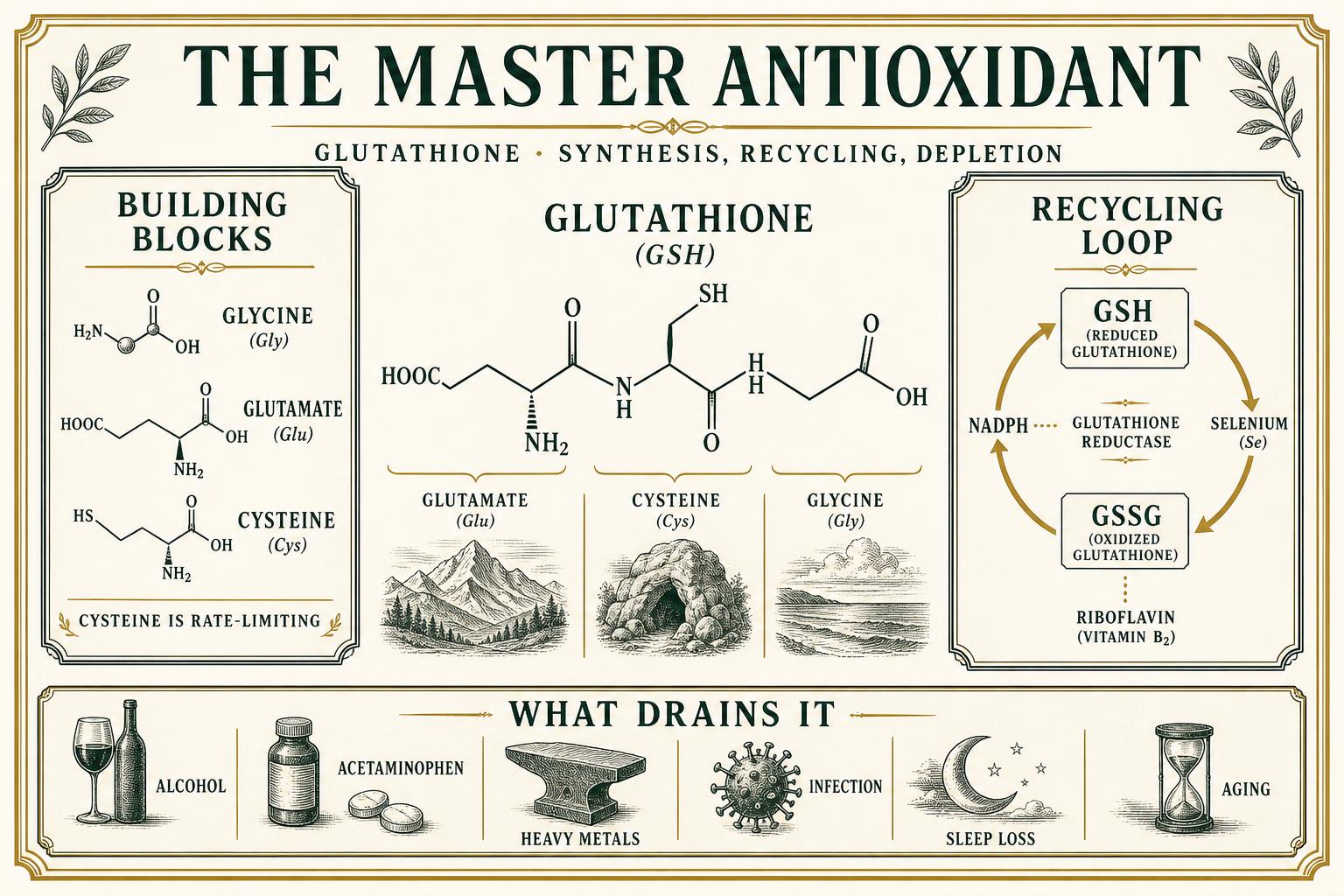
Glutathione (GSH) is a tripeptide of cysteine, glycine, and glutamate synthesized inside virtually every human cell. It is the dominant intracellular antioxidant, present at millimolar concentrations — far higher than vitamins C or E — and it works where most oxidative damage occurs: inside the cell and inside the mitochondrion.
Its second role is equally important. Glutathione conjugation is a core phase II detoxification pathway, the step that makes many drugs, environmental chemicals, and heavy metals water-soluble enough to excrete.
Contents(13 sections)
Key takeaways
Glutathione is synthesized in the cell from cysteine, glycine, and glutamate; cysteine availability is usually the rate-limiting factor.
The meaningful measure is the ratio of reduced (GSH) to oxidized (GSSG) glutathione, not total glutathione alone.
GSH conjugation is a primary phase II detoxification route for xenobiotics, acetaminophen metabolites, and some heavy metals.
Levels decline with age, chronic inflammation, alcohol, poor sleep, and high toxic or oxidative load.
Cysteine donors (NAC, whey protein), glycine, sulforaphane, and adequate selenium and riboflavin support the system more reliably than most oral glutathione products.
The Primer
What it does
Think of glutathione as the cell's internal repair currency. When reactive oxygen species damage lipids, proteins, or DNA, glutathione donates an electron to neutralize the threat and is itself oxidized to GSSG. Glutathione reductase then recycles it back to GSH using NADPH.
Because the pool is recycled, capacity depends on two things: how much glutathione the cell can build, and how well it can regenerate what it has already used. A person under heavy oxidative load can have adequate total glutathione and still be functionally depleted because too much of it is sitting in the oxidized form.
Why it also matters for detoxification
The liver uses glutathione to tag fat-soluble compounds so they can leave the body. This is the pathway that handles a therapeutic dose of acetaminophen — and the pathway that is overwhelmed in an overdose, which is precisely why the antidote is N-acetylcysteine, a cysteine donor that restores glutathione synthesis.
What depletes it
Chronic alcohol intake, sustained infection or inflammation, insufficient protein, poor sleep, intense unrecovered training loads, smoking, and high exposure to solvents, pesticides, and air pollution all draw down the pool. Aging lowers synthesis capacity independently of all of these.
The reasonable foundations
Adequate total protein with sulfur-containing amino acids (free-range eggs, fish, poultry, dairy, whey), cruciferous vegetables, alliums, sleep, and not overdrinking cover most of the ground. Nothing exotic is required to keep the system functional in a healthy person.
The Deep Dive
Synthesis and the rate-limiting step
Glutathione is built in two ATP-dependent steps. Glutamate cysteine ligase (GCL) joins glutamate and cysteine to form γ-glutamylcysteine; glutathione synthetase then adds glycine. GCL is the rate-limiting enzyme and is feedback-inhibited by GSH itself, so synthesis rises when the pool falls.
Cysteine is normally the limiting substrate because free cysteine is scarce, unstable, and mildly cytotoxic at high concentrations. This is the mechanistic rationale for N-acetylcysteine, which delivers cysteine in a stable, non-toxic form. Glycine can become co-limiting in older adults, and combined glycine plus NAC supplementation ("GlyNAC") has restored several markers of oxidative stress and mitochondrial function toward younger values in small controlled trials (Kumar et al., Clinical and Translational Medicine, 2021).
Tier II · Members only · Free
Continue into the deep dive
Tier I is free and always open. Tier II — the full mechanisms, dosing detail, nuance, and citations — unlocks with a free Vital Codex membership.
- Every Tier II deep dive across all hubs
- Saved reading progress across articles
- Member knowledge modules and their quizzes
- The Dispatch, if you opt in
Frequently asked
Should I take glutathione or NAC?
For most people NAC is the more efficient choice: it supplies the limiting substrate and is absorbed reliably, while ordinary oral glutathione is largely broken down before absorption. Liposomal glutathione is a reasonable alternative if NAC is poorly tolerated.
Can I test my glutathione level?
Erythrocyte or whole-blood glutathione and the GSH:GSSG ratio are available through specialty laboratories, but handling artifacts are common and reference ranges vary. Tracking inputs and clinical response is usually more practical than serial testing.
Do glutathione IV drips whiten skin?
Intravenous glutathione is marketed for skin lightening via tyrosinase inhibition. Evidence is limited and short-lived, and several regulators have warned about unapproved high-dose injectable use. It is not a health intervention.
Is more antioxidant always better?
No. Exercise adaptation, immune signaling, and normal cell turnover depend on transient oxidative signals. Blunting them indiscriminately with very high antioxidant doses has reduced training adaptations in several trials. The goal is a functional redox balance, not maximal suppression.
Continue exploring: Mitochondria — Cellular energy production and the mechanisms of senescence.
Explore Mitochondria