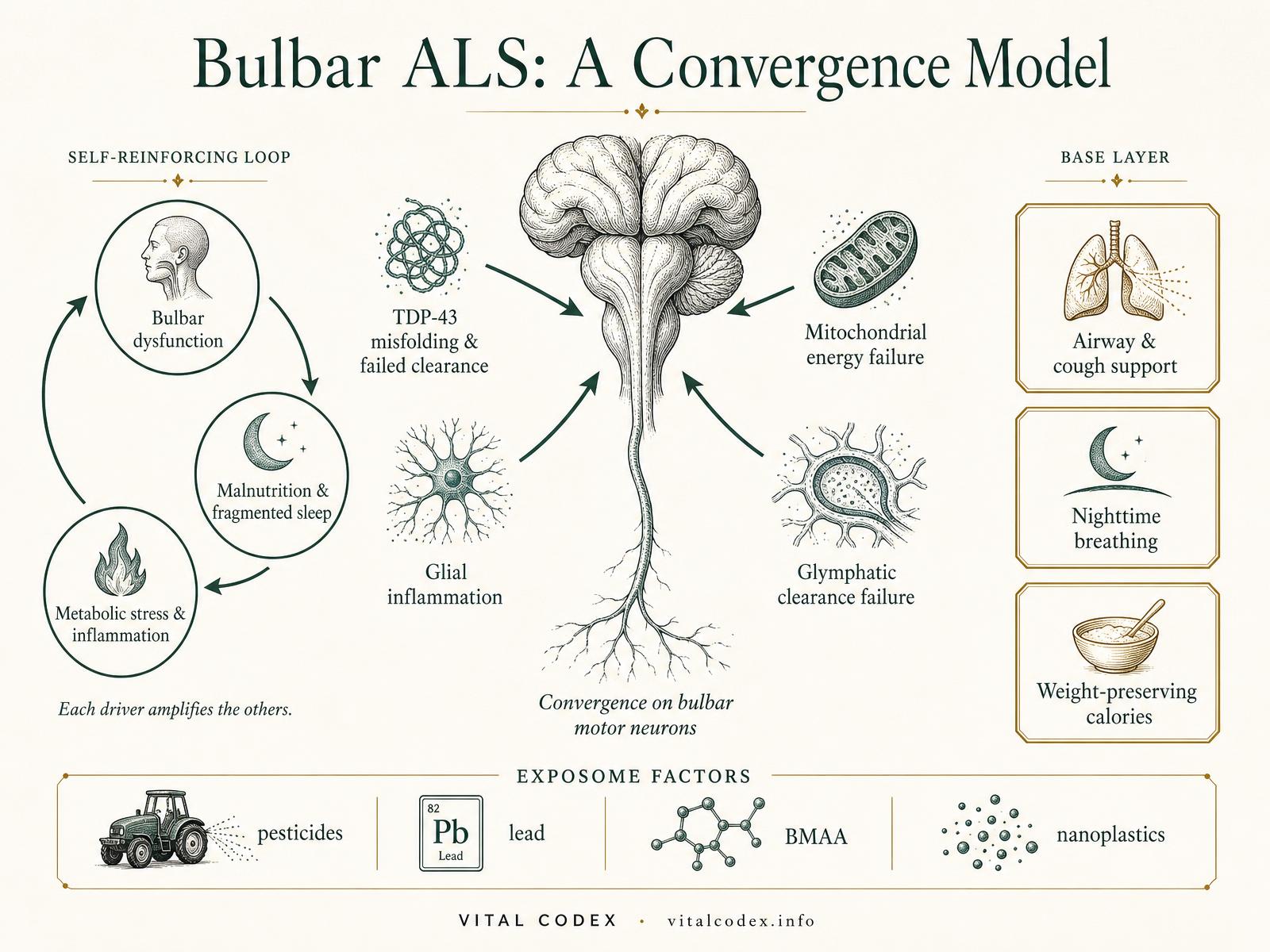
Bulbar-onset ALS may be better understood as a converging systems failure than as an isolated motor-neuron disease. The most useful working model is not a single root cause but a vulnerable motor-neuron network pushed past its resilience threshold by interacting forces: protein misfolding, impaired mitochondrial energy production, chronic glial inflammation, toxic exposures, defective cellular cleanup, disrupted sleep and clearance, and inadequate nutritional reserve.
For bulbar ALS the urgent practical reality is that impaired speech, swallowing, cough, secretion clearance, and nighttime breathing can become dangerous before limb weakness is severe. Any restoration-oriented protocol should run alongside early swallow, respiratory, nutrition, and cough-assist support — not after those functions have declined.
Motor neurons fail where energy demand is highest and reserve is thinnest. The pattern is the clue.
Contents(17 sections)
Key takeaways
Bulbar ALS begins in the brainstem systems governing speech, swallowing, tongue control, airway protection, and cough, so nutritional and respiratory risk often arrive before major limb weakness.
Bulbar dysfunction creates a self-reinforcing loop: reduced intake and fragmented sleep drive metabolic stress and inflammation, which further increase neuronal vulnerability.
Four mechanisms converge repeatedly in the literature: TDP-43 mislocalization with failed clearance, mitochondrial energy failure, microglial and astrocytic inflammation, and impaired glymphatic transport.
Metabolic support must be weight-preserving. Hypermetabolism and weight loss are adverse prognostic factors, so calorie-restrictive or starvation-style ketogenic approaches are the wrong tool here.
The strongest exposome signals are organochlorine pesticides, occupational lead, cyanobacterial BMAA, and — most recently — nanoplastics, with a 2026 human study reporting higher serum and cerebrospinal-fluid microplastic concentrations in ALS cases than controls.
Among natural agents, melatonin and carefully dosed C8/C10 MCT have the most rational footing; TUDCA and CoQ10 have both been demoted by trial results.
The Primer
Phenotype and priorities
Bulbar-onset ALS begins in the brainstem motor-neuron systems that govern speech, swallowing, tongue and facial control, airway protection, coughing, and eventually respiration. Typical early signs include:
- Slurred, slowed, strained, or increasingly nasal speech
- Tongue weakness, fasciculations, reduced tongue mobility, or difficulty moving food within the mouth
- Choking or coughing on liquids, pills, or saliva
- Food "sticking," prolonged meals, unexplained weight loss, or avoidance of difficult textures
- Drooling or thick, difficult-to-clear secretions
- A weak cough, recurrent chest infections, breathlessness when lying down, fragmented sleep, or morning headaches
- Emotional lability — sudden crying or laughing — which can reflect pseudobulbar affect rather than mood alone
Why the loop matters more than any single symptom
Diminished swallowing and respiratory efficiency reduce calorie intake, sleep quality, oxygenation, mobility, social contact, and resilience. Those losses then amplify inflammation, catabolism, mitochondrial strain, and clearance failure.
The sequence runs: bulbar dysfunction leads to malnutrition, sleep disruption, and aspiration risk; those produce metabolic stress and inflammation; and that increases neuronal vulnerability, which worsens bulbar function again.
This is why preserving nutrition, airway safety, nighttime ventilation, and effective secretion clearance is not merely symptomatic care. It is foundational terrain management. Guidelines recommend early respiratory support when indicated, lung-volume recruitment and assisted coughing for secretion retention, and mechanical cough assistance when cough flow is impaired.
A convergence model of causation
Most ALS is not explained by a single inherited mutation. Genetics matter — particularly C9orf72, SOD1, TARDBP, and FUS — but the broader picture is gene-environment interaction operating over decades. The "root cause" may therefore be better described as the point at which cumulative stressors overwhelm motor-neuron maintenance systems.
The Deep Dive
Protein misfolding and failed cellular cleanup
TDP-43 mislocalization and aggregation occur in most ALS cases. Normally this RNA-binding protein is primarily nuclear; in ALS it can accumulate in the cytoplasm, disrupt RNA processing, impair stress-granule dynamics, interfere with mitochondria, and contribute to progressive neuronal dysfunction.
Autophagy, proteasomal clearance, lysosomal function, heat-shock proteins, and mitochondrial quality control are all relevant. If oxidative stress or toxins damage these systems, proteins that should be repaired or cleared can instead become persistent aggregates.
Tier II · Members only · Free
Continue into the deep dive
Tier I is free and always open. Tier II — the full mechanisms, dosing detail, nuance, and citations — unlocks with a free Vital Codex membership.
- Every Tier II deep dive across all hubs
- Saved reading progress across articles
- Member knowledge modules and their quizzes
- The Dispatch, if you opt in
Frequently asked
What makes bulbar ALS different from limb-onset ALS?
Bulbar onset begins in the brainstem motor systems controlling speech, swallowing, tongue movement, airway protection, and cough. That means nutritional risk, aspiration risk, and nighttime breathing problems can appear while limb strength is still relatively preserved, so swallow and respiratory support usually need to start earlier.
Should someone with bulbar ALS follow a ketogenic diet?
Not a restrictive one. Ketone metabolism is mechanistically attractive because motor neurons face an energy deficit, but hypermetabolism and weight loss worsen ALS prognosis. The safer version is a calorie-sufficient, lower-glycemic pattern with gradual C8/C10 MCT added only if digestion and body weight hold steady.
How strong is the microplastics evidence in ALS?
Suggestive, not conclusive. Animal and cell work shows nanoplastics can drive oxidative stress, disrupt heat-shock-protein function, and promote TDP-43 condensation, and a 2026 human study found higher serum and cerebrospinal-fluid microplastic levels in ALS cases with a correlation to neurofilament light chain. That is an association strong enough to justify reducing exposure, not proof of cause.
Why does sleep matter so much in this model?
Deep non-REM sleep drives glymphatic fluid exchange, which supports clearance of metabolic waste and misfolded protein. In bulbar ALS, sleep-disordered breathing and nocturnal hypoventilation fragment exactly that sleep stage, so untreated nighttime breathing problems can simultaneously worsen clearance, oxygenation, and daytime function.
Which supplements have the best rationale, and which have been demoted?
Melatonin and carefully dosed C8/C10 MCT have the most rational footing, with a bioavailable curcumin as a secondary anti-inflammatory adjunct and deficiency correction as basic housekeeping. TUDCA and high-dose CoQ10 both had strong mechanistic cases that trial results have since weakened.
Research Notes & Sources(expand)
Respiratory and secretion management recommendations follow published ALS care guidance (CMAJ ALS guideline; ALS respiratory management reviews).
Mechanistic material on TDP-43, mitochondrial quality control, and epigenetic interaction draws on peer-reviewed ALS mechanism reviews indexed in PubMed.
Glymphatic findings reference imaging and AQP4 studies of glymphatic impairment in ALS and related neurodegenerative disease, plus sleep-clearance literature on deep non-REM transport.
Exposome material references a 2024 national case-control study of serum organochlorine pesticides and occupational lead exposure, BMAA experimental literature, nanoplastic animal and cell studies, and a 2026 human study of serum and cerebrospinal-fluid microplastic concentrations with neurofilament light-chain correlation.
Metabolic intervention data reference a 2026 ALS feasibility study comparing a ketogenic diet, ketone ester, and ketone salts, alongside ALS hypermetabolism and weight-loss prognostic literature.
Supplement positions reference the ALS melatonin protein-carbonyl study, the nanocurcumin add-on trial and the neutral 6-month curcumin trial, Hericium erinaceus human and preclinical work, the TUDCA phase II and phase III results, and the high-dose CoQ10 phase II futility outcome.
Continue exploring: Continue with the mitochondria hub for the bioenergetics underneath this model.
Explore Mitochondria