Autophagy — Greek for "self-eating" — is the process by which cells digest and recycle their own damaged components. It is genuinely central to cellular maintenance; the 2016 Nobel Prize in Physiology or Medicine recognized the mapping of its molecular machinery. It is also the most confidently over-claimed concept in popular longevity content.
The specific fasting durations circulating online are not measurements. They are extrapolations from rodent tissue. The biology is real; the clock is not.
Contents(31 sections)
Key takeaways
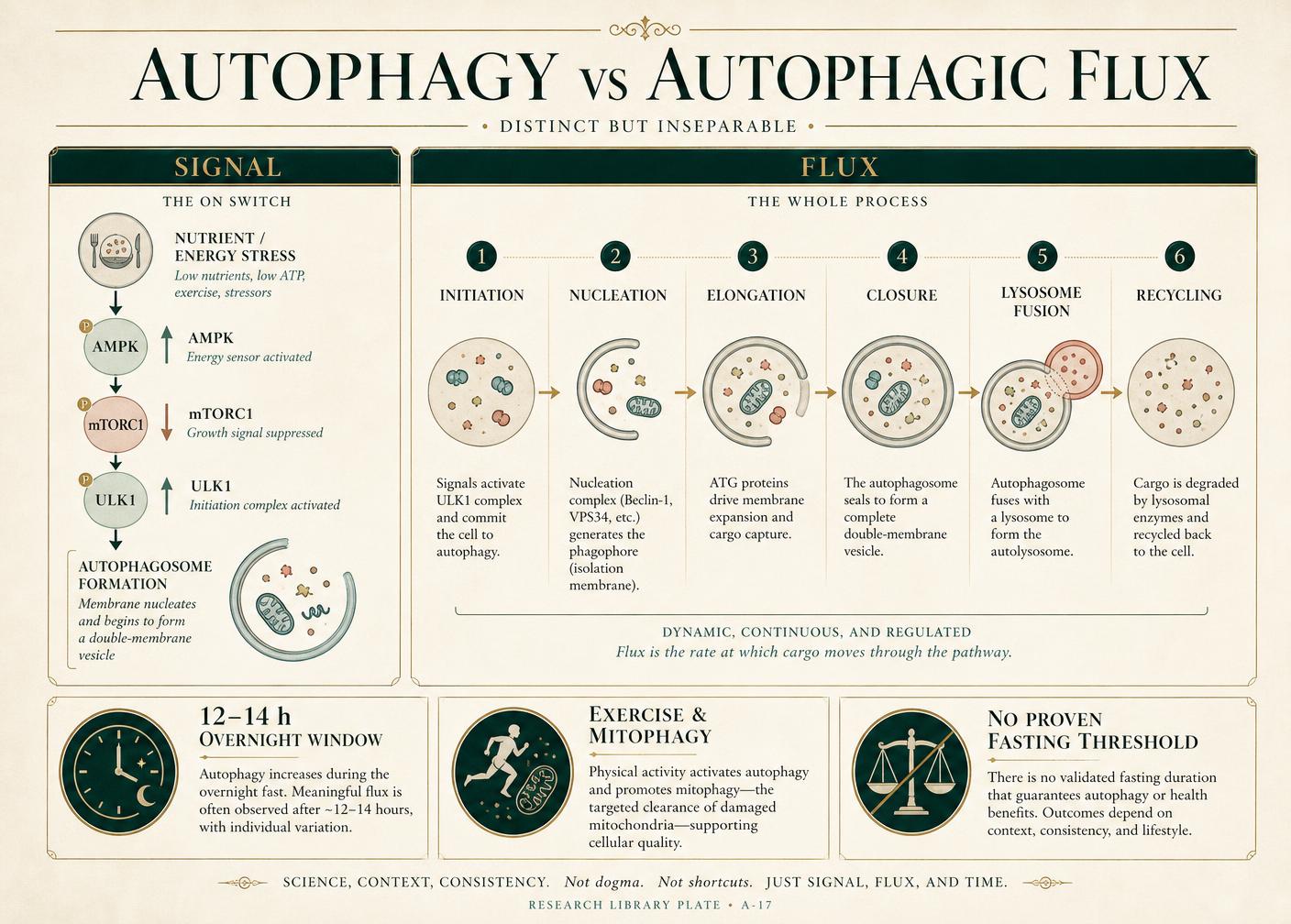
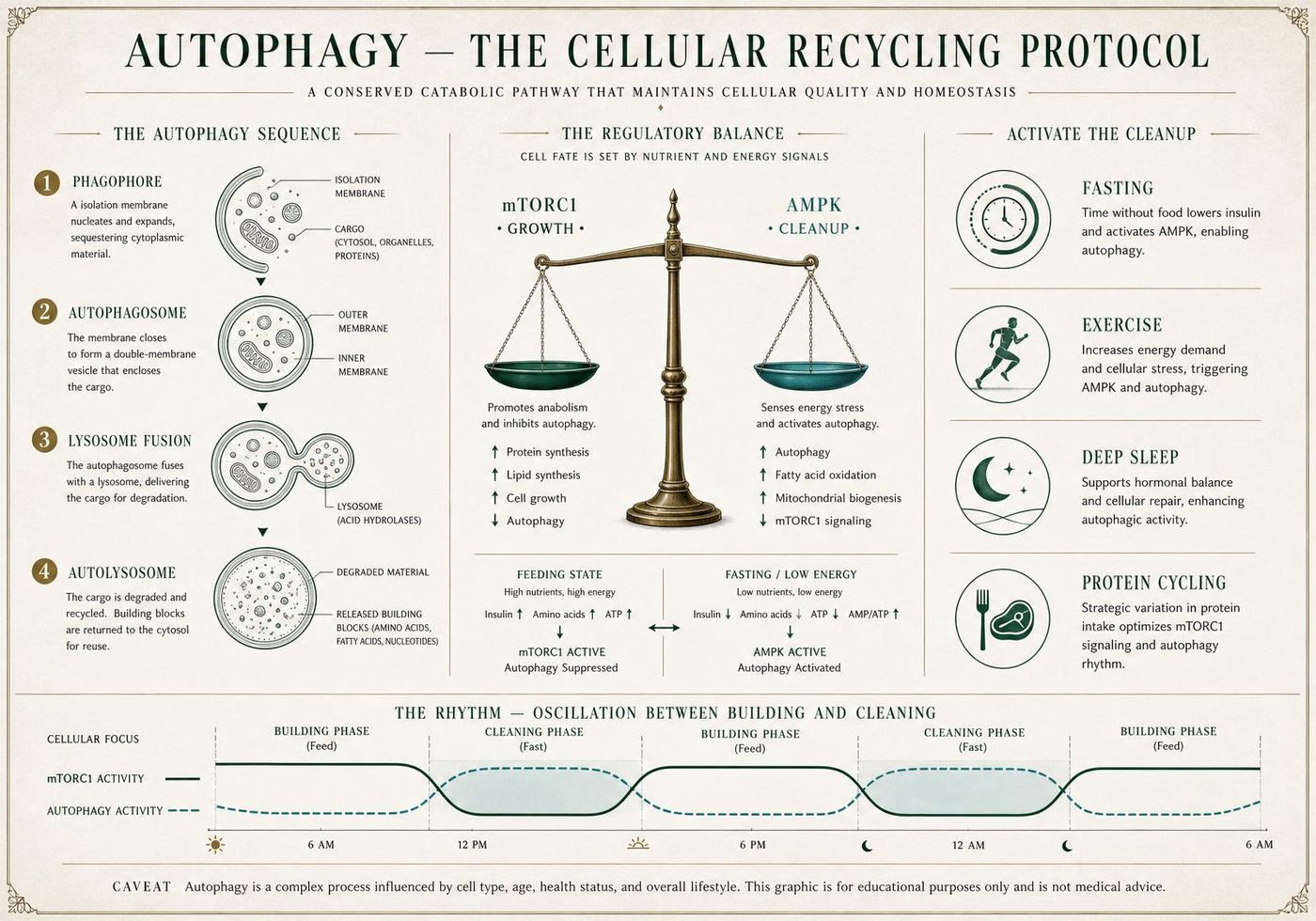
Autophagy is regulated by the balance between mTORC1 (growth) and AMPK (energy stress), driven by nutrient and energy status rather than by a clock.
The frequently cited 16-hour threshold has no direct human tissue measurement behind it; autophagy is a continuous flux, not a switch.
Amino acids — leucine in particular — suppress autophagy more specifically than calories alone, which is why protein timing matters as much as fasting length.
Exercise, deep sleep, and protein cycling activate autophagy alongside caloric restriction; fasting is one lever, not the only one.
Chronic maximal autophagy is not the goal. The same mTORC1 suppression that licenses cleanup also suppresses muscle protein synthesis. Health requires oscillation.
Mitophagy — the selective removal of damaged mitochondria via PINK1/Parkin tagging — is the arm most tied to aging, and only roughly 30–40% of people carry the gut bacteria needed to make urolithin A from dietary ellagitannins.
The Primer
The essential idea, in plain language
Think of a cell as a busy restaurant kitchen. Over a day, pans get scorched, tools break, and scraps pile up. If nobody cleans, the kitchen eventually stops working. Autophagy is the cleanup crew: it identifies broken cellular parts — misfolded proteins, oxidized lipids, worn-out energy generators — bags them inside a membrane, and delivers them to the cell's recycling center, the lysosome. There the parts are broken down into raw materials and reused to build new, functional components.
Mitophagy is the mitochondria-specific version, and it matters disproportionately. A damaged mitochondrion leaks reactive oxygen species and consumes resources without producing usable energy. Removing it is a net gain.
Mitophagy in plain language: scrapping the broken generators
Picture a factory powered by thousands of small generators. Some crack with age, leak toxic smoke, and produce almost no electricity. Leave them running and the smoke eventually poisons the workers. Mitophagy is the crew that hunts down those broken generators, slaps a "condemned" tag on them, and hauls them to the incinerator to be melted down for parts.
Three consequences follow:
- Zombie mitochondria. Mitophagy slows with age. Damaged mitochondria neither produce useful energy nor die — they persist, leaking inflammatory signals that degrade the tissue around them.
- Brain and muscle go first. The two highest-energy tissues suffer earliest when clearance falters, which is one mechanistic thread connecting mitophagy failure to brain fog, sarcopenia, and neurodegeneration.
- Scrapping precedes rebuilding. The amino acids and lipids released by breaking down a bad mitochondrion are the raw material for new ones. You cannot build a fresh engine without dismantling the old one.
Levers that trigger the purge: energy scarcity (fasting, exercise) via AMPK; hormetic stress (sauna, cold) that forces the weakest mitochondria out; and specific molecules — urolithin A and spermidine — that signal mitophagy even in the fed state.
Why it matters
- Brain protection. Neurons largely cannot divide and replace themselves. They depend on autophagy to clear toxic, misfolded proteins of the kind implicated in Alzheimer's and Parkinson's disease.
- Cellular quality. Continuous recycling keeps cells operating closer to new, which is one of the more defensible mechanistic links between maintenance and biological aging.
- Immune defense. Autophagy captures and destroys some viruses and intracellular bacteria.
- Metabolic efficiency. Cells with well-maintained mitochondria handle fuel better and resist the drift toward insulin resistance.
What turns it on
Autophagy is switched on by stress and scarcity, and switched off by abundance and growth.
- Fasting and caloric restriction — low cellular fuel activates AMPK and suppresses mTORC1, which together license autophagy.
- Exercise — the energy demand and micro-damage of training are the best-supported human stimulus.
- Deep sleep — brain clearance pathways and autophagy-related gene expression both rise overnight; short sleep suppresses them.
- Protein and carbohydrate cycling — keeping growth signals low for part of the day leaves room for cleanup signals to run.
- Heat and cold exposure — both intersect the pathway through heat shock proteins and AMPK.
The honest state of the human evidence
Almost all timing claims come from mouse tissue, where metabolic rate runs several times higher than in humans. Measuring autophagy in a living person requires tissue biopsy and flux measurement, not a blood marker, so no study has established a wall-clock threshold in humans. Human fasting trials do show real metabolic benefits — insulin sensitivity, triglycerides, blood pressure — mostly explained by energy balance and circadian alignment rather than by any confirmed autophagy dose.
The takeaway
You cannot be in a constant state of growth and a constant state of repair at once. Health requires rhythm: periods of feeding and building, followed by periods of fasting, training, and cellular cleaning. Fasting is worth doing for reasons that are measurable. Confident autophagy timelines are not among them.
The Deep Dive
The molecular switch: mTORC1 versus AMPK
Two nutrient-sensing kinases set the balance.
mTORC1 is the master growth regulator, activated by amino acids (leucine most potently), insulin, and growth factors. Active mTORC1 phosphorylates and inhibits the ULK1 complex, strongly suppressing autophagy initiation, while driving protein and lipid synthesis.
Tier II · Members only · Free
Continue into the deep dive
Tier I is free and always open. Tier II — the full mechanisms, dosing detail, nuance, and citations — unlocks with a free Vital Codex membership.
- Every Tier II deep dive across all hubs
- Saved reading progress across articles
- Member knowledge modules and their quizzes
- The Dispatch, if you opt in
Frequently asked
Does autophagy start at 16 hours of fasting?
No human measurement supports a specific hour. Autophagy is a continuous flux modulated by energy and amino acid status, not a switch with a fixed threshold. The 16-hour figure derives from rodent studies and human glycogen/ketone proxies.
What is the difference between autophagy and mitophagy?
Autophagy is the general recycling of damaged cellular components. Mitophagy is the selective removal of damaged mitochondria, governed primarily by the PINK1–Parkin pathway.
Does coffee break a fast?
Black coffee provides negligible calories and does not meaningfully raise insulin. Anything containing protein or substantial calories does suppress autophagy signaling.
Is longer fasting better for autophagy?
Not for most goals. Extended fasting raises the risk of lean mass loss, and the measurable metabolic benefits of fasting are largely achieved with a consistent 12–14 hour overnight window plus training.
Can I measure my own autophagy?
Not with available consumer testing. Assessment requires tissue-level flux measurement such as the LC3-II:LC3-I ratio. Ketones and glucose are related metabolic markers, not autophagy readouts.
Does everyone get urolithin A from eating pomegranate?
No. Urolithin A is produced by gut bacteria such as Gordonibacter species metabolizing ellagitannins, and only roughly 30–40% of people carry the microbiome needed to do it. Non-producers get little exposure from food alone; direct supplementation bypasses the bottleneck.
Can mitophagy be overdone?
Yes. Excessive clearance of mitochondria can collapse a cell's energy supply and trigger apoptosis. Animal and human data support optimizing mitochondrial quality control, not maximizing it.
Continue exploring: Mitochondria — Cellular energy production and the mechanisms of senescence.
Explore Mitochondria