Spirulina is not a plant and not a vegetable. It is Arthrospira platensis, a cyanobacterium — one of the organisms whose ancient relatives learned to run photosynthesis and, in a separate branch of the same bacterial world, gave rise to the mitochondria now inside every one of your cells. That lineage story is accurate, and it is the seed of nearly every marketing claim made about "anti-aging bacteria."
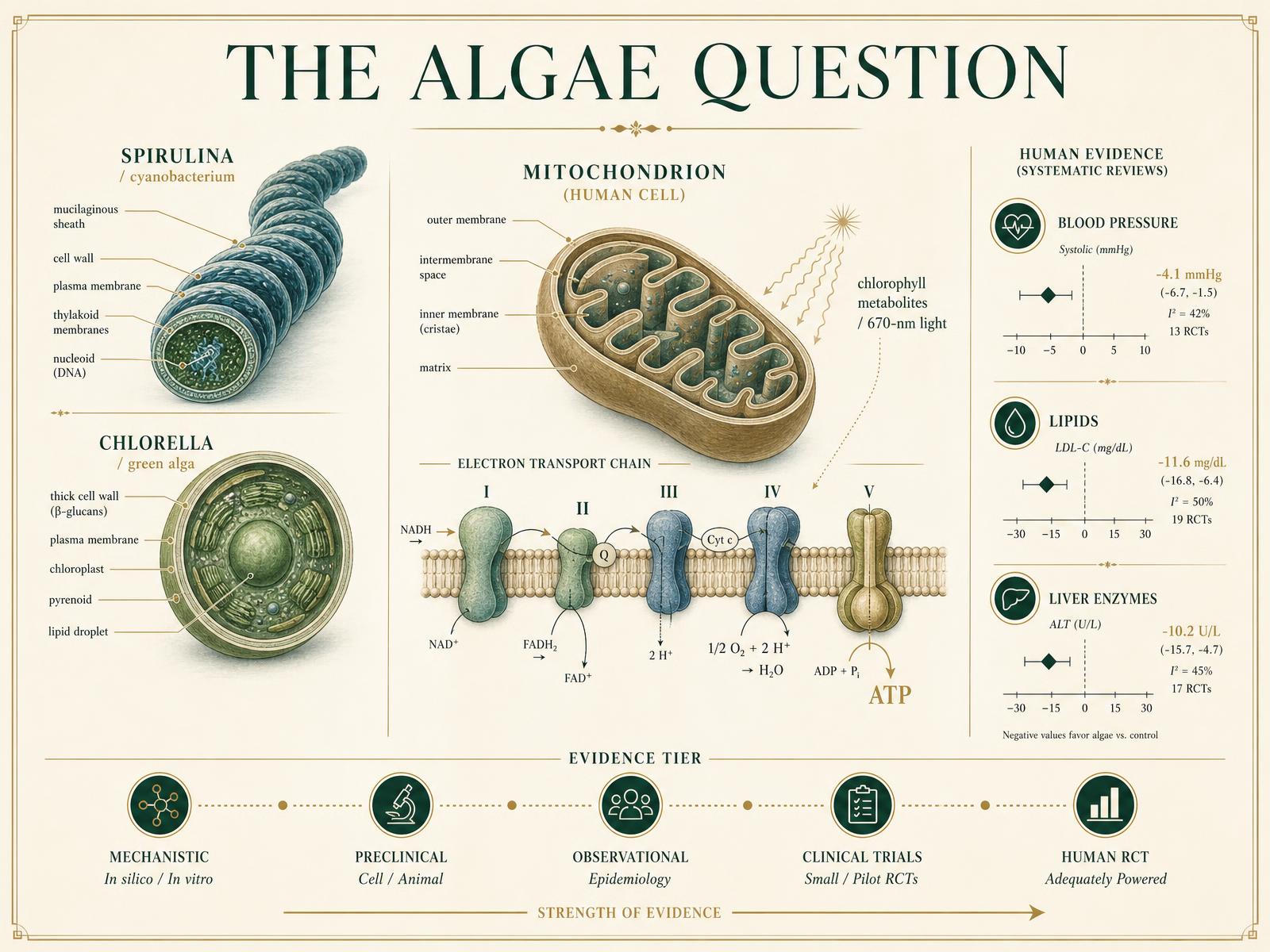
What the human evidence supports is narrower and more useful than the claim: spirulina modestly lowers blood pressure, both spirulina and chlorella nudge lipids and liver markers in metabolically stressed people, and phycocyanin — spirulina's blue pigment — is a genuinely interesting anti-inflammatory molecule with real mechanistic depth. What is not established is that eating algae increases mitochondrial ATP output in humans. That step is inference, not data.
Contents(13 sections)
Key takeaways
Spirulina is a cyanobacterium (a bacterium); chlorella is a true green alga with a tough cellulose cell wall. They are not interchangeable, and their evidence bases differ.
The strongest human signal is blood pressure: a 2025 GRADE-assessed meta-analysis found roughly −4.4 mmHg systolic and −2.8 mmHg diastolic with spirulina, at moderate certainty, concentrated in hypertensive, overweight, and over-50 groups (Nematollahi et al., Phytotherapy Research, 2025;39:397–412).
Chlorella's best data are in fatty liver disease: pooled trials show reductions in weight, fasting glucose, hs-CRP, LDL-C, and AST — but all trials come from one country and certainty was rated very low.
Phycocyanin's mechanism (Nrf2 activation, NADPH-oxidase inhibition via its phycocyanobilin chromophore) is well described in animal and cell models; human bioenergetic outcomes have not been measured.
The "chlorophyll makes ATP" claim traces to a real but preliminary line of work on chlorophyll metabolites acting as light-absorbing electron shuttles in mitochondria. It is mechanistic, not clinical.
The anti-aging case is indirect: algae may soften oxidative stress, low-grade inflammation, and metabolic aging markers, but no human trial has shown slower biological aging, longer telomeres, reduced senescent cells, or increased NAD+.
The Primer
What these two organisms actually are
Spirulina is a blue-green cyanobacterium. It has no nucleus and no cell wall you need to break — its digestibility is high because there is little structural cellulose in the way. Roughly 60–70% of its dry weight is protein, and its distinctive blue pigment, phycocyanin, can make up 10–20% of that mass.
Chlorella is a different organism entirely: a single-celled green alga with a nucleus, a chloroplast, and a rigid cell wall that human digestion cannot open. This is why quality matters more with chlorella than with almost any other supplement — unbroken cells pass through you largely intact, which is why credible products are labeled "cracked cell wall" or "broken cell wall."
Both are grown in water, both concentrate whatever is in that water, and both are among the most commonly contaminated categories in the supplement market. Heavy metals, microcystin toxins from wild-harvested or poorly controlled cyanobacterial ponds, and undeclared fillers are all documented problems. Sourcing is not a detail here; it is the whole decision.
The bacterial ancestry story, told accurately
Mitochondria descend from a free-living bacterium engulfed by an ancestral cell roughly 1.5 billion years ago. Chloroplasts descend from a cyanobacterium in a separate, later event. Both still carry their own circular DNA and their own membranes.
So the shared-ancestry claim is true. What it does not establish is a functional handoff. Eating a cyanobacterium does not deliver working machinery to your mitochondria any more than eating liver installs someone else's mitochondria in your muscle. Digestion reduces algae to amino acids, fatty acids, pigments, minerals, and vitamins. Any benefit has to travel through those molecules.
What the human trials actually show
Blood pressure is the most consistent finding. Pooled randomized trials place spirulina at roughly 4 mmHg systolic and 3 mmHg diastolic below placebo, with the effect largest in people who already have elevated pressure and after eight or more weeks of use. That is a real, modest, drug-adjacent effect for a food.
Lipids are less clear. Older dose-response analyses found meaningful reductions in total and LDL cholesterol, but a 2025 pooled analysis of chlorella and spirulina trials together found the lipid effects small and inconsistent, and chlorella's cardiovascular effect broadly neutral.
Liver and glucose markers improve in people who have something to improve. In non-alcoholic fatty liver disease, chlorella supplementation over 8–12 weeks reduced weight, fasting glucose, hs-CRP, LDL-C, total cholesterol, and AST across seven trials. The caveat is large: every trial was run in Iran, and the pooled certainty was rated very low.
Energy and fatigue — the claim most often used to sell these products — is the weakest area. There are animal studies on exercise-induced oxidative stress and small human performance trials, but no adequately powered human data showing increased mitochondrial output.
Practical use, if you use them
Spirulina trials cluster at 1–8 g per day, with most cardiometabolic benefit at 2–4 g daily sustained beyond eight weeks. Chlorella trials mostly use 1.2–4 g per day of cracked-cell product. Neither replaces vegetables, protein, or aerobic training — the actual mitochondrial levers.
Skip both if you have phenylketonuria (high phenylalanine), an autoimmune condition with immune-activating concerns, or you are on warfarin (chlorella is high in vitamin K1). Insist on third-party testing for heavy metals and microcystins, and on Arthrospira-specific, tank-cultivated spirulina rather than wild-harvested lake material.
The Deep Dive
Phycocyanin and phycobilin biochemistry
C-phycocyanin is a phycobiliprotein: an apoprotein carrying covalently bound phycocyanobilin, an open-chain tetrapyrrole chromophore. That chromophore is the mechanistically interesting part, and its structure is nearly identical to biliverdin — the substrate of biliverdin reductase.
This structural mimicry produces the mechanism most often cited. Phycocyanobilin is reduced by biliverdin reductase to phycocyanorubin, which — like bilirubin — inhibits NADPH oxidase (NOX2/NOX4) complexes. Because NADPH oxidase is a dominant source of extramitochondrial superoxide in vascular endothelium and activated immune cells, inhibiting it plausibly reduces the oxidative burden that degrades endothelial nitric oxide availability and drives inflammatory signaling. This is the most defensible mechanistic path from spirulina to the observed blood pressure effect: less NOX-derived superoxide, more preserved NO bioavailability, lower vascular tone.
Tier II · Members only · Free
Continue into the deep dive
Tier I is free and always open. Tier II — the full mechanisms, dosing detail, nuance, and citations — unlocks with a free Vital Codex membership.
- Every Tier II deep dive across all hubs
- Saved reading progress across articles
- Member knowledge modules and their quizzes
- The Dispatch, if you opt in
Frequently asked
Is spirulina really a bacterium?
Yes. Spirulina is a cyanobacterium — a prokaryote with no nucleus. It is often marketed as an "algae" because it photosynthesizes, but taxonomically it sits with bacteria, while chlorella is a true eukaryotic green alga.
Does spirulina or chlorella increase cellular energy?
Not in any way that has been measured in humans. People frequently report improved subjective energy, which is plausible via correcting iron or B12-adjacent deficiencies, lowering inflammatory burden, or simply improving diet quality — but no trial has shown increased mitochondrial ATP output or density.
How much should I take, and for how long?
Human cardiometabolic trials cluster at 2–4 g of spirulina daily, or 1.2–4 g of cracked-cell chlorella, sustained for at least eight weeks before effects on blood pressure and liver markers appear.
Is contamination a real risk?
It is the main risk. Spirulina and chlorella concentrate heavy metals from their growth water, and poorly controlled cyanobacterial cultures can carry microcystin hepatotoxins. Buy only tank-cultivated, third-party-tested product with microcystin and heavy metal results available.
Who should avoid it?
Anyone with phenylketonuria, anyone on warfarin (chlorella's vitamin K1 load interferes with dosing), and — with caution — people with autoimmune disease, given the documented TLR-mediated immune activation from algal polysaccharides.
Is chlorophyll the active ingredient?
Almost certainly not for the effects that have human support. Phycocyanin, polysaccharides, protein, and micronutrient density are more likely mediators. Chlorophyll's mitochondrial role remains a preclinical hypothesis dependent on both pigment metabolites and tissue-penetrating red light.
Can spirulina or chlorella slow aging?
Not in any way that has been proven in humans. They may improve blood pressure, liver enzymes, and inflammatory markers in people with metabolic stress, which are aging-related processes, but no human trial has shown slower biological aging, longer telomeres, reduced senescent cells, or increased NAD+ from algae supplementation.
Continue exploring: Mitochondria — Cellular energy production and the mechanisms of senescence.
Explore Mitochondria