Melanin is usually described as a pigment. Physically, it is a redox-active biopolymer and amorphous organic semiconductor that absorbs photons across an unusually wide band — ultraviolet, visible, infrared, and even ionizing X-ray and gamma radiation — and dissipates most of that energy as heat rather than as reactive oxygen species. That property, not skin colour, is why radiation biologists keep returning to it.
The strongest evidence melanin has produced is radioprotective. Molecularly engineered melanin raised survival in mice exposed to otherwise lethal gamma radiation from roughly 12% to 100% (Deng et al., Nature Communications, 2025), and cuttlefish-derived melanin nanoparticles show dual radioprotective and immunoprotective action in models of acute radiation syndrome (Huang et al., Frontiers in Immunology, 2025). Around this well-supported core sits a much more speculative frontier literature about melanin as a light-driven energy transducer — worth knowing, but worth labelling clearly as unsettled.
Engineered melanin took survival after lethal gamma exposure from roughly one in eight to all of them.
Contents(16 sections)
The essentials at a glance
Melanin's best-supported frontier function is broad-spectrum radioprotection: it absorbs UV, visible, infrared and ionizing photons and converts most of that energy to harmless heat with near-complete quantum efficiency.
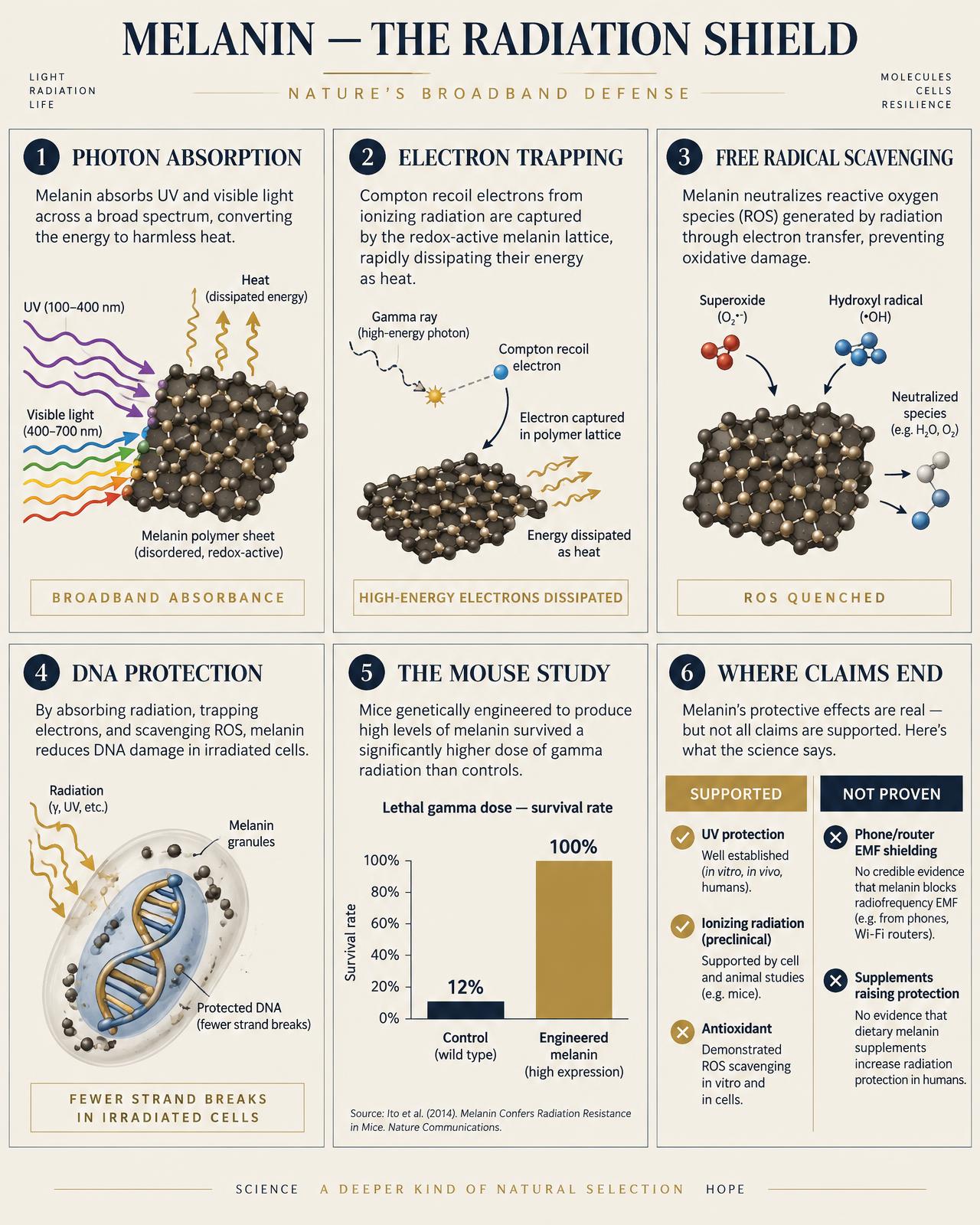
It protects through four distinguishable mechanisms: photon absorption, Compton recoil electron trapping, ROS scavenging, and reduced DNA strand breakage.
Engineered melanin took mouse survival after lethal gamma exposure from ~12% to 100%; melanin nanoparticles are being tested to shield bone marrow during clinical radiotherapy.
Melanin and melatonin share the tryptophan pathway: melanin handles the light phase, melatonin the dark phase, and skin makes melatonin locally.
Melanin synthesis depends on tyrosine, copper (tyrosinase cofactor) and zinc; deficiency in any of these limits it.
Claims that melanin splits water to generate an independent energy supply, or that structured "EZ water" is a validated fourth phase, remain hypotheses, not established physiology. Melanin is not sunburn insurance, and no melanin protocol protects against a real radiation exposure.
The Primer
What melanin actually is
Melanin is a family of pigment polymers — chiefly eumelanin (brown-black) and pheomelanin (red-yellow) — built from tyrosine by the copper-dependent enzyme tyrosinase. Unlike most biological molecules, melanin carries a stable population of free radicals, which lets it accept and donate electrons reversibly. In practical terms it behaves like a sponge for energetic particles and photons.
Where the body puts it
Melanin is not confined to skin. It is concentrated in tissues that handle high energy flux or fine sensory signal:
- Skin — epidermal melanocytes
- Eye — retinal pigment epithelium
- Inner ear — stria vascularis
- Brain — substantia nigra (neuromelanin)
- Adrenal medulla, hair follicles, and the leptomeninges
Loss of neuromelanin-containing neurons in the substantia nigra is the defining pathology of Parkinson's disease — an observation that has fuelled interest in melanin's protective role in the brain, though causation there is still contested.
Radiation protection, in plain terms
Melanin is the reason equatorial human populations tolerate high UV loads without catastrophic DNA damage. It works as a physical filter first: a melanin-dense epidermis absorbs the majority of incoming UVB before it reaches basal-layer DNA. What is newer is that the same chemistry works against far more energetic radiation. Melanin-covered nanoparticles are being developed to shield bone marrow while tumours are irradiated, precisely because melanin absorbs energy that would otherwise break DNA strands in healthy dividing cells.
Two limits matter. Melanin reduces risk; it does not abolish it — melanoma occurs in darkly pigmented skin, most often on less pigmented sites like palms and soles. And melanin's UV filtering also reduces vitamin D synthesis, which is why higher-melanin populations at high latitudes carry more vitamin D deficiency.
Supporting your own melanin
Melanogenesis needs raw material and cofactors:
- Tyrosine — grass-fed meat, wild fish, free-range eggs (free-range for a better fatty-acid and micronutrient profile), almonds
- Copper — liver, oysters, shiitake, sesame; the tyrosinase cofactor, and the rate-limiter people most often miss
- Zinc — oysters, beef, pumpkin seeds; needed for melanocyte function, but excess zinc suppresses copper absorption
- Vitamins C and E — protect melanocytes and membranes from oxidative load
- Gradual light exposure — melanogenesis is a response to UV signal; short, non-burning morning and mid-morning exposure builds pigment without the oxidative injury of a burn
Melanin and melatonin
Both come from tryptophan metabolism, and they divide the day. Melanin manages the light phase — absorbing, dissipating, shielding. Melatonin manages the dark phase — antioxidant defence, DNA repair, autophagy signalling, circadian resetting. Skin also synthesizes melatonin locally in response to light, independent of the pineal gland (Slominski et al., Journal of Investigative Dermatology, 2018). Blue light late at night suppresses the dark-phase half of that pair, which is the most actionable thing in this whole article.
The Deep Dive
The four radioprotective mechanisms
Melanin's protection is not one effect but four, operating at different energies.
1. Photon absorption and thermal dissipation. Melanin's broad absorption spectrum covers UVC through infrared. Absorbed energy relaxes through ultrafast non-radiative pathways, converting photon energy to heat with quantum efficiency approaching unity — the point being that the energy leaves as heat rather than as excited-state chemistry capable of damaging DNA.
Tier II · Members only · Free
Continue into the deep dive
Tier I is free and always open. Tier II — the full mechanisms, dosing detail, nuance, and citations — unlocks with a free Vital Codex membership.
- Every Tier II deep dive across all hubs
- Saved reading progress across articles
- Member knowledge modules and their quizzes
- The Dispatch, if you opt in
Frequently asked
Does having more melanin protect against ionizing radiation like X-rays or gamma rays?
Not to a clinically meaningful degree. Melanin chemistry demonstrably absorbs ionizing energy and traps Compton recoil electrons, and engineered melanin nanoparticles produced dramatic survival benefits in irradiated mice. But native skin pigment is thin, superficially located, and not positioned to shield internal organs. Skin melanin's proven protective role is against ultraviolet radiation, which is absorbed in the skin itself.
What was the "12% to 100% survival" result, exactly?
In Deng et al. (Nature Communications, 2025), mice given otherwise lethal whole-body gamma radiation survived at roughly 12% without treatment and 100% with molecularly engineered melanin as a radioprotective agent. It is a mouse study using an engineered nanomaterial given as a drug — strong proof of principle for melanin as a radioprotective platform, and no evidence at all that skin pigment or an oral supplement does the same thing.
Does melanin protect against EMF or 5G from phones and routers?
There is no credible evidence for this. Consumer-device radiofrequency is non-ionizing and does not damage tissue through the ionization pathways melanin defends against, so the mechanism that makes melanin a radioprotector does not transfer. Melanin's demonstrated non-ionizing role is against ultraviolet and blue light.
Can supplements increase my melanin?
Only indirectly, and only if you were short of something. Tyrosine, copper and zinc are required inputs — deficiency limits melanogenesis, and correcting a deficiency restores normal function. But loading these when you are already sufficient does not push pigment higher, and copper in particular is toxic in excess. Pigment is driven mainly by genetics and UV signal.
Is "EZ water" real science?
Partly. Water at hydrophilic surfaces genuinely has different structure and behaviour than bulk water, and that is well established. The stronger claims — that it is a distinct fourth phase, that it stores biologically usable energy at scale, and that melanin is its master organizer in living tissue — are hypotheses from a small literature that mainstream biophysics has not adopted. Treat it as an interesting open question, not a foundation for health decisions.
If melanin absorbs blue light, do I still need to limit screens at night?
Yes, and this is the practical heart of the matter. Retinal melanin absorbs blue light but does not neutralize its circadian signal — the melanopsin pathway still tells your brain it is daytime and suppresses melatonin. Melanin handles the light phase; only darkness enables the melatonin phase.
Is shilajit worth taking for this?
It is the weakest link in the popular protocol. Fulvic acid is a plausible antioxidant and shilajit has small human trials for cognition and testosterone, but claims about preserving melanocytes are preclinical. If you try it, use a standardized product with third-party heavy-metal testing, start at 250 mg, and treat it as optional rather than foundational.
Research Notes & Sources(expand)
- Deng R, et al. Molecular engineering of melanin for enhanced biological radioprotection. Nature Communications, 2025. doi:10.1038/s41467-025-62403-8
- Huang Y, et al. Immuno-protective impact and clinical translation of engineered cuttlefish melanin nanoparticles. Frontiers in Immunology, 2025. doi:10.3389/fimmu.2025.1610296
- Chen YY, et al. Beyond the conventional melanin synthesis. Cells, 2022;11(13):2082.
- Slominski RM, et al. Melanoma, melanin, and melanogenesis: the yin and yang. PMC8963986, 2022.
- Slominski AT, et al. Melatonin: a cutaneous perspective on its production, metabolism, and functions. Journal of Investigative Dermatology, 2018;138(3):490–499.
- Reiter RJ, et al. Dual sources of melatonin and evidence for different functional roles. Frontiers in Endocrinology, 2024. doi:10.3389/fendo.2024.1414463
- Pollack GH. The Fourth Phase of Water: Beyond Solid, Liquid, and Vapor. Ebner & Sons, 2013. (Frontier hypothesis.)
- Solís Herrera A. The unsuspected capacity of melanin to transform light energy into chemical energy. MOJ Cell Science & Report, 2015. (Not independently replicated.)
- Fungal melanin and the mammalian immune system. PMC8066723, 2021.
- Shilajit: a natural phytocomplex with potential procognitive activity. PMC3296184, 2012.
This is educational content, not medical advice. Radiation exposure is a medical emergency and requires professional care. Discuss copper, shilajit, high-dose antioxidants and any change in sun exposure with your clinician — particularly with a history of skin cancer, thyroid or autoimmune disease, or a copper metabolism disorder.
Continue exploring: The Vital Codex library on light, mitochondria, and the biophysics of cellular energy.
Explore Mitochondria