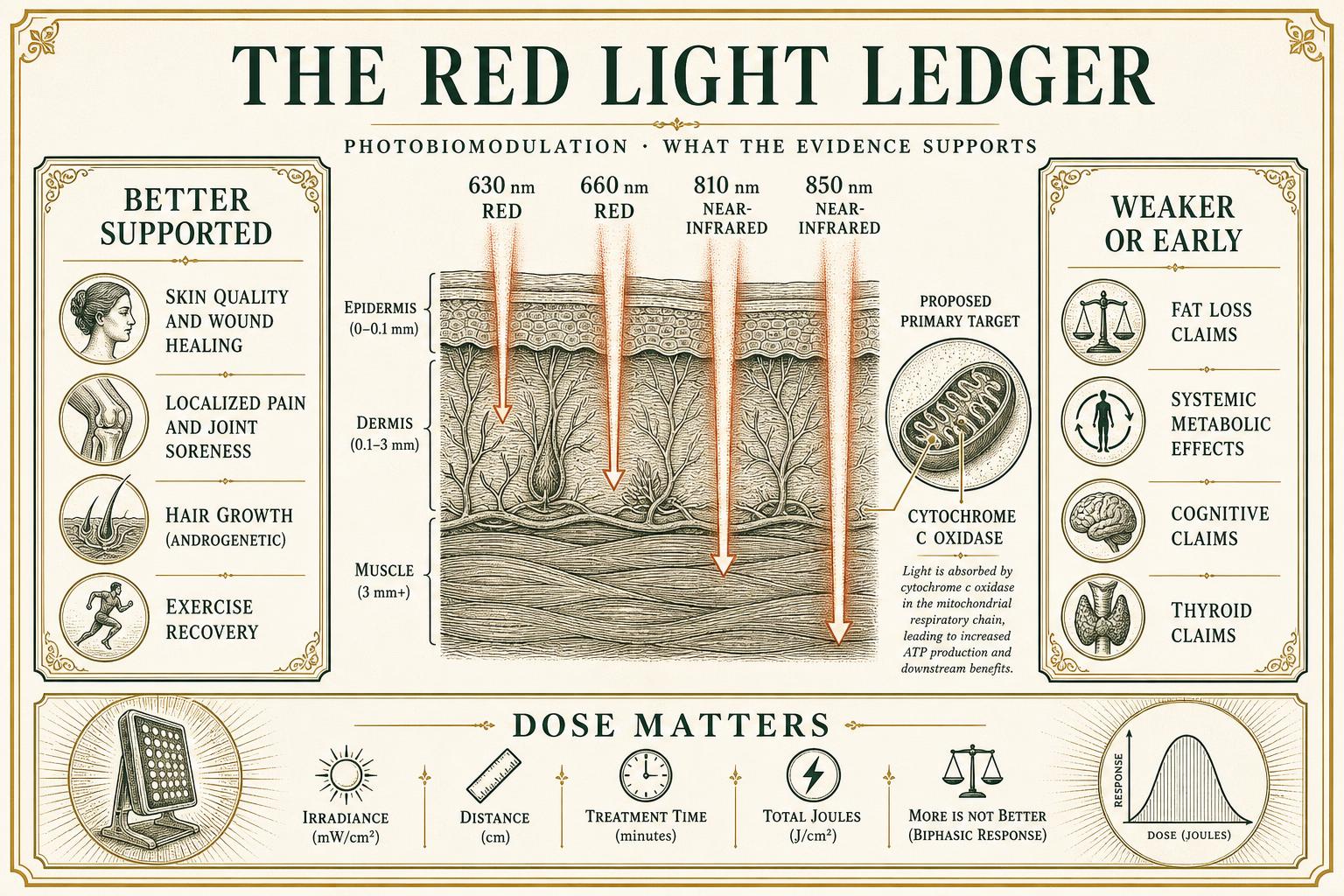
Photobiomodulation — the therapeutic use of red (roughly 630–700 nm) and near-infrared (roughly 800–880 nm) light — has an unusually specific proposed mechanism: absorption by cytochrome c oxidase, complex IV of the mitochondrial electron transport chain.
The clinical literature is large and uneven. Several applications have solid randomized evidence; many popular claims rest on small trials, surrogate endpoints, or in vitro work. The dividing line is usually dose and indication.
Contents(14 sections)
Key takeaways
The primary chromophore is cytochrome c oxidase; light absorption is thought to displace inhibitory nitric oxide, transiently increasing electron transport and ATP production.
Effects follow a biphasic dose-response (Arndt–Schulz curve): too little does nothing, too much can inhibit. More is not better.
The strongest evidence is in oral mucositis prevention, wound healing, musculoskeletal pain, and androgenetic alopecia.
Near-infrared penetrates deeper than red; red is more relevant for skin, near-infrared for muscle, joint, and transcranial applications.
Meaningful dose is measured in irradiance (mW/cm²) and total energy (J/cm²), not device wattage or marketing claims.
The Primer
The proposed mechanism
Cytochrome c oxidase is the final enzyme in the mitochondrial electron transport chain. Under stress, nitric oxide binds it and slows electron flow. Red and near-infrared photons are absorbed by copper and heme centers in that enzyme; the leading model is that this absorption releases the bound nitric oxide, briefly restoring electron transport and increasing ATP output.
Two secondary effects follow: a small, transient rise in reactive oxygen species that acts as a hormetic signal (activating Nrf2 and NF-κB pathways), and the release of nitric oxide locally, which increases blood flow.
What it is reasonably used for
Dermatology has the most consistent results: wound healing, acne, and measurable improvements in wrinkle depth and skin elasticity in controlled trials. Musculoskeletal pain and post-exercise soreness show real but modest benefit. Hair regrowth in androgenetic alopecia is FDA-cleared with supporting randomized data. Prevention of chemotherapy- and radiation-induced oral mucositis is well enough supported to appear in oncology supportive-care guidelines.
Where claims outrun evidence
Fat loss, systemic detoxification, large athletic performance gains, thyroid restoration, and reversal of neurodegenerative disease are all either unsupported or supported only by preliminary work. Transcranial photobiomodulation for cognition and traumatic brain injury is genuinely interesting and genuinely preliminary.
Practical use
Typical protocols deliver 3–10 minutes per site, three to five times weekly, at a distance where the device's stated irradiance is accurate. Eye protection is sensible with high-irradiance panels. It is not a substitute for sleep, training, or nutrition, and it works best layered on a functioning foundation.
The Deep Dive
Wavelength and penetration
Tissue has an "optical window" roughly between 650 and 1,200 nm, where hemoglobin absorption has fallen and water absorption has not yet risen. Within it, 660 nm reaches a few millimeters — appropriate for dermis and superficial wounds — while 810–850 nm reaches one to three centimeters of soft tissue and is the range used in transcranial and deep musculoskeletal work.
Wavelengths near 980 nm are absorbed largely by water and act partly through mild thermal and TRP channel mechanisms rather than cytochrome c oxidase. Devices that mix wavelengths are not automatically better; they are simply delivering multiple partial doses.
Tier II · Members only · Free
Continue into the deep dive
Tier I is free and always open. Tier II — the full mechanisms, dosing detail, nuance, and citations — unlocks with a free Vital Codex membership.
- Every Tier II deep dive across all hubs
- Saved reading progress across articles
- Member knowledge modules and their quizzes
- The Dispatch, if you opt in
Frequently asked
Does an infrared sauna give the same effect?
No. Infrared saunas work largely through heat and far-infrared wavelengths, producing cardiovascular and heat-shock responses. Photobiomodulation depends on specific red and near-infrared wavelengths at non-thermal doses. Both have evidence; they are different interventions.
How do I know whether a device delivers a real dose?
Look for stated wavelengths with tolerance ranges, measured irradiance at a specified treatment distance, and beam area. Then compute J/cm² for your intended session length and compare it with the published protocol for your indication.
How long before I see anything?
Pain and recovery effects can appear within days. Skin and hair endpoints in trials generally require 8–16 weeks of consistent use. If nothing has changed in three months of correctly dosed use, the intervention is probably not doing much for you.
Is more time per session better?
No — this is the most common mistake. The dose-response is biphasic, and excessive fluence can suppress the very mitochondrial response you are trying to elicit.
Continue exploring: Mitochondria — Cellular energy production and the mechanisms of senescence.
Explore Mitochondria