Mitochondrial biology has an unusual problem: the mechanisms are genuinely well described, and the practical instructions are usually terrible. People read about electron transport, mitophagy, and NAD+ decline, then buy a shelf of powders with no dose logic, no timing logic, no exclusion criteria, and no measurement plan. Six months later there is no way to know whether anything worked.
This guide is the operational layer. Every input below is placed in an evidence tier, given the dose range that was actually used in human trials, matched to a timing rule that follows its pharmacology, and paired with the contraindications that matter. The measurement section is deliberately conservative: most mitochondrial marketing biomarkers are not worth paying for, and the handful that are should be read as trends alongside a clinician who knows your medications.
Nothing here replaces medical care. Several of these compounds have real drug interactions, and two of them are actively dangerous in the wrong person.
Contents(14 sections)
Key takeaways
The highest-return mitochondrial interventions are not supplements: aerobic base volume, resistance training, sleep sufficiency, protein adequacy, and glycemic control produce the only reliably measured increases in human mitochondrial density and respiratory capacity.
Supplement evidence sits in tiers. Creatine and CoQ10/ubiquinol have the deepest human data; taurine, urolithin A, and NAD+ precursors are promising but narrower; methylene blue, NADH, and "mitochondrial complexes" are not supported for healthy adults.
Doses should come from trials, not labels: creatine 3–5 g/day, ubiquinol 100–200 mg/day with fat, taurine 1.5–3 g/day, urolithin A 500–1,000 mg/day, NR or NMN 250–500 mg/day.
Timing matters most for fat-soluble compounds (CoQ10 with a fat-containing meal) and for anything with alerting or circadian effects (avoid NAD+ precursors and red-light sessions late at night).
Hard contraindications exist: CoQ10 with warfarin, high-dose niacin forms with liver disease, methylene blue with any serotonergic drug, and creatine in advanced kidney disease without supervision.
Track a short panel with a clinician — hs-CRP, HbA1c, fasting insulin, ALT, ferritin, homocysteine, lactate, and VO₂max or resting heart rate — over 90-day windows rather than chasing single readings.
If a compound has no measurable effect on symptoms, function, or the panel after one full 12-week block, stop it. Stacking without stopping is how people end up on nine products with no signal.
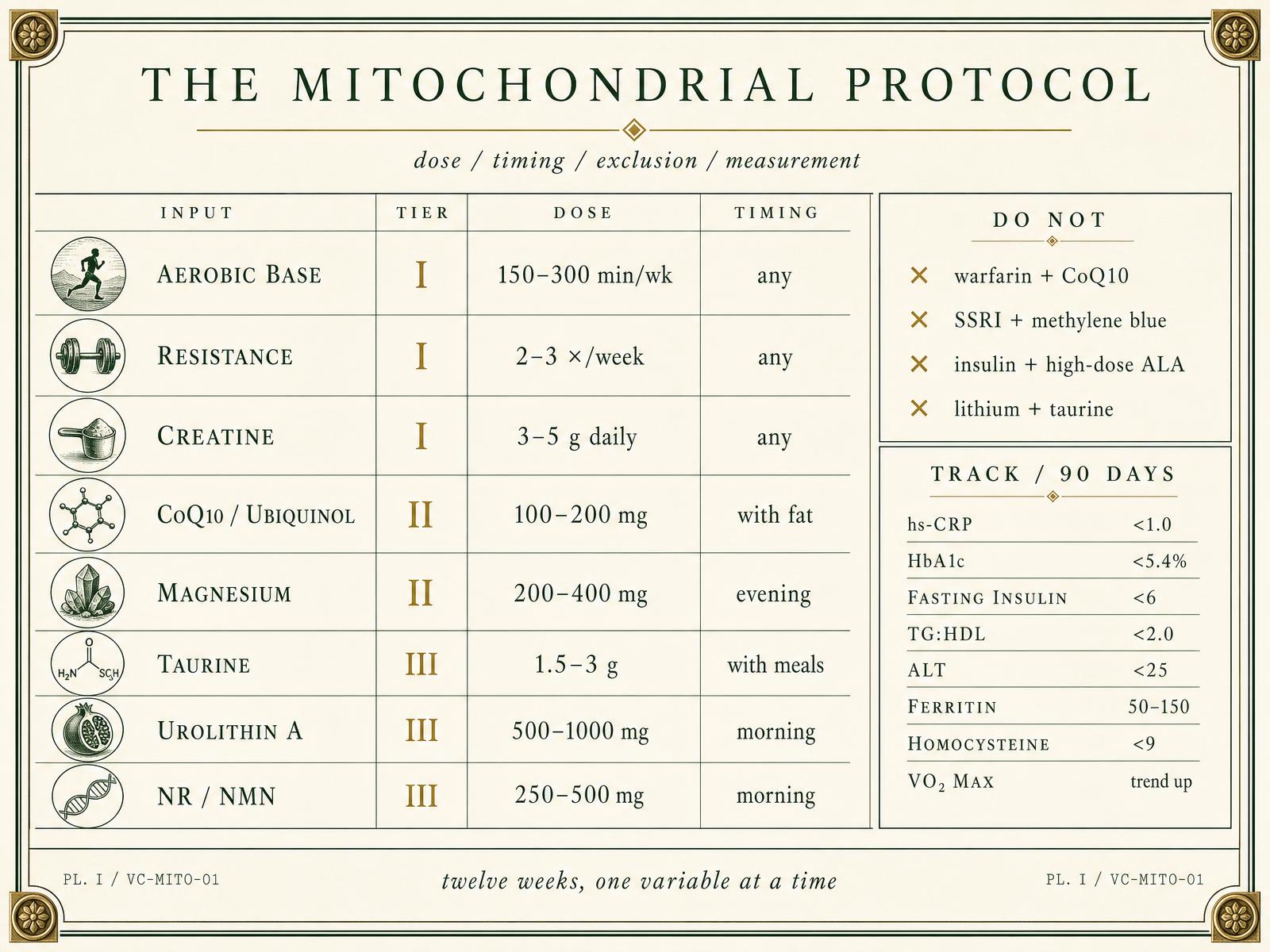
The Primer
Start with the four things that actually build mitochondria
Before any capsule, the inputs with the strongest human evidence for increasing mitochondrial content and function are behavioral.
Aerobic volume. Zone 2-style continuous work, 150–300 minutes weekly, is the most reliable stimulus for mitochondrial biogenesis in human muscle biopsy studies. Add one weekly interval session once the base is established.
Resistance training. Two to three sessions weekly protects the muscle mass that houses mitochondria. Losing muscle lowers whole-body oxidative capacity regardless of supplements.
Sleep. Seven to nine hours. Short sleep reduces insulin sensitivity and increases oxidative stress within days, which no antioxidant compensates for.
Fuel control. Steady glycemic load and adequate protein reduce the reductive stress that damages the electron transport chain. This is upstream of everything else in this guide.
If those four are not in place, supplements are decoration.
The short version of what to take
For a healthy adult who wants a defensible mitochondrial stack, the practical core is small:
- Creatine monohydrate, 3–5 g daily, any time, with the strongest overall evidence of anything on this list.
- Ubiquinol or ubiquinone (CoQ10), 100–200 mg daily with a fat-containing meal, especially over age 50 or on a statin.
- Magnesium glycinate or malate, 200–400 mg elemental in the evening, if intake is low.
- Taurine, 1.5–3 g daily, as a reasonable-cost option with interesting aging data and a wide safety margin.
That is it. Everything else belongs in the "conditional or experimental" column, and several popular products belong nowhere.
Timing rules that are worth following
Most timing advice online is invented. Four rules have real pharmacological basis:
- Fat-soluble with fat. CoQ10, vitamin K2, and vitamin D absorb far better with a meal containing 10–15 g of fat.
- Nothing alerting after mid-afternoon. NAD+ precursors, high-dose B vitamins, and photobiomodulation sessions can disturb sleep onset in sensitive people. Move them to morning.
- Creatine timing is irrelevant — it works by saturating a tissue pool over weeks, not by acute dosing.
- Give every change 12 weeks. Mitochondrial adaptation and most trial endpoints operate on 8–12 week timescales. Judging a compound at two weeks produces noise.
Who should not do this without a clinician
Anyone taking warfarin, insulin or sulfonylureas, thyroid medication, lithium, immunosuppressants, or serotonergic drugs. Anyone with chronic kidney disease, liver disease, a bleeding disorder, or a history of kidney stones. Anyone pregnant or breastfeeding. Anyone with an autoimmune diagnosis — immune-modulating inputs like algal polysaccharides and beta-glucans are not neutral.
The Deep Dive
The evidence-tiered protocol table
Doses below are the ranges used in human trials, not label suggestions. Tier reflects the strength of human evidence for a functional or clinical outcome, not mechanistic plausibility.
| Input | Tier | Trial dose range | Timing | Primary contraindications |
|---|---|---|---|---|
| Aerobic training | I — human, strong | 150–300 min/week | Any; earlier helps sleep | Uncontrolled cardiac disease |
| Resistance training | I — human, strong | 2–3 sessions/week | Any | Acute injury, uncontrolled hypertension |
| Creatine monohydrate | I — human RCT, moderate–high | 3–5 g/day (no loading needed) | Any, daily consistency matters | Advanced CKD, dialysis; caution with nephrotoxic drugs |
| CoQ10 / ubiquinol | II — human RCT, moderate | 100–200 mg/day (up to 300 mg in heart failure trials) | With a fat-containing meal | Warfarin (antagonises INR); check before surgery |
| Magnesium (glycinate/malate) | II — human RCT for deficiency correction | 200–400 mg elemental/day | Evening | CKD stage 4–5, bradyarrhythmia |
| Taurine | III — human RCT small, animal strong | 1.5–3 g/day | With meals, split | Lithium therapy; bipolar disorder caution |
| Urolithin A | III — human RCT small | 500–1,000 mg/day | Morning with food | Pregnancy; no long-term data past 4 months |
| NR / NMN (NAD+ precursors) | III — human RCT, biomarkers only | 250–500 mg/day | Morning | Active malignancy — discuss first; no long-term outcome data |
| Alpha-lipoic acid | III — human RCT in neuropathy | 300–600 mg/day | Fasted, morning | Insulin/sulfonylureas (hypoglycemia), thiamine deficiency |
| PQQ | IV — mechanistic, thin human data | 10–20 mg/day | Morning | Insufficient data in pregnancy |
| Red / near-infrared light | III — human RCT, local outcomes | 630–850 nm, 10–20 min, 3–5×/week | Morning or early afternoon | Retinal disease, photosensitising drugs, active melanoma |
| Nicotinic acid (flush niacin) | IV — dated outcome data, real harms | Not recommended for mitochondrial purposes | — | Liver disease, gout, insulin resistance |
| Methylene blue | V — not supported for healthy adults | — | — | Any SSRI/SNRI/MAOI (serotonin syndrome), G6PD deficiency, pregnancy |
| NADH tablets, "mitochondrial complexes" | V — not supported | — | — | Cost without evidence |
Tier II · Members only · Free
Continue into the deep dive
Tier I is free and always open. Tier II — the full mechanisms, dosing detail, nuance, and citations — unlocks with a free Vital Codex membership.
- Every Tier II deep dive across all hubs
- Saved reading progress across articles
- Member knowledge modules and their quizzes
- The Dispatch, if you opt in
Frequently asked
What is the single best mitochondrial anti-aging intervention?
Aerobic training with adequate sleep and protein. No supplement has produced increases in human mitochondrial density comparable to consistent endurance and resistance training.
What doses are actually used in trials?
Creatine 3–5 g/day, CoQ10/ubiquinol 100–200 mg/day, taurine 1.5–3 g/day, urolithin A 500–1,000 mg/day, NR or NMN 250–500 mg/day, alpha-lipoic acid 300–600 mg/day. Higher doses on labels are marketing, not trial protocol.
Does CoQ10 need to be taken with food?
Yes. It is fat-soluble and poorly absorbed on an empty stomach. Take it with a meal containing at least 10–15 g of fat, and split doses above 200 mg.
Are NAD+ precursors worth taking?
They reliably raise blood NAD+ and are well tolerated, but human trials have not consistently shown functional benefit — muscle strength, insulin sensitivity, and aerobic capacity results are mixed. They are a reasonable experiment, not a foundation.
Which supplements have real drug interactions?
CoQ10 with warfarin, alpha-lipoic acid with insulin or sulfonylureas, taurine with lithium, high-dose niacin with liver disease and gout medication, and methylene blue with any serotonergic antidepressant. Creatine does not damage kidneys but raises serum creatinine, which can be mistaken for kidney injury.
What biomarkers should I ask my clinician for?
hs-CRP, HbA1c, fasting insulin, triglyceride:HDL ratio, ALT, ferritin with transferrin saturation, homocysteine, and 25-OH vitamin D — repeated at 90 days, plus resting heart rate and a submaximal fitness test. Fasting lactate only if a primary mitochondrial disorder is suspected.
Should I take antioxidants after exercise?
Not in high doses. Large vitamin C and E doses taken around aerobic training have been shown to blunt the mitochondrial adaptations you trained for. Keep them away from the post-workout window, or get antioxidants from food.
How long before I should expect anything?
Twelve weeks. Mitochondrial adaptation, biomarker movement, and most trial endpoints operate on 8–12 week timescales. If a full block produces no subjective or measured change, discontinue that input.
Is methylene blue safe to try?
Not casually. At supplement doses it inhibits monoamine oxidase, and combined with SSRIs, SNRIs, or MAOIs it can cause serotonin syndrome. It is also contraindicated in G6PD deficiency and pregnancy. It belongs in clinical settings only.
Continue exploring: Mitochondria — Cellular energy production and the mechanisms of senescence.
Explore Mitochondria