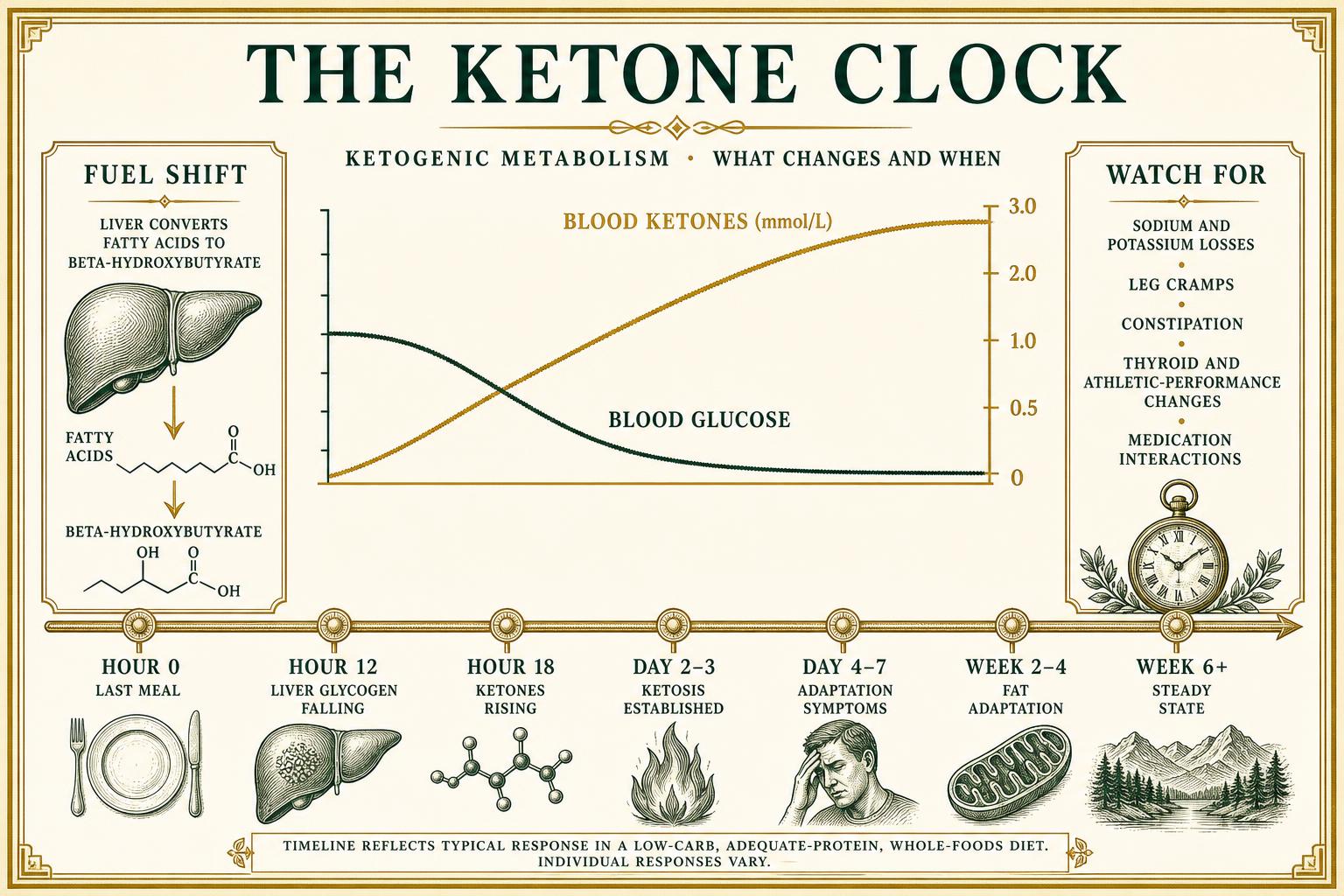
A ketogenic diet does not flip a single switch. It initiates an ordered sequence of adaptations: hepatic glycogen depletion within roughly 24–48 hours, rising ketone production over days, induction of ketolytic enzymes over two to four weeks, and mitochondrial and substrate-transport remodeling over one to three months.
Understanding the sequence explains most of the confusion around keto — including why the first week often feels worse than the diet's reputation suggests, and why performance measured at day five says almost nothing about performance at week eight.
Contents(14 sections)
Key takeaways
Hepatic glycogen is largely depleted within 24–48 hours of carbohydrate restriction below roughly 20–50 g/day, which is what triggers ketogenesis.
Nutritional ketosis is conventionally defined as blood β-hydroxybutyrate of 0.5–3.0 mmol/L, distinct from diabetic ketoacidosis (usually >15 mmol/L with acidosis).
Early symptoms — fatigue, headache, cramping — are largely sodium, potassium, and magnesium losses from falling insulin, not "detox."
Keto-adaptation of skeletal muscle and enzyme expression takes roughly 3–6 weeks; high-intensity performance often dips before it recovers.
Ketosis and metabolic flexibility are different goals; sustained ketosis is one tool, not a permanent requirement for metabolic health.
The Primer
Days 1–2: glycogen runs down
The liver stores roughly 80–110 g of glycogen. Restricting carbohydrate below about 50 g/day while continuing normal activity depletes most of it within a day or two. As hepatic glycogen falls, insulin falls with it, and the liver begins converting fatty acids into ketone bodies — mainly β-hydroxybutyrate and acetoacetate.
Water follows glycogen out, which is why the first few pounds come off quickly and mean very little about fat loss.
Days 3–7: the rough patch
Falling insulin tells the kidney to excrete sodium. Sodium loss pulls potassium and magnesium behind it, and the result is the cluster people call "keto flu": headache, lightheadedness, fatigue, muscle cramps, and irritability. It responds to salt and fluid rather than patience — roughly 3–5 g of sodium a day plus adequate potassium and magnesium usually resolves it within a day or two.
Meanwhile, ketones begin to rise into the 0.5–2.0 mmol/L range and the brain starts shifting a meaningful fraction of its fuel from glucose to ketones.
Weeks 2–4: the machinery catches up
Cells increase the transporters and enzymes needed to actually use ketones and free fatty acids. Hunger typically becomes easier to ignore, energy steadies, and mental clarity improves for many people. Endurance capacity at easy and moderate intensities returns and often exceeds baseline. Sprint and heavy-lifting capacity may still feel blunted.
Month 2 and beyond
By six to eight weeks, most people are genuinely fat-adapted: high rates of fat oxidation during exercise, stable energy without frequent eating, and low fasting insulin. Blood lipids, blood pressure, and liver fat commonly improve; LDL cholesterol responses vary widely and deserve monitoring.
The Deep Dive
The biochemistry of the transition
Ketogenesis occurs in hepatic mitochondria. Falling insulin and rising glucagon release the inhibition on hormone-sensitive lipase, increasing free fatty acid flux to the liver. Falling malonyl-CoA de-represses carnitine palmitoyltransferase-1 (CPT-1), allowing fatty acids into the mitochondrion for β-oxidation. Acetyl-CoA accumulating faster than the TCA cycle can consume it is condensed by HMG-CoA synthase into acetoacetate, then largely reduced to β-hydroxybutyrate.
Extrahepatic tissues reverse the process using succinyl-CoA:3-ketoacid CoA transferase (SCOT), an enzyme the liver deliberately lacks — which is why the liver produces ketones but cannot consume them.
Tier II · Members only · Free
Continue into the deep dive
Tier I is free and always open. Tier II — the full mechanisms, dosing detail, nuance, and citations — unlocks with a free Vital Codex membership.
- Every Tier II deep dive across all hubs
- Saved reading progress across articles
- Member knowledge modules and their quizzes
- The Dispatch, if you opt in
Frequently asked
How long until I am actually in ketosis?
Blood ketones usually cross 0.5 mmol/L within two to four days of restricting carbohydrate below about 50 g/day, faster with a fast or hard training session. Full adaptation of enzymes and transporters takes three to six weeks.
Why do I feel terrible in week one?
Almost always electrolytes. Falling insulin causes natriuresis; sodium, potassium, and magnesium follow. Adding 3–5 g of sodium daily plus potassium- and magnesium-rich foods typically resolves symptoms within 24–48 hours.
Will keto hurt my strength training?
Maximal strength is usually maintained, since it relies mainly on the phosphocreatine system. Higher-repetition, glycolytic work and repeated sprints are more often affected. Many strength athletes use targeted carbohydrate around sessions.
Do I need to stay in ketosis forever?
No. Unless you are using a ketogenic diet therapeutically for a specific condition, the durable objective is metabolic flexibility. Many people cycle in and out and retain most of the metabolic benefit.
Continue exploring: Metabolism — Glucose variability, insulin sensitivity, and substrate flexibility.
Explore Metabolism