For years the fiber story ended in the colon: fermentable fibers feed microbes, microbes make short-chain fatty acids, and those metabolites support the intestinal barrier, immune regulation, and metabolic signaling. That model is still useful. It is no longer the whole picture.
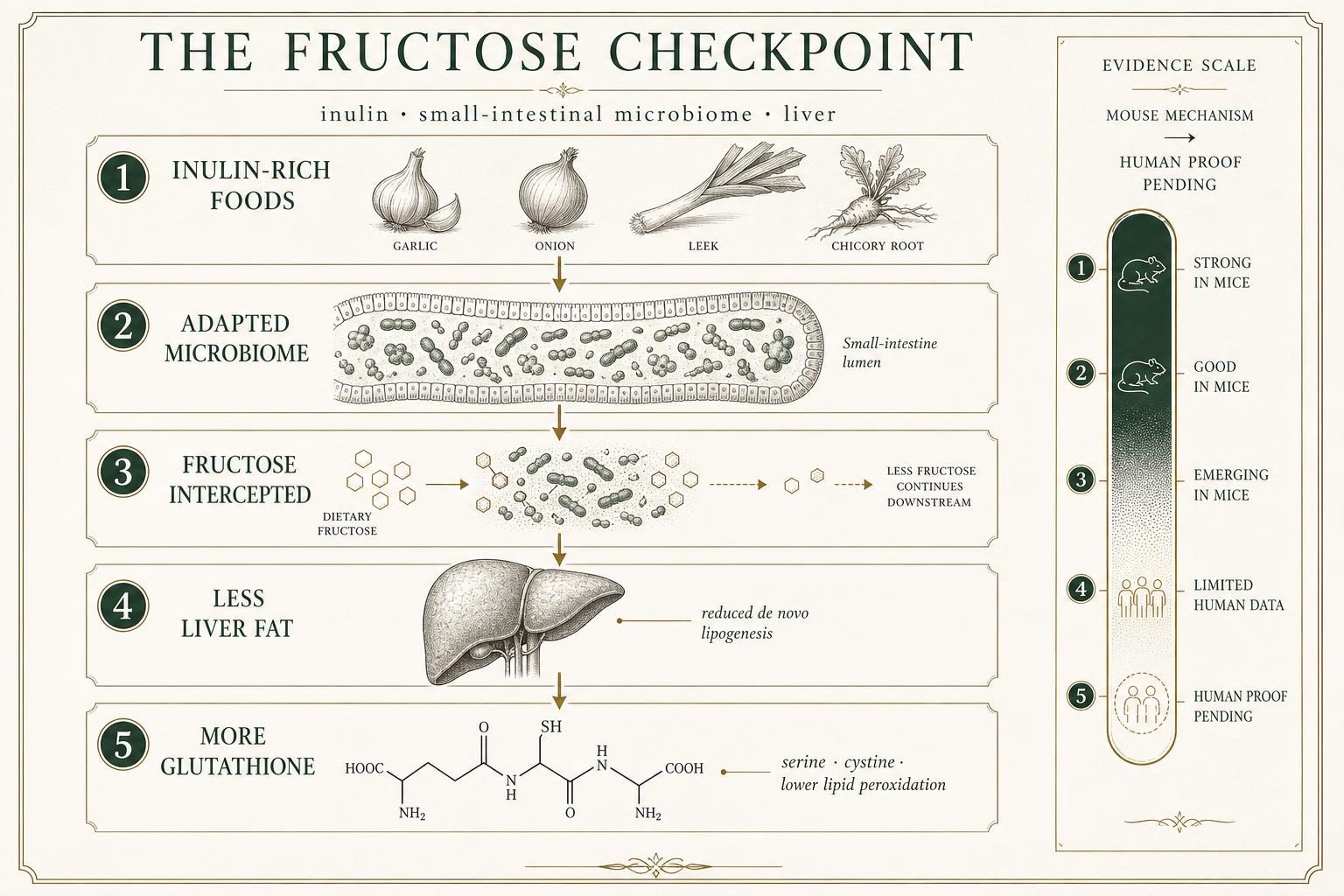
A 2025 Nature Metabolism study proposed something more provocative: the small-intestinal microbiome may act as a metabolic checkpoint. In male mice given high-fructose corn syrup, inulin reshaped small-intestinal microbial function so that microbes broke down more incoming fructose. Less fructose spilled over to the liver and colon. Liver fat fell, insulin resistance improved, and fibrosis-associated features improved in that controlled model.
This is frontier biology, not a proven human treatment for fatty liver disease. It is educational content, not medical advice.
The mechanism is ahead of the clinical proof.
Contents(22 sections)
Key takeaways
Inulin's liver benefit in the 2025 mouse study came from microbial fructose catabolism, not from changes in the host's own small-intestinal fructose metabolism.
Less fructose reaching the liver means less substrate for de novo lipogenesis — the conversion of carbohydrate into newly synthesized fat.
The liver also increased serine synthesis and cystine uptake, supporting glutathione production and lower lipid-peroxidation stress.
Antibiotic depletion removed most of the benefit; transferring the inulin-conditioned microbiome transmitted it — strong evidence the microbiome was causal.
Bacteroides acidifaciens was a key player but did not reproduce all benefits alone. The effect appears to need an ecosystem, not a single organism.
Human trials of inulin, FOS, resistant starch, and inulin-propionate ester show modest improvements in liver enzymes, insulin resistance, and in some cases MRI-measured liver fat — but no microbiome-targeted nutrition strategy has yet shown histological improvement in MASLD.
Inulin is a fructan and a FODMAP. Titrate from 1–2 g; there is no prize for forcing a high dose.
The Primer
The simple version
Excess fructose — especially from sweetened drinks, syrups, and refined snacks — arrives fast and gets routed to the liver, where it is unusually good at driving fat synthesis. The new idea is that a fiber-adapted gut community can eat part of that sugar load before the liver ever sees it.
That reframes fiber from "food for good bacteria" to something closer to a first-pass metabolic organ. It also reframes the practical question. Instead of asking which bacterium is good, ask what your microbiome can do.
1. Remove the main fructose burden first
The most direct application of the research is unglamorous: reduce repeated liquid and refined-sugar exposure. Soft drinks, sweetened coffee drinks, energy drinks, sweet tea, and fruit juice are the highest-yield removals, followed by syrups, sweetened snacks, and daily refined-carbohydrate-plus-sugar foods.
Whole fruit is not equivalent to juice. It arrives with water, chewing, fiber, micronutrients, and phytochemicals, and it should not be treated as the same exposure.
2. Build fiber capacity gradually
If your current diet is low in fiber, a large inulin dose will produce a dramatic gas-and-bloating response and teach you nothing. Make food-level changes first and keep them tolerable: onion, garlic, scallion, or leek in cooked meals; beans or lentils several times weekly starting small; vegetables daily with rotation across plant families; oats, chia, ground flax, barley, or psyllium as anchors; resistant-starch foods such as cooked-and-cooled rice, potatoes, or green banana as tolerated.
In Belize and similar tropical food environments the building blocks are already local: beans, plantain in sensible portions, roots and tubers, greens, onions, garlic, papaya and other whole fruit, cacao, culinary herbs, and seasonal vegetables.
3. If you use an inulin supplement, titrate rather than blast
A conservative self-experiment is more informative than a "therapeutic" dose on day one. Begin with 1–2 g daily with a meal and hold for four to seven days. Increase by about 1 g only if you are comfortable. Stop increasing once persistent bloating, cramping, urgency, constipation, reflux, or loose stools appear. For many people, 3–5 g per day is a reasonable tolerance-testing range.
Research doses vary widely and are not automatically appropriate for daily self-use. Anyone with IBS, known fructan sensitivity, severe unexplained bloating, active bowel disease, or suspected small-intestinal bacterial overgrowth should be particularly cautious.
4. Prefer a menu of fibers over one powder
Inulin is one substrate. A resilient microbiome is more likely to benefit from several fermentable structures than from very high intake of a single purified ingredient. Different fibers ferment at different speeds and in different regions of the gut, which nourishes different microbial functions.
5. Support the non-microbiome fundamentals
The microbiome does not operate independently of the host. Regular physical activity — resistance training plus walking after meals — adequate and regular sleep, reduced alcohol exposure, a predominantly minimally processed dietary pattern, and management of diabetes, triglycerides, blood pressure, sleep apnea, and excess visceral fat still carry the most weight. A fiber intervention helps most when it lowers overall metabolic burden rather than compensating for it.
The Deep Dive
What the 2025 study actually found
The study used a high-fructose mouse model designed to induce metabolic dysfunction and fatty liver without requiring obesity, and tested inulin both preventively and after liver changes had developed.
- Inulin improved insulin resistance, hepatic steatosis, and fibrosis-associated measures in male mice under a high-fructose challenge.
- The effect did not come from altering the host's own small-intestinal fructose metabolism. Inulin enabled the small-intestinal microbiome to catabolize more incoming fructose.
- Less fructose reached the liver, reducing fructose-driven de novo lipogenesis.
- The liver increased de novo serine synthesis and cystine uptake, supporting greater glutathione production and lower lipid-peroxidation stress.
- Antibiotic depletion removed much of the benefit; transfer of the inulin-conditioned microbiome transmitted protective effects.
- Bacteroides acidifaciens was a key contributor but did not reproduce all benefits by itself.
Tier II · Members only · Free
Continue into the deep dive
Tier I is free and always open. Tier II — the full mechanisms, dosing detail, nuance, and citations — unlocks with a free Vital Codex membership.
- Every Tier II deep dive across all hubs
- Saved reading progress across articles
- Member knowledge modules and their quizzes
- The Dispatch, if you opt in
Frequently asked
Does inulin reverse fatty liver disease?
No. In a 2025 mouse study inulin reduced liver fat, improved insulin resistance, and improved fibrosis-associated measures by enabling small-intestinal microbes to consume fructose before it reached the liver. No human trial has shown that inulin reverses MASLD or improves liver histology.
How does inulin protect the liver mechanistically?
By adapting small-intestinal microbial function so microbes catabolize more incoming fructose. Less fructose reaches the liver, so there is less substrate for de novo lipogenesis, and hepatic metabolism shifts toward serine synthesis and cystine uptake that support glutathione production.
How much inulin should I take?
Start at 1–2 g daily with a meal, hold for four to seven days, and increase by roughly 1 g only if comfortable. Many people find 3–5 g per day a reasonable tolerance-testing range. Research doses are not automatically appropriate for daily self-use.
Who should avoid inulin?
Inulin is a fructan and a FODMAP. People with IBS, known fructan sensitivity, severe unexplained bloating, active bowel disease, or suspected small-intestinal bacterial overgrowth should be cautious and involve a clinician.
Is a single probiotic strain the answer?
Not on current evidence. Bacteroides acidifaciens was a key player in the mouse work but did not reproduce all benefits alone, which suggests the effect requires a microbial ecosystem rather than one organism.
Is whole fruit a problem because of fructose?
Whole fruit is not equivalent to sweetened beverages. It arrives with water, chewing, fiber, micronutrients, and phytochemicals. The main fructose burden in most diets comes from soft drinks, sweetened coffee drinks, energy drinks, sweet tea, juice, and syrup-containing processed foods.
Research Notes & Sources(expand)
Inulin remodels the small-intestinal microbiome to catabolize dietary fructose, reducing hepatic de novo lipogenesis and oxidative stress in male mice. Nature Metabolism. 2025.
Microbiome-targeted nutrition in metabolic dysfunction-associated steatotic liver disease: review of prebiotics, synbiotics, and postbiotics.
Inulin-propionate ester and MRI-measured hepatic fat plus de novo lipogenesis in adults with NAFLD: randomized trial evidence.
Resistant starch, gut microbial change, and hepatic fat outcomes: defined fiber intervention literature.
ISAPP consensus definitions of prebiotic, synbiotic, and postbiotic.
Bile-acid signaling through FXR, TGR5, and FGF19 in gut–liver metabolic regulation.
Fructans and FODMAP tolerability in irritable bowel syndrome: dose-response literature.
Continue exploring: Metabolism — Glucose variability, insulin sensitivity, and substrate flexibility.
Explore Metabolism