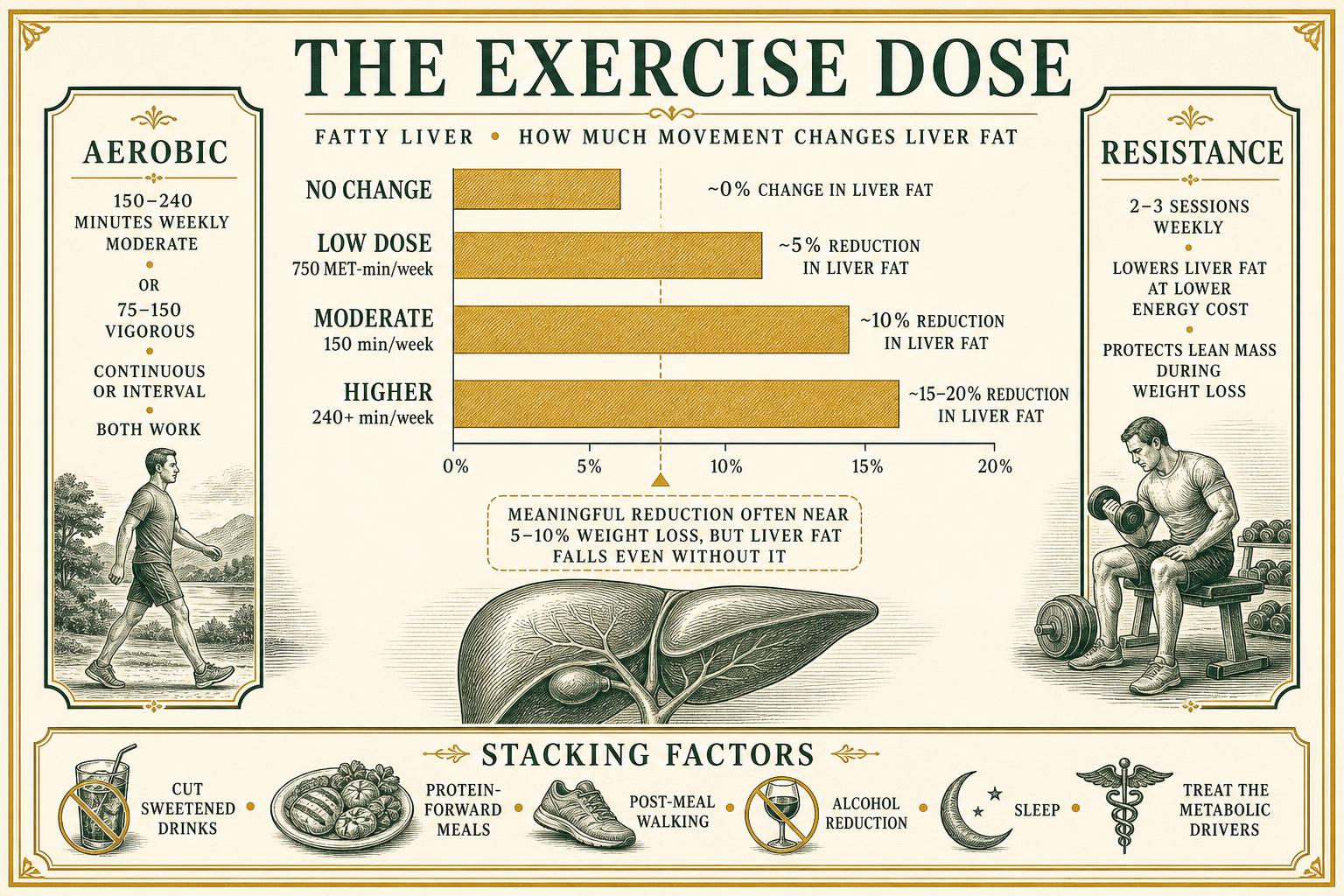
Roughly 150 minutes per week of moderate-intensity aerobic exercise reduces hepatic fat meaningfully in people with metabolic dysfunction-associated steatotic liver disease (MASLD), and it does so even when body weight does not change.
That last point is the clinically important one. Liver fat is more responsive to exercise than the scale is, so a program can be working well before it looks like it is.
Contents(13 sections)
Key takeaways
About 150 minutes/week of moderate aerobic exercise is the dose most consistently associated with reduced liver fat.
Liver fat falls independently of weight loss — the effect is not simply a byproduct of dropping pounds.
Higher volume produces additional benefit; intensity matters less than accumulated volume.
Resistance training also lowers liver fat, at lower energy cost, and is a reasonable alternative when aerobic work is limited.
Consistency over months matters more than any single session; benefit reverses within weeks of stopping.
The Primer
Why liver fat matters
The liver is not designed as a fat storage depot. When it accumulates lipid beyond about 5% of its weight, insulin signaling in the liver degrades, fasting glucose creeps up, triglycerides rise, and — in a subset of people — inflammation and fibrosis begin. MASLD now affects roughly 30% of adults worldwide and is the fastest-growing cause of liver transplant.
What "moderate intensity" actually means
Moderate intensity is brisk walking, cycling on flat ground, or swimming at a pace where you can speak in full sentences but not sing. In practical terms: about 30 minutes on five days, or 50 minutes on three days.
Why it works without weight loss
Exercise increases the liver's use of fat for fuel, improves skeletal muscle glucose uptake so less substrate reaches the liver for conversion into fat, and reduces the hepatic de novo lipogenesis that drives accumulation in the first place. None of those require a change in body weight.
The realistic path
Start with post-meal walking, which is the lowest-friction way to accumulate volume. Add two resistance sessions per week to build the muscle that handles glucose disposal. Expect measurable change in liver enzymes and imaging over 8–12 weeks of consistency, not days.
The Deep Dive
What the dose-response data shows
Randomized trials and pooled analyses converge on a dose-dependent relationship. The threshold for a reliable reduction in MRI-measured hepatic fat fraction sits around 135–150 minutes per week of moderate aerobic activity; below roughly 90 minutes the signal becomes inconsistent. A meta-analysis of randomized trials found exercise reduced hepatic steatosis with an effect independent of body weight change (Orci et al., Clinical Gastroenterology and Hepatology, 2016), and a randomized trial of 150 minutes weekly of moderate-intensity exercise achieved clinically significant liver-fat response versus standard care (Stine et al., American Journal of Gastroenterology, 2023).
Higher volumes add benefit, but the curve flattens; going from 150 to 300 minutes yields less additional liver-fat reduction than going from 60 to 150.
Tier II · Members only · Free
Continue into the deep dive
Tier I is free and always open. Tier II — the full mechanisms, dosing detail, nuance, and citations — unlocks with a free Vital Codex membership.
- Every Tier II deep dive across all hubs
- Saved reading progress across articles
- Member knowledge modules and their quizzes
- The Dispatch, if you opt in
Frequently asked
How long before liver fat changes?
MRI-detectable reductions appear in as little as four to six weeks of consistent training, with larger effects at 12 weeks. Liver enzymes often move on a similar timeline.
Do I need to lose weight for this to work?
No. Multiple trials show reduced hepatic fat with exercise in the absence of significant weight loss. Combining exercise with weight loss produces the largest effect, but exercise alone is sufficient for meaningful improvement.
Is walking enough?
Yes, if the volume is there. Accumulated brisk walking totaling 150 minutes weekly meets the dose used in the trials that showed benefit.
Should I do cardio or weights?
Aerobic work has the larger evidence base for liver fat specifically; resistance training works at lower energy cost and builds glucose disposal capacity. The best program for most people includes both.
Continue exploring: Metabolism — Glucose variability, insulin sensitivity, and substrate flexibility.
Explore Metabolism