Akkermansia muciniphila is a mucin-degrading bacterium that lives in the mucus layer coating the intestinal wall, where it typically represents 1–4% of the gut microbiota (Derrien et al., International Journal of Systematic and Evolutionary Microbiology, 2004). It earns its attention because of a paradox: it consumes the mucus barrier and, in doing so, prompts goblet cells to secrete more mucin, leaving the barrier thicker rather than thinner.
That single loop connects two things that are usually discussed separately — the physical integrity of the gut wall and the hormonal control of blood glucose. Low Akkermansia abundance is consistently observed in obesity, type 2 diabetes, and inflammatory bowel disease, and in a proof-of-concept human trial the pasteurized form improved insulin sensitivity and liver enzymes while the live form did not (Depommier et al., Nature Medicine, 2019).
A bacterium that eats your mucus barrier and leaves it thicker than it found it.
Contents(14 sections)
The essentials at a glance
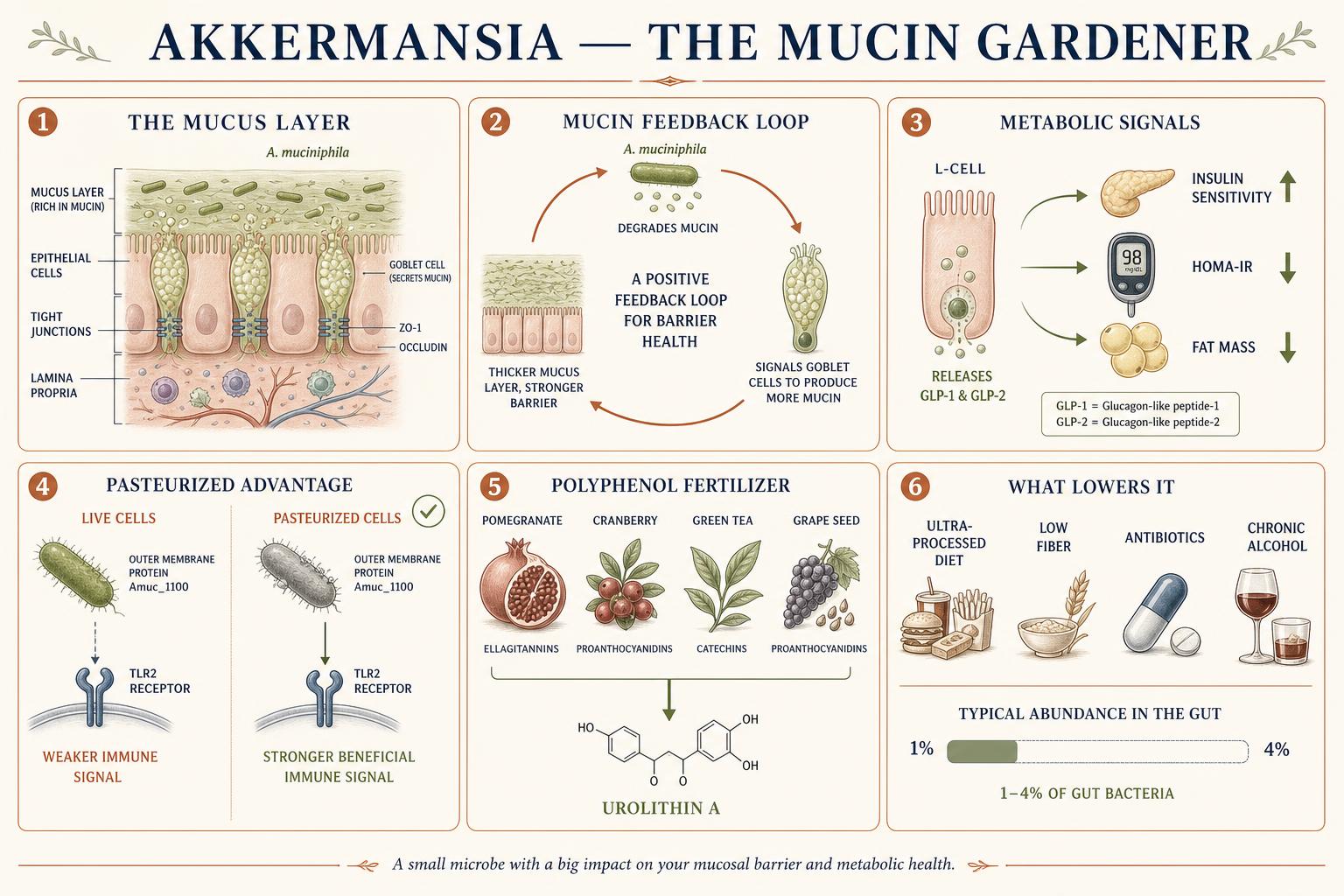
Akkermansia muciniphila lives in the intestinal mucus layer and normally makes up 1–4% of gut bacteria; abundance falls in obesity, type 2 diabetes, and IBD.
It degrades mucin yet increases net mucus thickness by stimulating goblet cell mucin turnover and raising tight-junction proteins ZO-1 and occludin.
Its metabolic effect runs largely through enteroendocrine L-cells: more GLP-1 and GLP-2, better insulin sensitivity, lower HOMA-IR.
Pasteurization stabilizes the outer membrane protein Amuc_1100, which signals through TLR2 — the pasteurized preparation outperformed live cells in the first human trial and removes any live-translocation concern.
Polyphenols are its most practical food-based fuel: pomegranate ellagitannins, cranberry and grape-seed proanthocyanidins, and green tea catechins all raise abundance in human and animal studies.
Human evidence is early: one small 3-month safety and exploratory-efficacy trial, not outcome data. Treat it as promising, not proven.
The Primer
What it is and where it lives
Most gut bacteria live in the lumen and feed on what you eat. Akkermansia lives in the mucus layer itself and feeds on mucin — the glycoprotein your goblet cells secrete to keep bacteria at arm's length from the epithelium. It is, in effect, a gardener working inside the hedge rather than a grazer in the field.
Because it eats a substrate your own body makes, it does not depend on your fiber intake in the way a fiber-fermenting species does. That is why it can persist during a low-carbohydrate diet and why polyphenols, not bulk fiber, are its most reliable dietary lever.
Why the mucus layer matters
The mucus layer plus the tight junctions between epithelial cells is the gut barrier. When it thins, bacterial fragments — most notably lipopolysaccharide (LPS) — cross into circulation and produce a low-grade inflammatory state usually called metabolic endotoxemia. That state tracks with insulin resistance, fatty liver, and the diffuse "brain fog and fatigue" pattern many people describe long before any diagnosis.
Akkermansia strengthens both halves of the barrier: it thickens the mucus by increasing mucin turnover, and it raises expression of the tight-junction proteins ZO-1 and occludin.
The three benefits worth naming
- Metabolic — better insulin sensitivity, lower fasting insulin and HOMA-IR, modest reductions in fat mass and body weight in the human pilot data.
- Barrier — thicker mucus, tighter junctions, less LPS translocation.
- Neuro-immune — lower TNF-α and IL-6 with higher IL-10 and regulatory T cells; the gut–brain relevance is mechanistically plausible and largely preclinical so far.
How to support it
Two routes, and they work well together:
- Feed what you have. Polyphenol-rich foods raise Akkermansia reliably: pomegranate, cranberry, blueberry, grape seed, green tea, cocoa, extra-virgin olive oil. Concord grape and cranberry extracts each increased abundance in controlled feeding studies (Roopchand et al., Diabetes, 2015; Anhê et al., Gut, 2015).
- Reintroduce it directly. Supplemental A. muciniphila is sold as a "next-generation probiotic," typically 10⁹–10¹⁰ pasteurized cells daily, the dose used in the human trial. Pasteurized preparations are the ones with human data.
And avoid what depletes it: ultra-processed, low-polyphenol diets, repeated broad-spectrum antibiotics, chronic alcohol, and emulsifier-heavy processed foods.
The Deep Dive
Mechanism 1 — barrier fortification and the endocannabinoid link
Akkermansia increases mucin turnover rather than net mucin loss: degradation products stimulate goblet cell secretion, and the mucus layer measured in colonized animals is thicker than in germ-free or depleted controls (Everard et al., PNAS, 2013). Alongside this, colonization raises intestinal levels of the endocannabinoid 2-arachidonoylglycerol (2-AG) and related bioactive lipids, which locally dampen inflammatory tone and support barrier function — one of the clearer examples of a bacterium acting through host lipid signalling rather than only through short-chain fatty acids.
It also produces acetate and propionate from mucin fermentation, cross-feeding butyrate producers such as Faecalibacterium prausnitzii and Anaerostipes — which is why the two species are often discussed as a pair rather than as alternatives.
Tier II · Members only · Free
Continue into the deep dive
Tier I is free and always open. Tier II — the full mechanisms, dosing detail, nuance, and citations — unlocks with a free Vital Codex membership.
- Every Tier II deep dive across all hubs
- Saved reading progress across articles
- Member knowledge modules and their quizzes
- The Dispatch, if you opt in
Frequently asked
Should I take live or pasteurized Akkermansia?
Pasteurized. The bioactive is the heat-stable outer membrane protein Amuc_1100, the human trial used the pasteurized form, and it showed benefits that the live form did not — while also removing any live-translocation concern.
What dose has actually been studied in people?
10¹⁰ pasteurized cells per day for three months in overweight or obese insulin-resistant adults. Doses of 10⁹ were also used in the dose-finding arm. Anything beyond that range is extrapolation.
Can I raise Akkermansia with food alone?
Often, yes — meaningfully. Pomegranate, cranberry, blueberry, grape seed, green tea, cocoa, and extra-virgin olive oil have all increased abundance in controlled studies. Food-first is the reasonable starting point, and it also feeds the rest of the community.
Does fiber help?
Indirectly. Akkermansia eats mucin, not fiber, so fiber does not feed it directly — but fiber-fed butyrate producers maintain the epithelial environment it depends on, and inulin-type fructans have raised Akkermansia in several human studies.
Is there anyone who should avoid it?
Anyone immunocompromised, anyone with an acute inflammatory bowel flare, and anyone with a central line or recent gut surgery should not take live preparations without clinical supervision. Pasteurized products carry no viable-organism risk, but the evidence base is still small enough that medical guidance is appropriate in complex cases.
Research Notes & Sources(expand)
- Derrien M, et al. Akkermansia muciniphila gen. nov., sp. nov. Int J Syst Evol Microbiol. 2004.
- Everard A, et al. Cross-talk between Akkermansia muciniphila and intestinal epithelium controls diet-induced obesity. PNAS. 2013.
- Plovier H, et al. A purified membrane protein from Akkermansia muciniphila or the pasteurized bacterium improves metabolism in obese and diabetic mice. Nat Med. 2017.
- Depommier C, et al. Supplementation with Akkermansia muciniphila in overweight and obese human volunteers: a proof-of-concept exploratory study. Nat Med. 2019.
- Routy B, et al. Gut microbiome influences efficacy of PD-1-based immunotherapy against epithelial tumors. Science. 2018.
- Derosa L, et al. Intestinal Akkermansia muciniphila predicts clinical response to PD-1 blockade in patients with advanced non-small-cell lung cancer. Nat Med. 2022.
- Bárcena C, et al. Healthspan and lifespan extension by fecal microbiota transplantation into progeroid mice. Nat Med. 2019.
- Roopchand DE, et al. Dietary polyphenols promote growth of the gut bacterium Akkermansia muciniphila. Diabetes. 2015.
- Anhê FF, et al. A polyphenol-rich cranberry extract protects from diet-induced obesity, insulin resistance and intestinal inflammation. Gut. 2015.
This article is educational and is not medical advice. Discuss supplementation with a qualified clinician, particularly if you are immunocompromised or managing inflammatory bowel disease.
Continue exploring: The Vital Codex library on the gut barrier, metabolic signalling, and the terrain that sustains both.
Explore Metabolism