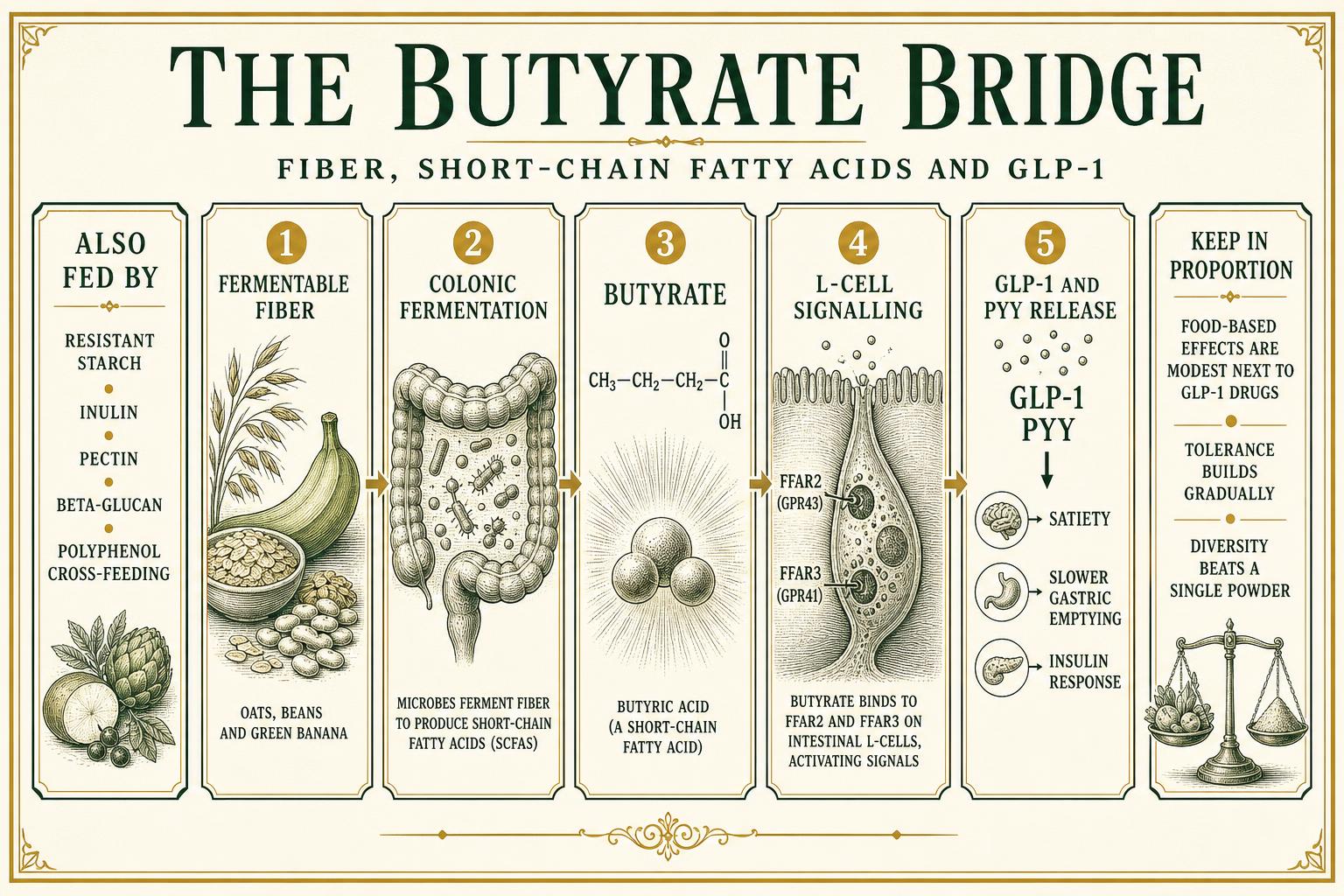
GLP-1 (glucagon-like peptide-1) became famous as a drug class, but it is first a normal human hormone. Enteroendocrine L-cells in the distal small intestine and colon release GLP-1 after meals, slowing gastric emptying, enhancing glucose-dependent insulin secretion, and signaling satiety to the hypothalamus.
One of the strongest natural stimuli for that release is butyrate — a short-chain fatty acid produced when colonic bacteria ferment dietary fiber. Where fermentable fiber is scarce, butyrate is scarce, and the endogenous GLP-1 signal is quieter than it should be.
Contents(12 sections)
Key takeaways
Butyrate is a short-chain fatty acid produced by colonic bacteria fermenting fiber; it is the primary fuel of colonocytes.
Butyrate stimulates GLP-1 and PYY secretion from intestinal L-cells, contributing to appetite regulation and glucose control.
Average fiber intake in industrialized countries is roughly 15–18 g/day; traditional and hunter-gatherer diets commonly exceed 50–100 g/day.
Low butyrate is associated with impaired gut barrier function, higher systemic inflammatory markers, and reduced incretin response.
Restoring butyrate is a nutritional strategy, not a replacement for pharmacologic GLP-1 agonists where those are clinically indicated.
The Primer
What butyrate is
Butyrate is a four-carbon fatty acid made in the colon, not the kitchen. Gut bacteria — notably Faecalibacterium prausnitzii, Roseburia, and Eubacterium rectale — ferment fibers and resistant starches and release butyrate, acetate, and propionate as byproducts.
Colon cells prefer butyrate over glucose as an energy source. That single fact explains much of its influence: when butyrate is plentiful, the intestinal lining is well fed, tight junctions hold, and the cells that make satiety hormones function normally.
Why appetite is downstream of the gut
L-cells sit in the intestinal wall and sense the chemical environment of the lumen. Butyrate binds free fatty acid receptors (FFAR2/FFAR3) on those cells and triggers GLP-1 and PYY release. GLP-1 then slows stomach emptying, sharpens the insulin response to a meal, and reduces the drive to eat again soon.
The practical implication is unglamorous: the most reliable way to strengthen your own satiety signaling is to eat enough of the fibers your microbes can ferment — legumes, oats, cooked-and-cooled potatoes and rice, green bananas, onions, garlic, leeks, and whole fruit.
If fiber currently makes you feel worse
Bloating on high-fiber food is a real signal, not a character flaw. When the microbial community is unbalanced, rapid fermentation produces gas faster than it produces benefit. The workable sequence is to stabilize first with well-tolerated foods, then reintroduce fermentable fiber in small, steady increments over several weeks rather than all at once.
The Deep Dive
Mechanism in more detail
Butyrate acts through two distinct routes. As a receptor ligand, it activates FFAR2 (GPR43) and FFAR3 (GPR41) on L-cells and immune cells, driving incretin secretion and modulating cytokine output. As a histone deacetylase (HDAC) inhibitor, it alters gene expression in colonocytes and regulatory T cells, favoring barrier proteins and an anti-inflammatory tone (Koh et al., Cell, 2016).
Butyrate also supports colonocyte beta-oxidation, which consumes oxygen and keeps the mucosal surface hypoxic. That hypoxia favors obligate anaerobes — the butyrate producers themselves — and disfavors facultative anaerobes such as Enterobacteriaceae. Butyrate sufficiency is therefore self-reinforcing, and butyrate deficiency is self-perpetuating (Byndloss et al., Science, 2017).
Tier II · Members only · Free
Continue into the deep dive
Tier I is free and always open. Tier II — the full mechanisms, dosing detail, nuance, and citations — unlocks with a free Vital Codex membership.
- Every Tier II deep dive across all hubs
- Saved reading progress across articles
- Member knowledge modules and their quizzes
- The Dispatch, if you opt in
Frequently asked
Should I just take a butyrate supplement?
Oral butyrate salts and tributyrin have some clinical support, particularly for gut barrier endpoints, but they are absorbed proximally and deliver less butyrate to the distal colon than fermentation does. Supplements are a reasonable adjunct during the stabilization phase, not a replacement for fermentable fiber.
How much fiber should I actually target?
Most evidence points to 25–40 g/day for adults, with benefit continuing across that range. The number matters less than the fermentability and diversity of the sources, and less than reaching it gradually.
Does this mean GLP-1 medications are unnecessary?
No. For people with obesity or type 2 diabetes where those drugs are indicated, their effect sizes exceed anything diet alone reliably produces. Butyrate restoration improves the underlying gut and metabolic terrain and is compatible with pharmacotherapy.
Can I raise butyrate on a low-carbohydrate diet?
Yes, but it takes deliberate effort. Non-starchy vegetables, nuts, seeds, avocado, and small servings of legumes supply fermentable substrate without large glycemic load. Very low-fiber ketogenic patterns reliably lower fecal SCFA concentrations.
Continue exploring: Nutrition — Protein sufficiency, micronutrient density, and food quality.
Explore Nutrition