Almost everything the public believes about salt descends from a single inference made in the 1970s: salt raises blood pressure, blood pressure causes cardiovascular death, therefore less salt means fewer deaths. Each link in that chain is partly true. The chain as a whole has never been demonstrated.
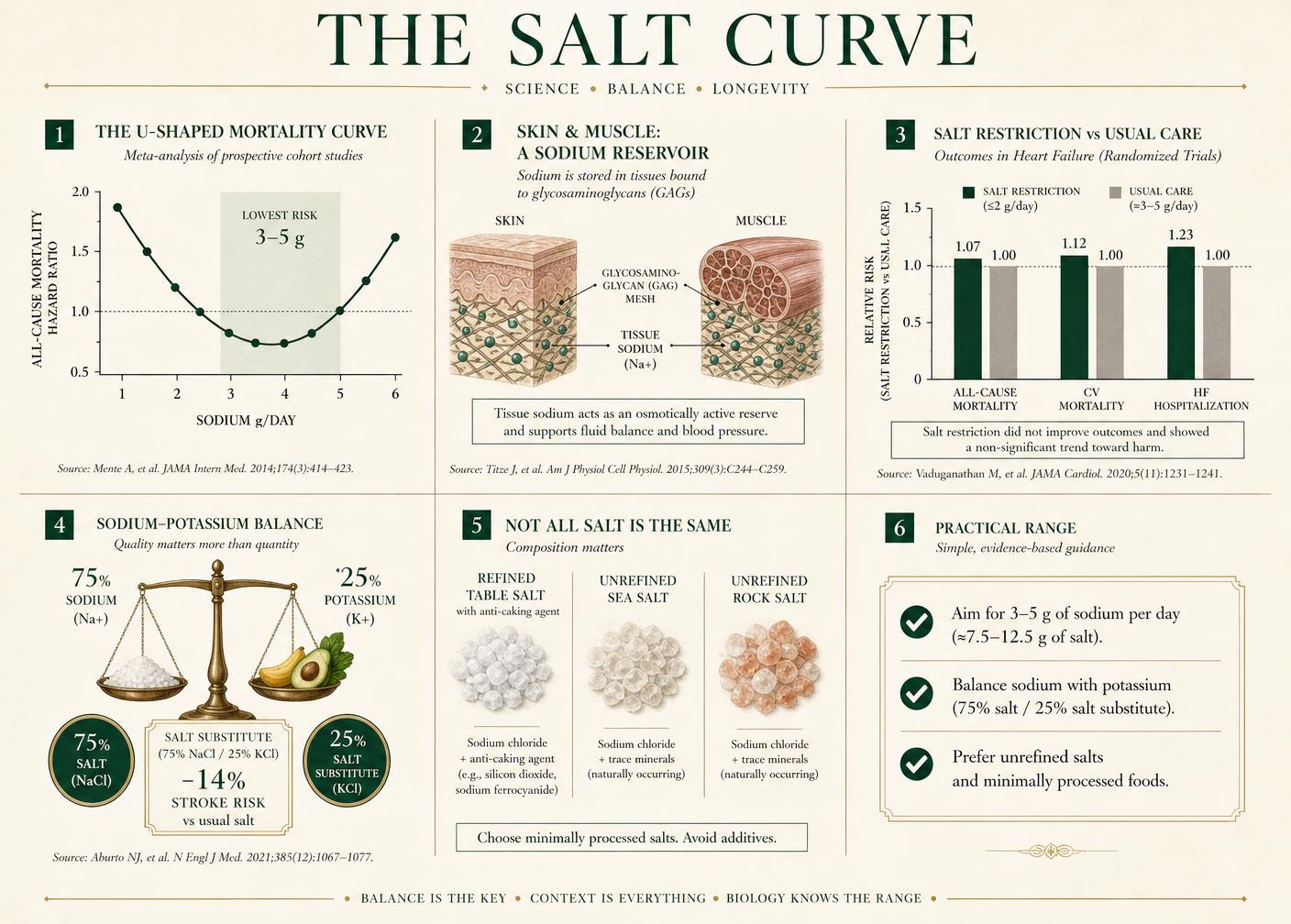
What the evidence actually describes is a U-shaped curve. Sodium intake far above habitual levels is associated with harm in some people. Sodium intake far below habitual levels is associated with harm in nearly everyone — measurably, repeatedly, and with a mortality signal at least as strong as the one attributed to excess. Meanwhile the population sits in a narrow band, 3 to 5 grams of sodium a day, that almost no culture on earth has ever voluntarily left, and that sits at or near the bottom of the risk curve.
This article covers what the trials show, what the frontier work on tissue sodium and immune signalling has added since 2013, and what a reasonable person should actually do about the salt shaker.
Salt does not have a maximum safe dose. It has an optimal range — and most of the harm attributed to salt belongs to what salt travels with.
Contents(22 sections)
Story at a glance
Sodium intake and mortality trace a U-shaped curve. The observed low-risk zone sits around 3–5 g sodium per day (roughly 7.5–12.5 g of salt), which is close to what most humans already eat by instinct.
The largest Cochrane synthesis found that cutting salt by about 4.4 g/day lowers blood pressure by roughly 5.4/2.8 mmHg in hypertensives but only about 2.4/1.0 mmHg in people with normal pressure — a small average change masking large individual variation.
Salt sensitivity is real but is a minority phenotype, concentrated in older adults, people with kidney disease, and some ancestral groups. Population-wide restriction treats everyone as though they had it.
Hyponatremia is one of the most common electrolyte abnormalities in hospitalised patients, and even mild chronic low sodium is independently associated with increased mortality, falls, fractures, and cognitive impairment.
Heart failure was the strongest case for restriction, and it has now largely reversed: the SODIUM-HF trial and subsequent meta-analyses found no benefit from restriction, with some analyses showing harm. European guidance has softened accordingly.
Sodium is not simply dissolved in blood. Tissue-sodium imaging shows meaningful sodium stored osmotically inactive in skin and muscle, bound to glycosaminoglycans — a buffering reservoir the classic two-compartment model never contained.
The frontier is immunological: sodium acts on epithelial sodium channels in immune cells, drives Th17 polarisation, and alters gut commensals — linking salt to autoimmunity and inflammation rather than to plumbing pressure alone.
Potassium may matter more than sodium. In a 21,000-person trial, replacing ordinary salt with a 75% sodium / 25% potassium substitute — without reducing intake — cut strokes by 14%, major cardiovascular events by 13%, and deaths by 12%.
Most of the harm statistically attributed to "high salt" arrives inside ultra-processed food, alongside refined oils, additives, and low potassium. The exposure is a package, not a molecule.
Needs are not fixed. Heat, heavy sweating, ketogenic or low-carb eating, diuretics, SGLT2 inhibitors, SSRIs, adrenal insufficiency, and endurance training all raise sodium requirement, sometimes substantially.
The Primer
What salt actually does in the body
Sodium is the principal cation of extracellular fluid. It sets extracellular volume, and therefore blood pressure and organ perfusion. It powers the sodium–potassium pump, which consumes a large share of the body's resting energy budget and maintains the membrane potential every nerve impulse and muscle contraction depends on. It drives nutrient absorption in the gut and reabsorption in the kidney, since glucose and amino acid transporters are sodium-coupled. It is required for stomach acid, for adrenal function, and for the fluid volume that carries oxygen to tissue.
The kidney regulates it with extraordinary precision. Given a high intake, sodium is excreted. Given a low intake, aldosterone and the renin–angiotensin system rise and the kidney reclaims nearly all of it — at a cost, because that same hormonal response raises sympathetic tone, insulin resistance, and cholesterol markers. This is the central point the low-sodium era missed: sodium restriction is not passive subtraction. It is an active hormonal stress response.
The blood pressure claim, examined
The claim that salt raises blood pressure is not false. It is smaller and narrower than the messaging implies.
The Cochrane reviews of sodium reduction, which are the most systematic accounting available, find that a substantial cut in intake produces a meaningful blood pressure change in people who already have hypertension and a very small one in people who do not. Alongside that modest benefit, restriction reliably raises renin, aldosterone, noradrenaline, adrenaline, triglycerides, and total cholesterol — measurable adverse shifts that the blood pressure number alone does not capture.
The larger problem is the missing second step. Lowering a risk marker is not the same as lowering risk. No adequately powered randomised trial has ever shown that reducing dietary sodium in the general population reduces cardiovascular death, and the observational literature increasingly points the other way at the low end.
Why the low end is dangerous
The hazards of too little sodium are concrete, well documented, and rarely discussed with patients.
Hyponatremia — blood sodium below roughly 135 mmol/L — is among the most common electrolyte abnormalities on hospital admission. Its acute presentation is dramatic: confusion, seizure, cerebral oedema. But its chronic, "mild," asymptomatic form is the more relevant one for readers, because that form is independently associated with higher mortality over five years, with unsteadiness and falls, with fractures in older adults, and with attention and gait deficits that resolve when sodium is corrected.
Aggressive dietary restriction contributes. So do the medications that frequently accompany it — thiazide diuretics, SSRIs, carbamazepine, and others — which impair free-water excretion. A person on a thiazide, an SSRI, and a low-salt diet has three independent pushes toward the wrong side of the curve at once.
Subclinical under-salting produces a milder version of the same picture: fatigue, lightheadedness on standing, exercise intolerance, poor heat tolerance, muscle cramps, salt craving, and brain fog. These are frequently attributed to age, deconditioning, or anxiety.
The U-curve
Large prospective cohorts measuring sodium excretion have repeatedly found the lowest all-cause mortality and cardiovascular event rates in the middle of the intake range, roughly 3–5 g sodium per day, with rising risk both below and above. The most cited of these is the PURE study, spanning more than eighteen countries.
That work is genuinely contested. Critics argue that spot-urine estimation formulas systematically distort intake at the extremes, and that reverse causation — sick people eating less — inflates the apparent harm of low intake. Those criticisms are worth taking seriously; they are also, notably, the same methodological objections that would apply to the observational studies used to justify restriction in the first place.
What survives the argument is this: the evidence base is not strong enough to support pushing an entire population below its instinctive intake, and the burden of proof for a universal intervention sits with the people proposing it.
The heart failure reversal
Salt restriction in heart failure was the one recommendation with a clean mechanistic rationale. A weakened heart, a congested circulation, sodium-driven fluid retention — restrict the sodium, reduce the congestion.
The trials did not cooperate. A 2018 systematic review found no evidence that restriction reduced deaths, hospitalisations, or length of stay. SODIUM-HF, the largest randomised trial to date with 806 patients across six countries, found that reducing sodium below 1,500 mg/day did not reduce deaths, cardiovascular hospitalisations, or emergency visits versus usual care. Later reviews and meta-analyses have gone further, reporting a signal toward increased mortality with strict restriction, most pronounced in the sickest patients and when restriction was stacked on top of fluid restriction and diuretics.
Acute decompensation from a very high sodium load in advanced heart failure is real and well documented. Chronic prophylactic restriction is a different intervention, and it does not have the evidence behind it. European guidance has begun to reflect this; American practice largely has not.
Not all salt is the same
Refined table salt is roughly 97–99% sodium chloride, stripped of the trace mineral fraction present in the original brine or deposit, and usually carrying an anti-caking agent — silicon dioxide, sodium ferrocyanide, or in some markets aluminosilicates — plus added iodine and sometimes dextrose as an iodine stabiliser.
Unrefined sea salt and rock salts retain magnesium, potassium, calcium, and trace elements. The honest accounting is that these fractions are small: the magnesium in a daily gram of sea salt is not a meaningful magnesium source. The defensible arguments for unrefined salt are the absence of processing additives, better flavour at lower dose, and a marginally more physiological ion profile — not mineral supplementation.
Two real caveats. First, most unrefined sea salts contain little iodine; if you switch away from iodised salt, iodine must come from somewhere else — seaweed, dairy, eggs, fish, or a supplement. Second, ocean-sourced salts carry measurable microplastic contamination in analytical surveys, with rock salts generally lower. Neither point is a reason to fear salt; both are reasons to choose sourcing deliberately.
The potassium half of the equation
The most useful practical finding in this entire literature is not about sodium at all.
Ancestral diets delivered far more potassium than sodium. Modern diets invert that ratio. In the largest trial to test the rebalancing directly — roughly 21,000 participants at high stroke risk, followed for five years — simply replacing ordinary salt with a 75% sodium chloride / 25% potassium chloride substitute produced 14% fewer strokes, 13% fewer major cardiovascular events, and 12% fewer deaths. Total salt intake was not reduced. Only the ratio changed.
Potassium substitutes are not universally safe. Anyone with chronic kidney disease, on ACE inhibitors, ARBs, or potassium-sparing diuretics needs medical supervision, because hyperkalemia is dangerous. For everyone else, the more robust route is dietary: potatoes, beans, leafy greens, avocado, squash, yoghurt, and fruit.
The other sodium: sodium bicarbonate
Salt is not the only sodium compound with a physiological job. Sodium bicarbonate (NaHCO₃) — ordinary baking soda — is the body's principal extracellular buffer, and it is the one sodium salt whose usefulness has almost nothing to do with blood pressure and almost everything to do with acid.
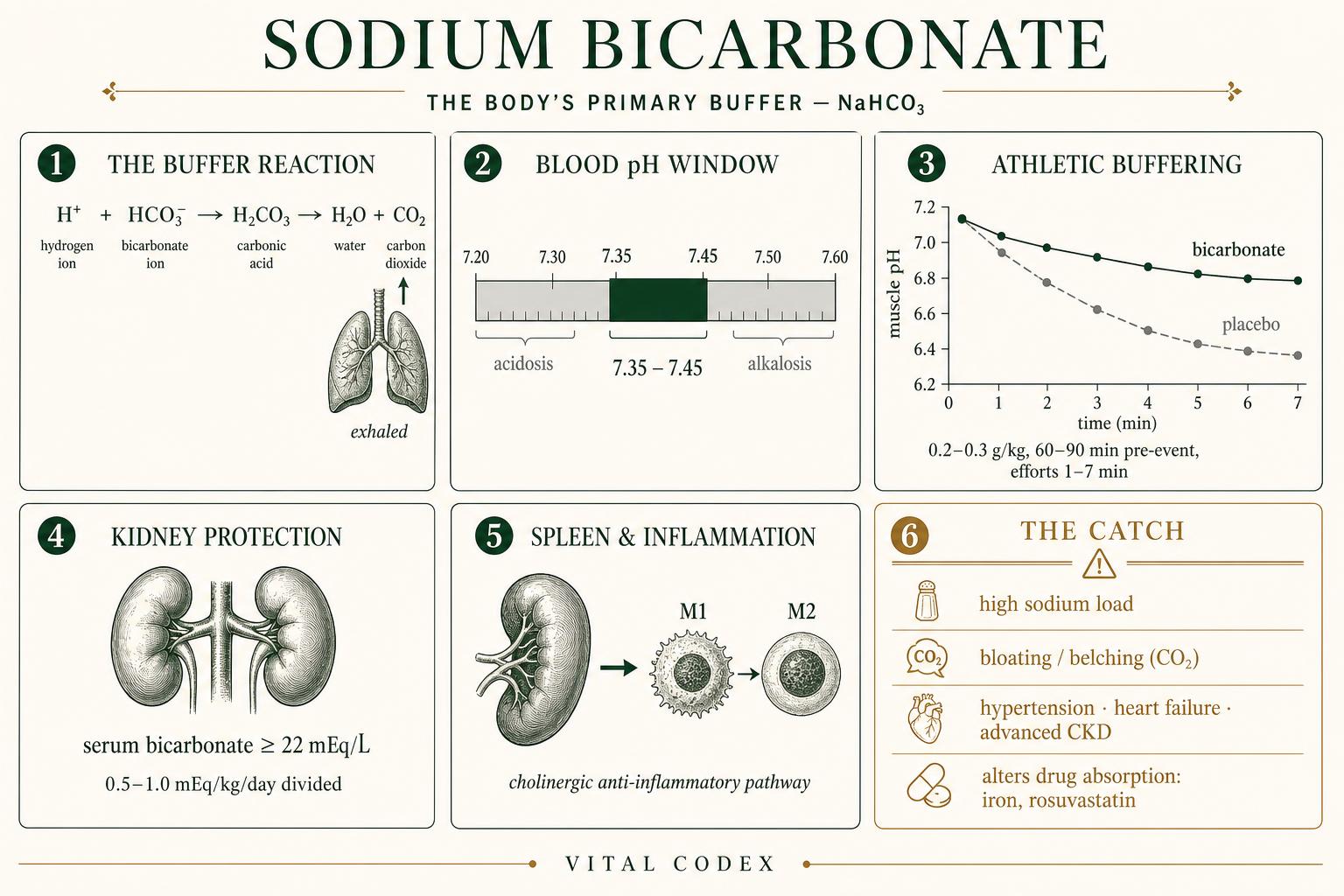
Think of bicarbonate as a biological fire extinguisher. When tissue or blood turns more acidic — from a hard sprint, a heavy protein-and-grain diet, or declining kidney function — bicarbonate absorbs the excess hydrogen ions and restores the narrow pH range life runs on. That single mechanism explains four separate uses.
Digestive relief. Bicarbonate neutralises stomach acid within seconds, which is why it has been a heartburn remedy for a century. Roughly ¼ to ½ teaspoon in half a glass of water, and no more than three or four doses in twenty-four hours.
Athletic edge. By raising buffering capacity outside the muscle cell, bicarbonate delays the pH drop that produces the burn, extending high-intensity efforts lasting about one to seven minutes. The studied dose is 0.2–0.3 g per kg of body weight, taken 60–90 minutes before the event.
Kidney protection. In chronic kidney disease, low serum bicarbonate is both a marker and a driver of decline. Correcting it slows the loss of kidney function — one of the few cheap interventions in nephrology with that claim behind it.
Immune calming. Newer work suggests oral bicarbonate signals through the spleen to shift macrophages toward an anti-inflammatory state, lowering systemic inflammation without broad immunosuppression.
The catch is that bicarbonate is a sodium salt, and a concentrated one. Everything the U-curve says about sodium having a ceiling as well as a floor applies here with less margin: in hypertension, heart failure, or advanced kidney disease, bicarbonate is a supervised intervention, not a kitchen habit.
The Deep Dive
Salt sensitivity as a phenotype, not a population trait
Roughly a quarter of normotensive adults and about half of hypertensive adults show a measurable blood pressure response to a sodium load, using strict loading and depletion protocols. The rest do not. Salt sensitivity rises with age, obesity, reduced nephron mass, chronic kidney disease, and in some populations of African ancestry.
There is no routine clinical assay for it, which is precisely why blanket restriction became policy: it is easier to tell everyone to cut salt than to identify who benefits. But the intervention is not free for the majority. Applying a treatment to a whole population on the assumption that the minority phenotype is universal is an epidemiological convenience, not a physiological finding.
Tier II · Members only · Free
Continue into the deep dive
Tier I is free and always open. Tier II — the full mechanisms, dosing detail, nuance, and citations — unlocks with a free Vital Codex membership.
- Every Tier II deep dive across all hubs
- Saved reading progress across articles
- Member knowledge modules and their quizzes
- The Dispatch, if you opt in
Frequently asked
Does salt cause high blood pressure?
In salt-sensitive people, sodium intake measurably affects blood pressure. Across the general population the average effect of substantial restriction is small — roughly 1 mmHg systolic in normotensives in the Cochrane data — and it comes with rises in renin, aldosterone, catecholamines, and lipids. Salt is one input to blood pressure, and not the largest.
How much sodium should I eat per day?
Cohort data place the lowest-risk zone at approximately 3–5 g of sodium (7.5–12.5 g of salt) per day for most adults. This is above the 2.3 g guideline ceiling and well above the 1.5 g "ideal" figure, and it is close to what most people already eat.
Is low-sodium dangerous?
The associations are consistent: hyponatremia, including mild chronic hyponatremia, predicts higher mortality, falls, fractures, and cognitive impairment, and sodium restriction raises the risk of developing it — especially alongside diuretics or SSRIs.
Should heart failure patients still restrict salt?
The randomised evidence no longer supports routine strict restriction; SODIUM-HF found no benefit below 1,500 mg/day, and later meta-analyses suggest harm. Acute decompensation from a large sodium load remains real. This is a conversation to have with the treating cardiologist, not a decision to make unilaterally.
Is Himalayan pink salt healthier than table salt?
Marginally, and not for the reasons usually claimed. The trace mineral content is nutritionally negligible. The real differences are the absence of anti-caking additives and, for most people, better flavour at a lower dose. It also contains almost no iodine, so an iodine source must be arranged separately.
What about iodine if I stop using iodised salt?
Iodised salt is a genuine public health success and iodine deficiency has real consequences, including in pregnancy. If you switch to unrefined salt, get iodine from seaweed, dairy, eggs, fish, or a supplement, and treat it as a deliberate decision rather than an oversight.
Are potassium salt substitutes safe?
For most people, yes, and the trial data are encouraging. They are not safe in chronic kidney disease or for people taking ACE inhibitors, ARBs, or potassium-sparing diuretics, where hyperkalemia is a serious risk. Whole-food potassium has no such ceiling problem.
Why do I crave salt?
Sodium appetite is a regulated drive running through aldosterone-sensitive HSD2 neurons in the brainstem. Persistent craving usually reflects genuine need — sweat losses, low-carb eating, adrenal or aldosterone dynamics, or simply an intake below requirement — and is worth investigating rather than suppressing.
Does salt cause kidney damage?
In established chronic kidney disease, sodium management is part of clinical care. In healthy kidneys, ordinary intake within the U-curve's low-risk band has not been shown to cause disease; the kidney's sodium-handling capacity is enormous, and the hormonal cost of chronic restriction is itself a stressor.
Is sea salt contaminated with microplastics?
Analytical surveys find microplastics in most commercial sea salts, with rock and mine salts generally lower. Absolute exposure from salt is small compared with other dietary routes, but if it matters to you, rock salt is the lower-exposure option.
Is baking soda the same thing as salt?
No. Table salt is sodium chloride; baking soda is sodium bicarbonate. Both deliver sodium, but chloride supports extracellular volume and gastric acid, while bicarbonate buffers acid. They are not interchangeable in either direction.
Is a daily spoon of baking soda a good idea?
Not as a habit. The evidence supporting bicarbonate is dose- and context-specific — a pre-event athletic dose, a clinician-monitored dose in kidney disease, an occasional antacid dose. Daily unsupervised use adds a large sodium load and can shift electrolytes and drug absorption in ways you will not feel until they matter.
Research Notes & Sources(expand)
Graudal NA, Hubeck-Graudal T, Jürgens G. "Effects of low-sodium diet vs. high-sodium diet on blood pressure, renin, aldosterone, catecholamines, cholesterol, and triglyceride." Cochrane Database of Systematic Reviews — the core synthesis showing small average pressure change alongside consistent adverse neurohormonal and lipid shifts.
O'Donnell M, Mente A, Rangarajan S, et al. "Urinary sodium and potassium excretion, mortality, and cardiovascular events." New England Journal of Medicine 2014;371:612–623 — the PURE analysis behind the U-shaped curve.
He FJ, MacGregor GA. "Salt and cardiovascular disease in PURE: a large sample size cannot make up for erroneous estimations." Journal of the Renin-Angiotensin-Aldosterone System 2018;19(4) — the principal methodological rebuttal, included deliberately: the estimation critique is real and readers should weigh it.
Ezekowitz JA, Colin-Ramirez E, Ross H, et al. "Reduction of dietary sodium to less than 100 mmol in heart failure (SODIUM-HF): an international, open-label, randomised, controlled trial." The Lancet 2022;399:1391–1400.
Mahtani KR, Heneghan C, Onakpoya I, et al. "Reduced salt intake for heart failure: a systematic review." JAMA Internal Medicine 2018;178(12):1693–1700.
McCallum L, Lip S, Padmanabhan S. "The hidden hand of chloride in hypertension." Pflügers Archiv 2015 — the chloride-versus-sodium distinction that most salt discussion omits entirely.
Corona G, Giuliani C, Parenti G, et al. "Moderate hyponatremia is associated with increased risk of mortality: evidence from a meta-analysis." PLoS ONE 2013;8(12):e80451.
Renneboog B, Musch W, Vandemergel X, et al. "Mild chronic hyponatremia is associated with falls, unsteadiness, and attention deficits." American Journal of Medicine 2006;119(1):71.e1–8.
Titze J, Dahlmann A, Lerchl K, et al. "Spooky sodium balance." Kidney International 2014;85(4):759–767; and Rakova N, et al. "Long-term space flight simulation reveals infradian rhythmicity in human Na⁺ balance." Cell Metabolism 2013;17(1):125–131 — the Mars500 balance work that broke the two-compartment model.
Kopp C, Linz P, Dahlmann A, et al. "²³Na magnetic resonance imaging-determined tissue sodium in healthy subjects and hypertensive patients." Hypertension 2013;61(3):635–640.
Wiig H, Schröder A, Neuhofer W, et al. "Immune cells control skin lymphatic electrolyte homeostasis and blood pressure." Journal of Clinical Investigation 2013;123(7):2803–2815 — macrophage/TonEBP/VEGF-C control of the interstitial sodium reservoir.
Kleinewietfeld M, Manzel A, Titze J, et al. "Sodium chloride drives autoimmune disease by the induction of pathogenic TH17 cells." Nature 2013;496:518–522.
Wilck N, Matus MG, Kearney SM, et al. "Salt-responsive gut commensal modulates TH17 axis and disease." Nature 2017;551:585–589 — the Lactobacillus murinus mechanism, with a small human high-salt arm.
Kirabo A, Masenga SK, Kleyman TR. "Epithelial Na⁺ channels, immune cells, and salt." Annual Review of Physiology 2025;87:381–395 — the current synthesis of immune-cell ENaC and isolevuglandin formation in salt-sensitive hypertension.
Neal B, Wu Y, Feng X, et al. "Effect of salt substitution on cardiovascular events and death (SSaSS)." New England Journal of Medicine 2021;385:1067–1077 — the 21,000-participant potassium substitution trial.
Gasparini S, Peltekian L, McDonough MC, et al. "Aldosterone-induced salt appetite requires HSD2 neurons." JCI Insight 2024 — identification of HSD2 neurons in human brain and their causal role in sodium appetite.
Elliott P, Stamler J, Nichols R, et al. INTERSALT and INTERMAP programme publications — the population-level sodium/blood pressure datasets from which the original policy inference was drawn.
Hew-Butler T, Bennett BL, Rosner MH, et al. "Wilderness Medical Society clinical practice guidelines for the management of exercise-associated hyponatremia: 2019 update"; and McCubbin AJ, et al. "Sodium intake for athletes before, during and after exercise: review and recommendations." Performance Nutrition 2025;1:11.
Yang D, Shi H, Li L, et al. "Microplastic pollution in table salts from China." Environmental Science & Technology 2015;49(22):13622–13627; and Kim JS, et al. Environmental Science & Technology 2018;52(21):12819–12828 — the sea-salt microplastic surveys.
Mattes RD, Donnelly D. "Relative contributions of dietary sodium sources." Journal of the American College of Nutrition 1991;10(4):383–393 — the origin of the ~70% processed-food, ~10–15% table-salt apportionment, replicated repeatedly since.
Weinberger MH. "Salt sensitivity of blood pressure in humans." Hypertension 1996;27(3 Pt 2):481–490 — the phenotype prevalence figures used above.
Ray SC, Baban B, Tucker MA, et al. "Oral NaHCO₃ activates a splenic anti-inflammatory pathway." Journal of Immunology 2018;200(10):3568–3586.
de Brito-Ashurst I, Varagunam M, Raftery MJ, Yaqoob MM. "Bicarbonate supplementation slows progression of CKD and improves nutritional status." Journal of the American Society of Nephrology 2009;20(9):2075–2084.
Grgic J, Pedisic Z, Saunders B, et al. "International Society of Sports Nutrition position stand: sodium bicarbonate and exercise performance." Journal of the International Society of Sports Nutrition 2021;18(1):61.
Continue exploring: The Vital Codex library on minerals, blood pressure, and the daily inputs that regulate them.
Explore Nutrition