Boron is a trace mineral the body needs in milligram amounts and almost no one tracks. It has no recognized deficiency disease, no RDA, and a research literature that reaches into mineral retention, vitamin D metabolism, steroid hormones, inflammatory signaling, connective tissue, cognition, and — most recently — the gut mucus layer.
It comes almost entirely from plant foods. That makes it one of the few nutrients a strict carnivore, very-low-plant, or heavily processed diet can drop close to zero without anyone noticing.
Boron may not target one disease. It may help regulate the systems that let the body repair, adapt, and stay resilient.
Contents(21 sections)
Key takeaways
Boron intake in most Western diets runs roughly 1–2 mg/day, almost all of it from fruit, nuts, legumes, tubers, greens, coffee, and tea.
Controlled low-boron feeding studies showed increased urinary calcium and magnesium loss, altered vitamin-D-related physiology, changes in estrogen-related signaling in postmenopausal women, and measurable declines in attention and psychomotor performance.
Boron's chemistry — reversible bonds with diols and phosphate esters — is why one small mineral can touch sugars, glycoproteins, cell surfaces, and mucus at once.
Calcium fructoborate is the preferred supplemental form: measurable elemental boron, plant-like boron–carbohydrate chemistry, and the best human research for joint and inflammatory markers.
Borax (sodium tetraborate) does deliver boron, but "pinch" dosing is imprecise and the research base is thinner.
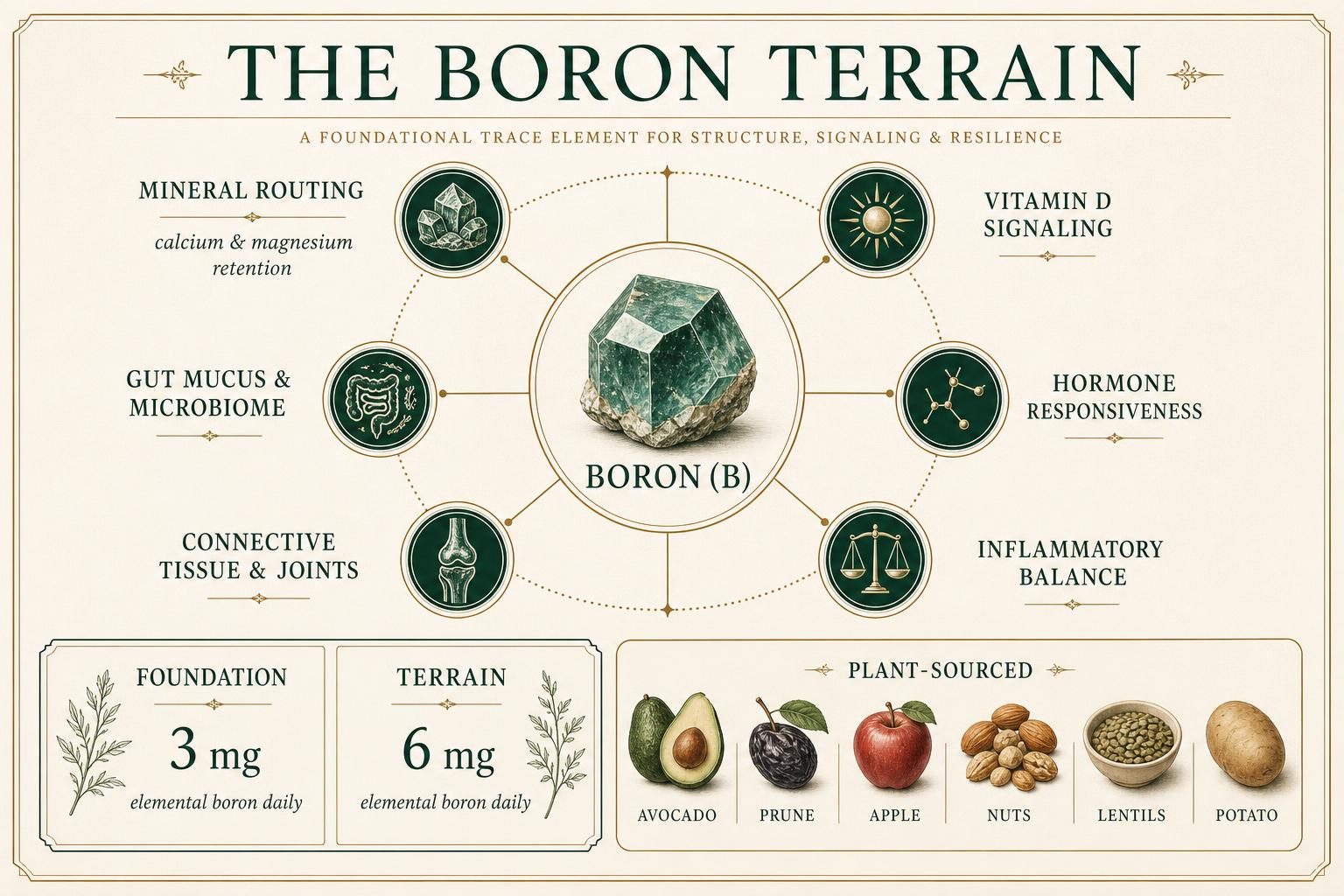
Practical range: 3 mg elemental boron daily with food as a foundation; 6 mg daily, split between meals, for joint, recovery, mineral, or hormone-transition support.
The tolerable upper intake level for adults is 20 mg/day of boron; protocol doses sit well below it.
The Primer
What boron actually is
Boron is a metalloid trace element absorbed almost completely from food and cleared efficiently by the kidneys. It is not stored in large reserves, so status tracks recent intake fairly closely.
Its role is regulatory rather than structural. Boron is not a building block the way calcium is; it appears to influence how other minerals and signals are handled.
Why plant intake matters
Good sources: avocado, prunes, raisins, apples, pears, grapes, peaches, oranges, beans, lentils, chickpeas, nuts and nut butters, potatoes and sweet potatoes, leafy greens, coffee, and tea.
Animal foods contribute very little. A well-built carnivore diet can be excellent for protein, B12, iron, zinc, and fat-soluble vitamins while providing a fraction of typical boron intake.
What low boron looks like
Not a syndrome — a pattern. Less calcium and magnesium retention, more vulnerability to magnesium depletion, less stable vitamin D signaling, more connective-tissue stress, reduced hormonal adaptability, greater inflammatory sensitivity, and lower resilience during aging, illness, restriction, or heavy training.
The practical version
If plant foods are low or absent, calcium fructoborate providing 3 mg elemental boron daily with a meal is a reasonable foundation. For joints, recovery, mineral balance, inflammation, or a hormone transition, 6 mg daily split between two meals is the more purposeful level.
Read the label for elemental boron, not compound weight: roughly 110 mg of calcium fructoborate supplies about 3 mg of boron, and 220 mg about 6 mg.
---
The Deep Dive
Boron is a coordinator, not a nutrient with one job
Boron forms reversible covalent bonds with cis-diols and phosphate esters — structures abundant in sugars, glycoproteins, nucleotides, cell-surface glycans, and mucin. That single chemical property is the reason a mineral needed in milligrams can plausibly influence signal stabilization across several systems at once.
A defensible working model: boron may help coordinate minerals, hormones, inflammatory resolution, repair, energy metabolism, and microbial signaling so that the terrain stays stable and adaptable.
Tier II · Members only · Free
Continue into the deep dive
Tier I is free and always open. Tier II — the full mechanisms, dosing detail, nuance, and citations — unlocks with a free Vital Codex membership.
- Every Tier II deep dive across all hubs
- Saved reading progress across articles
- Member knowledge modules and their quizzes
- The Dispatch, if you opt in
Frequently asked
What is boron?
Boron is a trace mineral found mainly in plant foods. It appears to help regulate mineral balance, vitamin D activity, hormone signaling, inflammation, connective tissue, antioxidant defenses, brain function, and possibly gut ecology.
Is boron likely to be low on a carnivore diet?
Yes, plausibly. Most dietary boron comes from fruits, vegetables, legumes, nuts, tubers, coffee, and tea. Strict carnivore and very-low-plant diets remove nearly all of those sources.
What are the signs of low boron intake?
There is no official boron-deficiency syndrome. A low-boron pattern may appear as weaker mineral retention, joint or connective-tissue vulnerability, slower recovery, less stable hormone signaling, cognitive fatigue, or heightened inflammatory sensitivity.
What does boron do for calcium and magnesium?
Low-boron feeding studies showed increased urinary calcium and magnesium loss, which repletion reduced. Boron appears to support retention and the wider vitamin D–mineral system rather than acting as a mineral itself.
Does boron raise testosterone or estrogen?
Boron influences steroid-hormone metabolism and appears to support hormone responsiveness. It is better understood as improving the environment for hormone signaling than as a direct hormone booster.
Can boron help joints?
Joint terrain is boron's best-supported practical use. Calcium fructoborate trials report changes in CRP, IL-6, IL-1β, and MCP-1 alongside improvements in joint comfort measures.
Does boron support detoxification?
Indirectly at most — through antioxidant and glutathione-related systems, mitochondrial energy, mineral balance, membrane stability, and inflammatory resolution. It is resilience support, not toxin removal.
Can boron help gut health?
Possibly. Emerging work on microbiota-accessible boron complexes suggests food-like boron forms may influence the mucus layer and microbial signaling. This is a frontier area, not established practice.
Is borax a good source of boron?
Borax does supply boron, but it is a crude inorganic salt and pinch dosing is unreliable. Calcium fructoborate is more precise, more food-like, and better researched.
Why calcium fructoborate rather than boron glycinate or citrate?
Glycinate and citrate provide measurable boron and are acceptable. Calcium fructoborate more closely resembles plant-associated boron complexes and has the most focused research for joint, inflammatory, and gut-terrain questions.
What dose should I take?
3 mg elemental boron daily is a practical starting level; 6 mg daily is a more focused terrain experiment. Check the label for elemental boron content, not compound weight.
How long does boron take to work?
Mineral and signaling changes precede visible structural changes. Track joints, recovery, and general terrain over several weeks while holding other habits stable.
Which foods contain the most boron?
Avocado, prunes, raisins, apples, pears, grapes, peaches, oranges, beans, lentils, nuts and nut butters, potatoes, sweet potatoes, and leafy vegetables — plus coffee and tea.
Continue exploring: Nutrition — Protein sufficiency, micronutrient density, and food quality.
Explore Nutrition