Ultraviolet radiation is a documented carcinogen and the dominant cause of squamous and basal cell skin cancers. It is also the primary source of vitamin D for most humans, a trigger for cutaneous nitric oxide release, and the strongest zeitgeber for circadian entrainment.
Both statements are true, which is why the defensible position is dose control rather than elimination. The single behavior most consistently linked to melanoma risk is intermittent intense exposure producing sunburn — not cumulative moderate exposure, which shows a different and in some analyses inverse relationship.
Contents(13 sections)
Key takeaways
Sunburn, especially in childhood and adolescence, is the exposure pattern most associated with melanoma; a history of five or more sunburns roughly doubles risk.
Outdoor workers with high cumulative UV exposure show lower melanoma incidence than indoor workers in multiple analyses — the paradox that separates burn risk from cumulative-dose risk.
In a 20-year Swedish cohort of nearly 30,000 women, avoidance of sun exposure was associated with all-cause mortality roughly comparable in magnitude to smoking (Lindqvist et al., J Intern Med, 2016).
UVA triggers release of nitric oxide from cutaneous nitrite stores, lowering blood pressure independently of vitamin D.
Vitamin D supplement trials have largely failed to reproduce the benefits seen in observational sun-exposure data, suggesting vitamin D is partly a marker of exposure rather than the sole mediator.
The Primer
What the sun does that matters
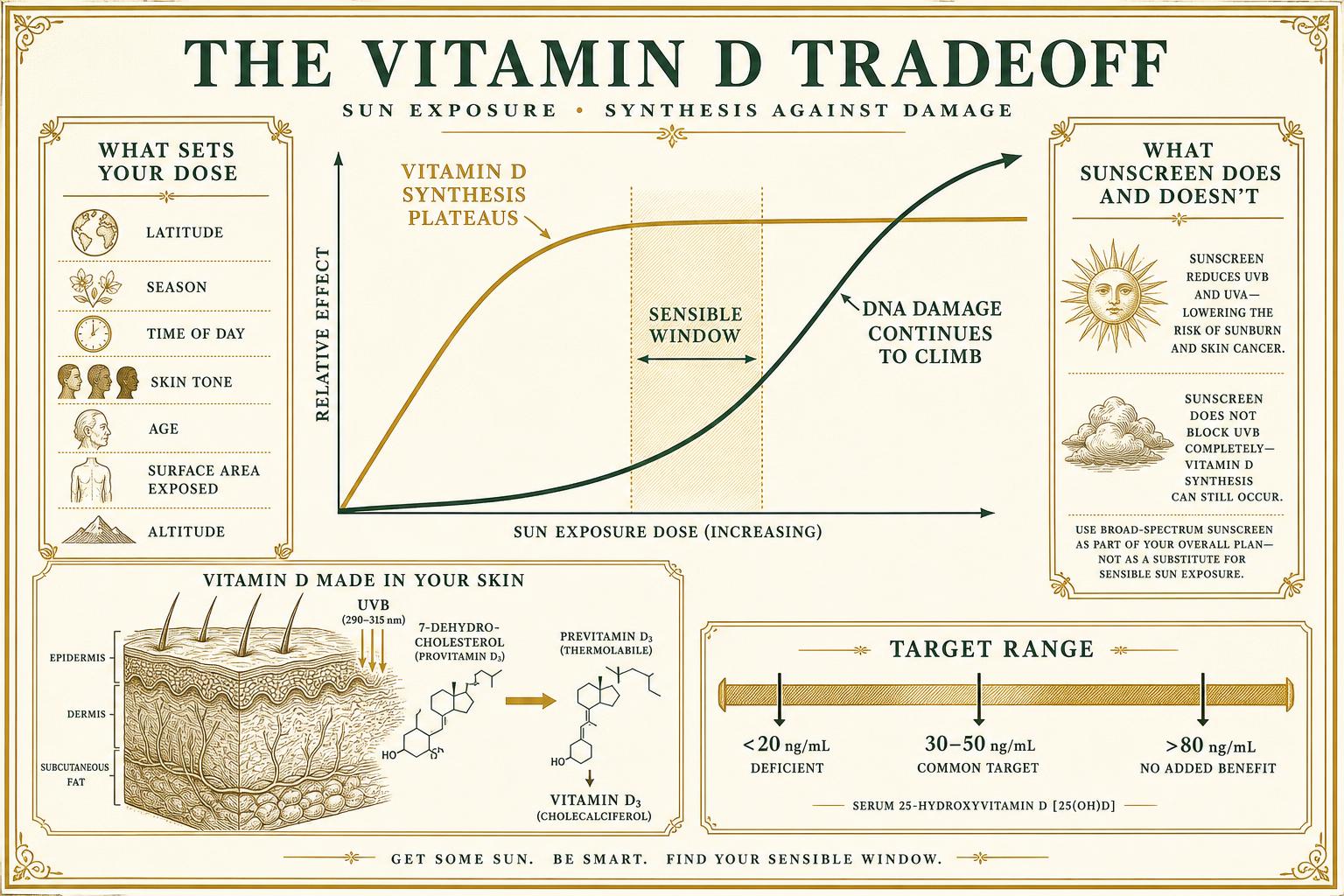
UVB (280–315 nm) converts 7-dehydrocholesterol in skin to previtamin D3, the rate-limiting step in vitamin D production. UVA (315–400 nm) penetrates deeper, generates reactive oxygen species, and mobilizes nitric oxide from stored nitrite and nitrosothiols in the dermis. Visible light entering the eye sets the circadian clock, which governs melatonin timing, cortisol rhythm, and sleep quality.
Skin also adapts. Regular graduated exposure builds melanin and thickens the stratum corneum, raising the dose required to burn. This adaptation is why the person who is outdoors daily and the person who takes one beach holiday a year face different risks at the same total exposure.
The behavior that matters most
Avoid sunburn. That is the actionable core. Practically it means building exposure gradually early in the season, using shade and clothing during peak UV index hours rather than relying on sunscreen alone to extend exposure time, and treating erythema as the ceiling rather than the target.
Where skin type sets the rules
Fitzpatrick I–II skin burns in minutes at high UV index and has the highest melanoma risk; conservative limits and reliable protection apply. Fitzpatrick V–VI skin requires several-fold more UVB for equivalent vitamin D synthesis and carries a much higher prevalence of deficiency at temperate latitudes — a group for whom blanket avoidance advice does more harm than good.
The Deep Dive
Reading the melanoma epidemiology carefully
Melanoma risk factors cluster into two groups. Host factors — fair skin, red or blond hair, high nevus count, family history, and CDKN2A or MC1R variants — carry the largest relative risks. Behavioral factors are dominated by intermittent intense exposure and sunburn history, with tanning-bed use before age 35 associated with a substantial increase in risk.
The occupational paradox is the finding that resists simplification: chronic occupational sun exposure has been associated with equal or reduced melanoma risk relative to indoor work in several meta-analyses, while intermittent recreational exposure raises it. Proposed explanations include photoadaptation, higher vitamin D status, differences in anatomic site distribution, and detection bias among higher-socioeconomic-status indoor workers who see dermatologists more often. Whichever combination is correct, the data do not support treating all UV exposure as equivalent.
Tier II · Members only · Free
Continue into the deep dive
Tier I is free and always open. Tier II — the full mechanisms, dosing detail, nuance, and citations — unlocks with a free Vital Codex membership.
- Every Tier II deep dive across all hubs
- Saved reading progress across articles
- Member knowledge modules and their quizzes
- The Dispatch, if you opt in
Frequently asked
Is sun exposure safe if I never burn?
Never burning substantially reduces melanoma risk but does not eliminate cumulative-dose risks for squamous and basal cell carcinoma or photoaging. It is the single highest-yield rule, not a guarantee.
Can I get enough vitamin D from sunlight in winter?
Above roughly 37 degrees latitude, UVB is insufficient for cutaneous synthesis for several months. Supplementation or stored summer status carries that period.
Does sunscreen block vitamin D production?
In theory substantially; in practice, typical under-application leaves meaningful UVB transmission, and studies of regular sunscreen users generally do not show deficiency attributable to sunscreen.
Should I take vitamin D supplements?
To correct documented deficiency, yes. As a substitute for sunlight exposure with an expectation of cardiovascular or cancer prevention, the randomized evidence does not support it.
Continue exploring: Hormones — Endocrine rhythm, cortisol regulation, and signaling health.
Explore Hormones