Iodine is the only nutrient whose atoms are physically built into a hormone molecule. Thyroxine is four iodine atoms on a tyrosine scaffold. That makes iodine non-negotiable — and it also makes the thyroid the one gland with a built-in shutdown response to too much of its own raw material.
Contents(12 sections)
Key takeaways
Adult requirement is roughly 150 µg daily; 220–290 µg in pregnancy and lactation.
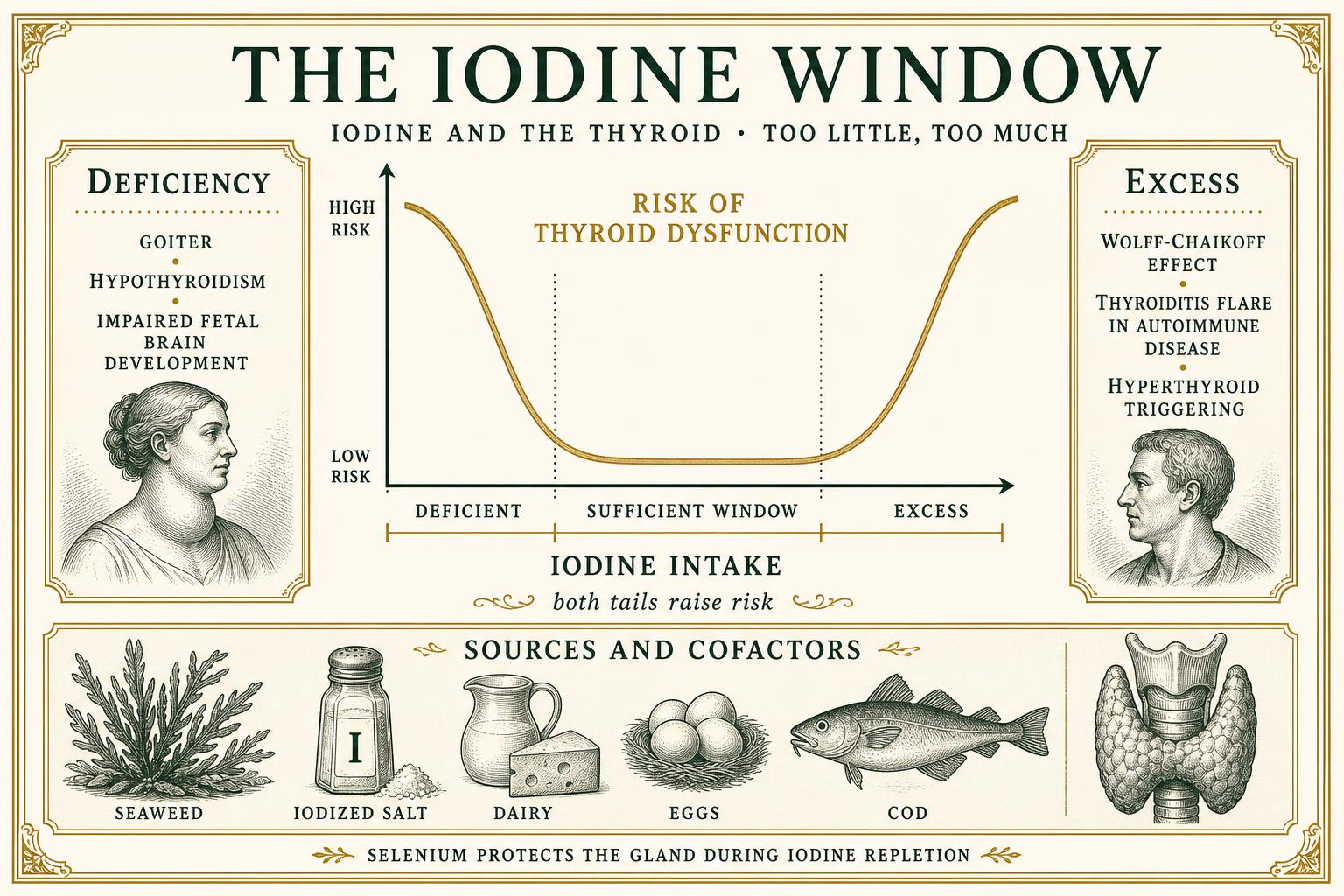
Excess iodine triggers the Wolff-Chaikoff effect, temporarily suppressing hormone synthesis.
High-dose iodine can unmask or accelerate autoimmune thyroiditis, especially when selenium is low.
Selenium-dependent enzymes handle the peroxide generated during iodine organification; iodine without selenium raises oxidative risk.
The Primer
Why the thyroid needs iodine specifically
The thyroid pulls iodide out of the bloodstream against a steep gradient, attaches it to tyrosine residues on thyroglobulin, and couples those units to make T4 and T3. No iodine, no hormone. Severe deficiency produces goiter, hypothyroidism, and — in pregnancy — irreversible impairment of fetal brain development. It remains the leading preventable cause of intellectual disability worldwide.
The narrow window
Unlike most nutrients, iodine has a U-shaped risk curve that is unusually tight. Deficiency causes goiter and hypothyroidism. Excess also causes goiter and hypothyroidism, by a different mechanism, and can trigger hyperthyroidism in nodular glands. Population data show thyroid dysfunction rising at both ends of intake.
This is why gram-level iodine protocols marketed for energy or metabolism deserve real caution: the dose is thousands of times the requirement.
Sources and status
Iodized salt, dairy, free-range eggs, and seafood carry most dietary iodine in developed countries. Seaweed is the most concentrated and the most variable — kelp in particular can deliver milligrams per serving, far above requirement, with batch-to-batch swings of an order of magnitude.
Spot urinary iodine reflects recent intake, not stores, and is only interpretable across a population or from repeated samples. A single test does not diagnose an individual's iodine status.
The Deep Dive
Organification and the peroxide problem
Iodide enters the follicular cell through the sodium-iodide symporter (NIS), moves to the apical membrane via pendrin, and is oxidized by thyroid peroxidase using hydrogen peroxide generated by DUOX2. Oxidized iodine is attached to thyroglobulin tyrosines, forming monoiodotyrosine and diiodotyrosine, which couple to yield T4 and a smaller amount of T3.
Every molecule of hormone therefore costs the gland a burst of hydrogen peroxide. Glutathione peroxidase and thioredoxin reductase — both selenoproteins — neutralize it. In selenium deficiency that peroxide damages thyrocytes, which is the mechanistic bridge between iodine repletion and autoimmune flare.
Tier II · Members only · Free
Continue into the deep dive
Tier I is free and always open. Tier II — the full mechanisms, dosing detail, nuance, and citations — unlocks with a free Vital Codex membership.
- Every Tier II deep dive across all hubs
- Saved reading progress across articles
- Member knowledge modules and their quizzes
- The Dispatch, if you opt in
Frequently asked
Do I need an iodine supplement?
Most people eating iodized salt, dairy, free-range eggs, or seafood do not. Those avoiding all four, and anyone pregnant or lactating, are the groups where deficiency is realistic.
Is kelp a good iodine source?
It is a concentrated but unpredictable one. Iodine content varies enormously between species and batches, so it is easy to exceed the tolerable intake unintentionally.
Why does iodine sometimes make hypothyroidism worse?
Through the Wolff-Chaikoff effect in a gland that cannot escape it, and through increased oxidative and immune stress on thyrocytes in existing autoimmune disease.
Should selenium come before iodine?
Mechanistically yes. Selenoenzymes clear the peroxide generated during iodine use and drive T4-to-T3 conversion, so selenium sufficiency makes iodine safer to raise.
Continue exploring: Hormones — Endocrine rhythm, cortisol regulation, and signaling health.
Explore Hormones